Tuesday, December 14, 2021

Trending Patient-centric Healthcare Apps!


Innovative digital trends are giving rise to amazing healthcare applications that not only deliver a unique patient experience but also focus on patient satisfaction and meaningful patient engagement. These healthcare apps come with a promise of speedy access, less paperwork, enhanced convenience, secured payments, and improves productivity, healthcare records management, appointment management, etc., Such apps are beneficial to patients as well as service providers.

Let’s explore the offerings of some of the most trending patient-centric healthcare apps that every healthcare app creator must know!

Trending Patient-centric Healthcare Apps


Check out some of the most popular healthcare apps across various niches!

Doctor-on demand Services

Teladoc

This on-demand telehealth app provides instant virtual care in case of injuries and medical conditions that are not life-threatening. Using this app, individuals can avoid a doctor visit for minor ailments that can be easily resolved via video/telephonic communication. Once, users register themselves with the app and then furnish insurance particulars, they are informed about the services available to them as well as the charges involved. A basic charge of 75$ is levied for daily appointments in the case of users without an insurance policy.

Amwell

With Amwell, users get a convenient as well as an affordable option for resolving routine healthcare conditions that do not require an in-person visit. Amwell makes use of advanced technology to arrange for an online doctor visit through their mobile app or website and provides 24X7 services.

Once users log in, the app displays a list containing board-certified practitioners available within Amwell’s network. Then the users can discuss their health problem with the desired doctor using an on-the-spot video chat facility. These physicians answer queries, recommend treatment plans, and prescribe medication if required.

Apart from on-demand medical services users can also avail themselves of other healthcare services like nutrition advice, pediatric care, psychiatry, therapies, and many more. Though this app can be downloaded for free, charges apply for most of the services provided. But, if a patient’s health insurance covers Amwell services, the fees are either reduced or waived off completely.

Treatment /Monitoring

Eye Treatment: EyeCare Live

With this smartphone app, users can connect with eye specialists for consultation and advice; through advanced communication channels. This app is recommended for minor conditions like eye allergies, dryness or redness in eyes, any queries concerning contact lenses, etc. The users are asked to record their eye condition by clicking pictures or recording videos of their affected eye/s. Then, this picture/video is examined by a practitioner. High definition videos are used for this purpose so that the doctor gets a better understanding of the condition and is able to resolve the issue at the earliest.

The app connects users with a virtual eye doctor within an hour and allows users to renew prescriptions that are less than 2 years old. This app can be downloaded free of cost, but charges have to be paid for virtual doctor consultations and eye tests.

Customized Acne Treatment: MDacne

Earlier patients had to undergo long waiting times for obtaining a dermatologist’s appointment. But, with MDacne, users enjoy the facility of immediate access to dermatologists. The app comes with an outstanding UI and is easy to use.

The app provides a treatment plan as per the users’ skin type within five minutes of inquiry and works wonders in the realm of acne treatment. MDacne monitors skin conditions employing cutting-edge technologies provide productive recommendations, initiates a chat with dermatologists, and sends treatment reminders to patients. Besides, the app provides natural remedies for acne issues like skin redness or scarring, to patients who do not prefer chemical treatments.

The patients need to upload pictures of their affected area and answer certain questions regarding their skin. The app examines the skin within a few minutes and suggests treatment plans that can be tailored as per the patients’ specific needs and delivered to their doorstep.

Dermatology: First Derm

First Derm is a dermatology app designed to address external skin conditions. Users need to click two pictures of the affected area – one close view and another taken from a distance. These photos, along with a description of the issue provided by the users are sent to a licensed dermatologist who responds within twenty-four hours of receiving the snapshots and provides users a solution for their problem. The consultation charges for each case registered for doctor examination are 40$.

First Derm also offers an AI-powered service that helps users to identify a skin problem without consulting a dermatologist. The users need to upload a picture of their skin problem and then AI technology matches the image to all possible skin conditions

DNA/Nutrition

Generis

This is an avant-garde healthcare app that provides DNA-based advice, and recommendations concerning food, supplements, nutrition, fitness, etc. The app is capable of retrieving DNA-based data from 23 and ME and Ancestry.com. Its interface is pleasing as well as user-friendly. With this app, individuals are able to understand their genes and obtain actionable steps to follow that are secure and accurate as well. This way, users are educated to become the best version of themselves.

As the efficiency of burning energy differs from one individual to another, Generis employs a formula for rolling out the best-suited personalized suggestions for its users. This formula is prepared by genetics experts after considering over fifty markers that have positively impacted wellness. Furthermore, each claim made by Generis is backed by scientific evidence contained in peer-reviewed journals.

Medication/Prescriptions

Medication Reminder: Medisafe

With this app, users receive notifications on their smartphones regarding the intake of medicines. Medication reminders are so accurate that they notify patients of the exact time at which a particular medicine needs to be taken. Patients can manually add prescriptions and non-prescribed supplements like vitamins, or import prescriptions from renowned pharmacy chains like Rite Aid, CVS, Walgreens, etc.

Medisafe can also be utilized for tracking medication refills/measurements, receiving coupons on future prescriptions, and accessing resources as per their health condition.

Lowest Medication Prices: GoodRx

This app helps individuals to save expenses incurred on prescriptions. The GoodRx allows users to find the pharmacy that offers the lowest price for a particular medicine. The users need to search on the GoodRx app or website and are provided the option to select from over 75,000 pharmacies located in their area of residence. The price-tracker functionality allows consumers to observe prescription prices within their area and compare them with other pharmacies. The “coupon finder” feature automatically searches if there are any free coupons available for a specific prescription. Once, identified, users can activate the coupon using a button called “Get Coupon” and then avail of the benefits while collecting their prescription.

Therapy

Talkspace

This app offers to counsel regarding mental health problems such as depression, anxiety, addiction, eating disorders, LGBTQ, PTSD, etc. to individuals who do not have the resources or time to access in-person counseling. This digital therapy platform has roped on 2,000+ licensed psychiatrists and therapists offering private therapy services. The app matches and then connects users with their desired therapist via communication services like video/audio, unlimited text messaging, etc. Premium users can avail themselves of live online sessions as well. Users are recommended medication or treatment plans if needed.

Patient Portal App

MyChart

This patient portal app, allows individuals to avail of doctor communications, online appointment scheduling, and access their electronic health records. With this app, patients can have a look at their diagnostic test results, immunization history, prescribed medicines, and other healthcare records. These records are displayed on the screens of their computer/tablet/smartphone.

Patients can effortlessly schedule appointments as well as make payments for services using its features concerning bill payment and appointment scheduling. Moreover, users can utilize this app for connecting to their practitioners and sharing healthcare records from other doctors. Furthermore, with the usage of an activity tracking app, one can transfer their fitness/health data into his/her MyChart profile.

Diabetes Tracking and Management

Diabetes:M

This app assists diabetic patients in tracking/monitoring food intake and managing their glucose levels, insulin levels, injection sites, etc. Users can store their health data and receive detailed reports that can be then shared with doctors. The pro version allows users to create an additional profile and also connects users to their Bluetooth-empowered monitoring device.

MySugr

This app enables users to instantly track their blood glucose levels, bolus, carbs as well as estimated HbA1. Individuals need to log their healthcare data on a regular basis and this practice has helped them to manage diabetes in a better way. Moreover, physicians can review this data for treating their patients more effectively. Besides, MySugr provides motivating challenges to users coupled up with feedback on how to manage Type1/Type2 diabetes.

Concluding Lines:

Aren’t these game-changing apps amazing? If you too would like to architect such incredible patient-friendly healthcare apps, get in touch with Biz4Solutions, a prominent healthcare mobile app development company, having a rich experience of 10+ years in tailoring top-notch solutions for global clients. Check out our ready-to-use pharmacy delivery app as well.

To know more about our core technologies, refer to links below:

RoR App development Company

PHP App Development Company

Flutter App Development Company

Thursday, December 9, 2021

Why should Startups Opt for Ionic App Development?

Every start-up entrepreneur desires to reach out to a wide range of audiences and aspires to grow exponentially. And, having a digital destination for a business is essential for fulfilling these aspirations. Nevertheless, the software development approach, frameworks, and technologies for building a digital platform should also be chosen wisely.

A majority of start-ups adopt a cross-platform software development approach to craft mobile/web apps for multiple platforms using a single codebase. This approach saves development time, effort as well as expenses.

And, amongst several cross-platform app developments frameworks, the Ionic framework has been one of the most preferred ones for start-up app development. Ionic, empowered by open web technology, has helped several start-ups to transform their vision into reality by offering unparalleled cross-platform app experiences. Untappd, Cryptochange, ChefSteps, Sworkit, Pacifia, Marketwatch, etc. are examples of the world’s fastest-growing start-ups who owe their success to Ionic app development.

This blog introduces you to the Ionic framework and outlines the reasons why it proves beneficial for cross-platform app development.

Ionic Framework: An Overview

Ionic is a framework meant for developing cross-platform apps employing web technology such as JavaScript, HTML, and CSS. The framework comes with a lightweight component library and a host of tools like auxiliary CLI, native access plugins, data handling, and binding, routing and navigation, template population, etc.

The type of apps that can be built using Ionic app development includes PWAs (Progressive Web Applications), Web Apps, Hybrid Mobile Apps, and Desktop Applications (employing Electron).

Reasons to opt for Ionic App Development

Open-sourced Nature

Since start-ups are likely to face budgetary constraints, open-sourced frameworks work best for them. And, Ionic, being an open-sourced framework, licensed under MIT, offers several cost-efficient options for app creation. Moreover, while other open-sourced frameworks may encounter unexpected architectural breakdowns during app development, Ionic handles these issues effectively and hence, is considered to be steady as well as dependable.

A Rich UI/UX

A rich UI/UX design is the key prerequisite of a top-grade mobile app and Ionic fares well in this aspect as well. This front-end framework comes with captivating designs and contains components like JavaScript, HTML, and CSS. As such, Ionic mobile app developers can reap the benefits of smooth animations containing beautiful designs and themes to build interactive and user-friendly apps.

Intuitive UI

Ionic’s ecosystem comes with a humongous repository of customizable themes that enable the creation of a highly usable app with a dynamic UI. The app components automatically adapt to the app development platform used.

The Support of AngularJS

AngularJS, one of the most versatile app development frameworks, forms the base of the Ionic framework. The presence of AngularJS imparts a robust structure to the developers for making the code more manageable, provides a host of features to app designers, and leads to the creation of an interactive app solution.

The Presence of Cordova

The Ionic framework uses Cordova, a mobile app development framework created by Adobe Systems. Apache Cordova enables Ionic to access and utilize a mobile device’s hardware like camera, contacts, geolocation, etc. For this purpose, Cordova plugins need to be used. This functionality helps Ionic mobile app developers to craft highly competitive apps.

Advanced Integration Abilities

Ionic allows integration with a vast range of add-ons, plugins, and modules for Cordova and AngularJS. The plugin repository of Angular consists of 2000+ modules and because of this advantage, Ionic apps can easily integrate with popular web services that implement complicated UI elements.

Moreover, the app integration abilities of the Ionic framework allow the sharing of information and processes amongst various enterprise applications. Because of this feature, enterprises can easily coordinate their business processes and link them with cloud applications.

Code Reusability

Ionic codes are highly reusable. The codes written by Ionic app developers for one platform can be effortlessly used across other platforms too, eliminating the need for creating different platform-specific codes.

Widget Creation

Ionic app development supports the creation of widgets. With the help of widgets, the frequently used applications can be embedded into the home screens of smartphones, such that the users can trigger the app from the home screen itself.

High Adaptability

Switching to the Ionic ecosystem is effortless as most developers are well versed with programming languages like CSS, HTML, and JavaScript. So, it is advisable to use Ionic while switching from native to the hybrid app as it eases out the whole process.

Command-Line-Interface

Ionic offers Command-Line-Interface, commonly known as CLI which is an in-built development server. This interface is text-based wherein users activate the command “prompt” for interacting with the Ionic app via different commands.

Enhanced Performance

Ionic’s CSS transitioning technology provides a considerable amount of leverage for the GPU. As such, the processing time can be effectively maximized resulting in the speedier functioning of the app.

Convenient App Testing

The Ionic framework simplifies the process of app testing by offering multiple convenient testing options. An Ionic web app can be tested on the desktop browser and in the case of Android and iOS apps, simulator testing is conducted by employing Cordova commands. iOS apps can also be tested using a Safari web browser or a mobile browser. An Ionic app development team can directly test the app as a hybrid/native app on a real platform for gaining more precise insights on its functioning. Besides, these testing methodologies facilitate remote debugging as well.

Final Verdict:

Thus, employing Ionic for developing cross-platform apps is a profitable option for start-ups. Ionic not only saves the time and resources of app owners but also comes with innumerable outstanding offerings.

If you are looking for hiring an Ionic app developer or an Ionic App Development team, contact Biz4Solutions. We are a distinguished Ionic App Development Company in India and U.S.A. with an excellent track record in mobile/web app development and a rich experience of partnering with global clients.

To know more about our other core technologies, refer to links below:

React App development Company

Angular App Development Company

.Net App Development Company

Tuesday, December 7, 2021

Blockchain’s Contribution in Implementing Employee Safety Protocol in Workspaces!

Today, a huge chunk of employees across the globe have returned into a physical office environment and several others are scheduled to resume working-from-office after remotely working for a long time. But, the fear of getting infected with the Covid19 virus persists.

So, how could organizations maintain safety protocols at their workspaces? Well, the two most effective mechanisms that are being incorporated by enterprises to ensure employee safety are: contact tracing and maintaining digital health wallets for employees. However, there are security risks involved in both these processes and so employees may be reluctant to adopt these processes.

This post explores how Blockchain application development improves the effectiveness and enhances the safety quotient of the aforementioned processes.

Before we delve deeper, check out the unique attributes and functioning of Blockchain technology!

Blockchain Technology: Key Attributes

Distribution

The participants, who are a part of the blockchain, are connected through a distributed network. “Nodes” (computers) are present for operating this network. The nodes run programs for imposing the rules laid down by the business enterprise that owns the blockchain. The nodes also maintain a copy of the ledger and updates data independently, whenever a new transaction takes place.

Decentralization

Blockchain is a decentralized ledger, based on peer-to-peer technology, in which the information is distributed across the network instead of being stored by one single entity. As such, no entity can control a majority of the nodes or dictate terms. Thus, unlike the traditional approach, this approach eliminates the need for a centralized authority for controlling the network. Instead, multiple participants are authorized for managing the network – a “consensus mechanism” is employed for approving and checking transactions. Decentralization, increases reliability as the users no longer have to trust a third-party authority and also minimizes the risk of systematic failures considerably. Hence, Blockchain solutions are more transparent, secure, performant, and irreversible.

Encryption

This feature uses pseudonyms to record the participants’ details and thus ensures the security of all recorded data. The participants are entitled to control their personal details and share them only with authorized entities whenever needed.

Tokenization

With this functionality, items of value or physical or non-physical elements are converted into “tokens”. Blockchain identifies these “tokens” as “currency” within the system and these can be traded as well. Data and even a participant’s identity can be represented as the value that can be converted to tokens and then traded.

Transparency

This aspect of Blockchain imparts a layer of accountability that is a crucial prerequisite for several enterprises. All transactions can be searched for as well as traced in open Blockchain. And, to protect data privacy, granular access is provided to certain authorized users and at the same time, the data is protected from unauthorized access.

Immutability

This ground-breaking property of Blockchain rules out any third-party interference to the continuously growing chained data. Blocks are used for storing data introduced into Blockchain and these blocks are connected as well as secured by cryptography. Each block is given a unique identification number employing a cryptographic algorithm and is called the cryptographic hash function. During a transaction, blocks are time-stamped, sequentially added to the ledger, and cryptographically signed. Each block contains its own hash, transaction-related data, a timestamp, and the cryptographic hash of the previous data. As such, data once entered into the Blockchain network, cannot be tampered with.

Functioning of the Blockchain Network

When somebody joins the Blockchain network, an entire copy of the Blockchain is received and the nodes verify whether every aspect is in order. This new block is then sent to all participants of the network and the block is verified by each node for ensuring that no tampering has taken place. Once successfully verified, the block is added by each node into their Blockchain and the transaction is completed.

For ensuring the authenticity of this new block, the nodes use a particular consensus mechanism. All the nodes present within the network create a consensus by agreeing on which of the blocks are valid and which of them are invalid. Any block within the network that has been tampered with will be rejected by the other nodes of the network.

So for tampering with a Blockchain system successfully, one must manipulate every block contained within the chain and then gain control over more than half of the P2P network, which is not possible by any means.

Blockchain’s Role in maintaining Safety Protocols at the Workplace

Today, contact tracing and maintaining digital health wallets for employees has become an essential prerequisite to ensure safety protocols at workplaces. And, employing Blockchain app development for architecting such solutions is necessary. Let’s explore!

Contact Tracing

What is Contact Tracing?

Contact tracing is a mechanism that is implemented for limiting the spread of communicable diseases or disease-causing viruses. This process involves the following steps:

Step 1: Identifying the infected and their contacts

Individuals infected with a communicable disease are identified and asked about their routine activities and locations visited in the recent past. This is done to identify other individuals like family members, colleagues, friends, medical practitioners/staff, etc. who were within close vicinity of the patient.

Step 2: Tracking down the contacts

Once identified, a list of all persons who have come in close contact with the patient during the past couple of days is prepared. These contacts are then tracked down and notified about the situation. They are also provided guidance on the timely measures to be adopted and the practices to follow if they develop any symptoms of the communicable disease and are advised to stay in isolation if needed.

Step 3: Follow-ups with contacts

The health symptoms of these contacts are closely monitored by conducting regular/periodic follow-ups and tests to limit the spread of the disease.

The Traditional way of Contact Tracing: Limitations

Contact tracing was implemented in the past to control the spread of various communicable diseases. Also, for tackling Covid19 the traditional approach was implemented in some countries. But, the traditional approach comes with certain limitations. The lists of identified contacts who are likely to contract the infectious disease are maintained in paper files and the contacts are notified as well as advised via phone calls or emails. So, the entire process becomes not only time-consuming but also error-prone. To sum up, the paper-based system is unorganized, incomplete, less effective owing to data redundancy, alterable, insecure, and less accurate.

Digital Contact Tracing and its Challenges

In modern times, digital contact tracing, with the use of contact tracing apps via smartphones is trending. This method guarantees prompt as well as convenient contact tracking and is being implemented for tracing down Covid19 patients and their contacts in several regions. But, this approach too, comes with its share of downsides, the key challenges being issues concerning transparency and risks to the security and privacy of personal/medical data, if the apps are not bound by strict privacy rules like GDPR.

For example, the Covid19 patients need to upload their personal data to the centralized server so that the concerned authorities can download it and use it in contract-tracing maps. But, during this process, the users’ data becomes vulnerable to risks like trajectory attacks and reconstruction of information.  For this reason, many users are reluctant to share personal health information and if the participation rates are low, the apps become virtually useless.

So, the employers whose employees need to share personal data using a contact tracing application must comply with the laws mandated by the State, Federation, and Region, depending on the kind of data that is being collected. Some regions in the U.S like California have enforced privacy laws for protecting the geolocation data of individuals by providing the option of opting out or deleting obligations. But such laws do not exist in other areas of the country.

How does Blockchain-enabled contact tracing solutions resolve all challenges?

Despite its challenges, there is no other better option than using digital contact tracing app solutions for contact tracing, and integrating Blockchain technology for building such applications is the one-stop solution. Blockchain-powered contact tracing apps can successfully resolve all challenges and also enhance the efficiency, accuracy, and speed of this system. In such solutions, a symmetric key cryptographic mechanism is employed to avoid misuse of data and guarantee the privacy of users’ data. And, digital contact tracing is decentralized, thereby keeping users’ data private and secured and ruling out any chances of trajectory attacks.

Blockchain-empowered Digital Health Wallets

Why are Digital Health Wallets needed?

While the contact tracing process is needed for isolating the Covid19-affected individuals, there also needs to be an effective means of verifying that all employees entering the workplace have tested negative. For fulfilling this requirement, employees need to share their test results and immunization records digitally with third parties like the employer, TSA agents, transportation personnel, etc.

Here again, data security is essential and hence, a digital health wallet based on Blockchain is needed so that the users’ sensitive/personal data is protected from the risks of getting exposed.

How does a Blockchain-infused digital wallet function?

Persons who wish to get tested for Covi19 need to share their Blockchain-powered digital ID with their healthcare service provider. Once the test is conducted, the medical provider will upload the test results and link them to the patients’ digital credentials with cryptographic evidence, so that its authenticity could be easily verified by any third party. Thereafter, the test result is directly issued into the health wallet of patients.

On reaching the workplace, an employee is required to scan his/her QR code with a smartphone/computer application for verification. This app would then extract the information contained within the credential and check the evidence prior to displaying the test result.

Advantages of Decentralization

Blockchain entirely decouples the users’ Covid19 status from their personal information, ruling out any possibility of data reconstruction. Moreover, the data can be moved off the chain into a private database so that the owner can directly control his/her data and delete obsolete data. Thus, the decentralized platform created by Blockchain ensures the privacy of users’ data. However, for making this model work effectively, the Covid19 test results and immunization records provided by medical bodies need to be wallet-ready.

Concluding Lines:

With Blockchain-empowered systems in place, coupled up with other common safety measures like social distancing amongst colleagues, daily screening of employees, etc. employers would be able to create a safer workplace.

If you are looking for experienced and adept Blockchain app developers / Blockchain app Development Company for crafting impeccable Blockchain-powered solutions, reach out to Biz4Solutions. We are a prominent Offshore app development company in India having a proven track record of delivering outstanding Blockchain solutions.

To know more about our other core technologies, refer to links below:

Swift App development Company

Angular App Development Company

Java App Development Company

The most Notable Free Angular Templates that every Angular App Development Team must have!

An Angular template is an HTML snippet that provides instructions on how to do the rendering of components within an Angular app.

Some of the major benefits of using Angular templates are:

  • Provides a clear boundary by separating the view layer from the other parts of the framework
  • Ability to transform the templates during the compilation of the code.
  • Separates the dynamic and static parts of the view that enables developers to speedily look at the structure of the view and figure out how it can change.
  • When the framework leverages templates, the data-access integration library can derive the queries from the templates easily.
  • Allows the framework to convert static text from one language to the other without involving any runtime cost.

Hence, the usage of templates forms a crucial part of Angular app development projects.

This post lists down the names of some free Angular templates that every Angular app development team must have!

CoreUI

This is a free and open-source AngularJS dashboard template that is based on Bootstrap. It contains 100+ customizable components that include a host of styles, widgets, and layouts. This dashboard template also offers 1000+ quality icons for designing an application. Besides, the CoreUI Layout API turns out to be a handy developer tool that helps to develop customized software for multiple platforms including web and mobile devices.

CoreUI also offers a pro/paid version that comes with additional offerings like more UI kits and plugins, access to the GitHub repository, and many more.

Egret Angular

This Angular admin template is created by integrating Angular CLI, TypeScript, Flex-Layout, AND Angular Material. Egret ensures the top-quality design, one of the best codebases, light as well as dark themes, page templates, various layouts, several applications, etc. The components offered by Egret are not only reusable but also responsive. Some of its key offerings include lazy loading, multiple color options, an in-built customizer, code splitting ability, routing access control, vertical/horizontal navigation, JWT authentication, and help/support videos.

Argon Dashboard Angular

This free Angular template offers a host of features just like a premium version. These include seven example pages, five plugins, and 100+ elements to choose from. It also comes with a live preview and documentation that provides a better understanding of this tool and guides developers using it. Furthermore, Argon’s team of experts is available for assisting developers, solving their queries, and providing additional support.

Laravel Angular Admin

This is an Angular admin dashboard template and happens to be one of the high-end Laravel products. The starter kit guides angular developers on creating their own user interfaces and crafting their own software development projects. Moreover, this Angular admin template offers a host of customization abilities and features JWT authentication.

Purple Angular

This Angular dashboard template offers a beautifully drafted admin dashboard with a unique gradient design and loads of necessary components – icons, UI elements, and components that ease out the creation of web apps as well as customization. The other features include pricing tables, invoices, and dedicated eCommerce pages called “Orders”.

It comes with a clean look having enough white space for reducing clutter so that users are able to retrieve the desired information from a clutter-free dashboard. This Angular11 dashboard template is styled using ng-Bootstrap. It offers Sassy CSS (SASS) and Gulp taskrunner for speedier customization, support for a one-year period, and lifetime updates for free.

Angular Material dashboard

This dashboard has Material Design as its base and provides a free UI kit. This open-source template fulfills individual as well as business requirements. It comes with a wide variety of components, Sass styles, and animations that facilitate the designing and development of an Angular website/web app. This project is highly responsive across various devices like desktops, laptops, tablets, smartphones, etc., and possesses 1,300 GitHub stars.

Nebular 4.0

This Angular8 UI Library focuses on an appealing design and can effortlessly adapt to brands. It offers a robust theming engine having the option of runtime theme switching, support for custom CSS properties mode, and four attractive visual themes.

Paper Kit 2 Angular

This is an Angular template as well as a free Bootstrap 4 UI kit. It is designed for Angular7 and comes with alluring typography and beautiful colors, several custom-made icons, navigation tabs, pagination, inputs, pre-defined pages, SASS files, documentation, and many more. All its components are highly responsive and complement all kinds of screen sizes. Its colors, shadows, and transitions are just like the flow obtained using paper pieces. Angular web app development and prototyping various Angular projects become easier with this tool.

Notus Angular

This is a free Tailwind CSS and Angular kit and Admin. Its amazingly cool features assist developers to create tools that elevate the project standards and quicken web development. It comes with a wide range of components and vibrant colors that help in architecting alluring websites. Each element has various states for colors, hover, styles, etc. that are easy to access as well as use. This Angular website template offers the freedom to choose and integrate as well as modify the components. Since all elements are implemented, developers save a considerable amount of time when they move from prototyping to a fully functional code. It possesses pre-built examples and hence enables a seamless development process and effortless switching to the website.

Ngx Admin

This free admin dashboard template based on Angular5+ versions, Bootstrap4; is brilliant and plain sailing. It is highly responsive, offers a neat web design that guarantees a pleasurable Angular web development experience. It provides flexibly configurable themes containing two themes for hot-reload – a dark and a light version.

Corona Angular

Corona Angular is Angular’s version of a dark-themed admin panel for users who prefer dark themes. It has been crafted in a way that it is very easy on individuals’ eyes particularly if they work during the late-night hours. This template supports the dark themes only and comes with over 50 custom pages and over 25 sample pages that include register, login, and eCommerce.

NG Matero

This free Angular material admin template is highly customizable as well as responsive. It comes with a robust color system and several layouts. The prime objective of this admin template is to offer a customized template of superior quality. Some of its notable features are the support for schematics, material extensions, modern design styles, RTL support, multiple admin layouts, rich CSS helpers, and support for the dark mode.

Final words:

These handy Angular templates are an integral part of developing mobile/web applications in Angular. I hope this post was insightful and will help you to pick the most suitable dashboard/admin template that perfectly fulfills the requirement for your upcoming Angular development project. Take a look at other useful Angular developer tools for building websites/web apps.

For technical assistance on executing Angular projects, reach out to Biz4Solutions, a renowned Outsourcing company in India offering high-end AngularJS App Development Services for the last 10+years.

To know more about our other core technologies, refer to links below:

Ionic App Development

.Net App Development

React Native App Development

Friday, December 3, 2021

ReactJS vs React Native: A Comparative Analysis!

The technologies React Native and ReactJS (also known as React) are prominent names in the software sector. Both of these technologies were coined by the tech giant Facebook to address certain issues. Two such issues were the clogging of productivity due to frequent updates to the system and the inability of users to access chats and view the news feed simultaneously. So, Jordan Walke, an engineer at Facebook, took a cue from XHP (a component library in HTML for PHP) and launched an early prototype of React, named FaxJS that soon became ReactJS. This was deployed on Facebook’s news feed at first, in the year 2011, and thereafter on Instagram in the year 2012. React was made open-source in 2013 which was declared at the JSConf held in the U.S. In a nutshell, React is a JavaScript library for developing web apps and extends support to the server and the front-end in an innovative way.

Facebook engineers further expanded the functionalities of React by providing a framework that was used to build apps for iOS, Android, and the UWP (Universal Windows Platform). This framework was named React Native and was launched at the React Conf held by Facebook in February 2015. React Native was made open-source in March 2015.

The fact, that ReactJS and React Native belong to the same ecosystem, baffles many. Even seasoned developers fail to comprehend their differences and as such are unable to identify the projects that are best suited to each of these technologies.

This post provides wide-reaching insights on React and React Native, their differences, business benefits, and pitfalls. A thorough read will help you to understand the correct use cases for each of these technologies.

ReactJS vs React Native: An Overview

ReactJS

ReactJS is a JS library used for web app development and is also known as React.js or React. It is ideal for crafting complicated user interfaces having a great deal of dynamic content and the best part is that the UI transforms easily when a user interacts with the elements of the page. Furthermore, React apps can render on the server-side as well as the client-side as per the need. It provides a declarative view for the developers allowing the code to debug easily and make the code more predictable. Click here to check out some handy Devtools.

React Native

It is an open-source JavaScript framework that facilitates cross-platform app development. This technology has been leveraged by several big players like Skype, Facebook, Instagram, etc. Programmers well versed in JavaScript can effortlessly master this framework. React Native apps contain two major elements - native part and JS core - that run simultaneously. Click here to gain more insights on this framework.

ReactJS vs React Native: Business Benefits

ReactJS: Unique Selling Points

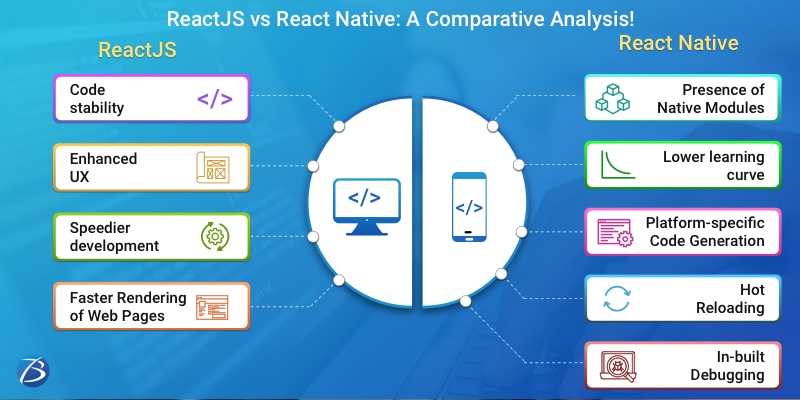
Code stability on account of One-way data flow

React.js employs one-way data binding for ensuring that the parent structures remain unaffected by any alteration made in the child structures. For this reason, every component becomes self-contained and when changes occur in smaller parts, updates need to be applied only in the data model and not the whole state. As a result, whenever a new edit is applied, a major part of the app remains unchanged. This makes the code pretty stable and so, ReactJS applications are easy to maintain.

Virtual DOM: Enhanced UX and Faster Development

The document object model commonly referred to as DOM is a logical structure containing documents in XML, XHTML, or HTML formats. Simply put, this is the process in which an agreement is visualized on the inputs and outputs of data which is present in the form of a tree. Layout engines are used by web browsers for transforming/parsing the representation HTML syntax into a document object model that can be viewed in the browsers.

The traditional DOM construct encounters issues due to the manner in which it processes the changes like queries, user inputs, etc. The server continuously checks the variation brought about by these changes for providing the required response. But, for providing proper responses, the DOM trees of the entire document need to be updated. And, since DOM trees are quite large these days, consisting of thousands of elements, the aforesaid process is not very simple.

Nevertheless, the React.js team managed to speed up updates with the usage of a virtual DOM, instead of using the real DOM like other frameworks. The virtual DOM is an abstract clone of the real DOM and updates even minor changes made by the user without affecting other portions of the interface. React’s data structure and its ability to isolate components quickly also contribute to this process.

This feature of React speeds up updates and facilitates the creation of a dynamic user interface and also eliminates the need for binding the DOM to the functionality at the front-end as it’s already connected to React elements. This functionality has increased the programming speed and has enhanced performance in React apps.

Speedier development owing to Reusable Components

React’s capacity to reuse components speeds up developments and reduces expenses. This is because owing to reusable codes the developers need not create different codes for app components that are similar. Furthermore, on account of React’s component-based structure, frequent debugging is not required, and if one part of the application is edited the other parts remain unaffected. This saves a considerable amount of time spent on debugging and testing.

Faster Rendering of Web Pages

ReactJS enables the speedier rendering of web pages resulting in lower page loading times, thereby lowering the bounce rate of web pages. Thus, web apps developed in React are SEO-friendly.

React Native: Unique Selling Points

The Presence of Native Modules

The presence of Native components quickens run times in React Native apps. Moreover, unlike other frameworks, React Native does not render code employing the WebView.

The Usage of JavaScript as the Scripting Language

With the use of JavaScript as the scripting language, the developers get to leverage the benefits of JavaScript’s powerful V8 engine and hence the process of creating the code for the browser becomes easy. Besides, owing to the simplicity of JavaScript, the developers encounter a lower learning curve as compared to other frameworks.

Platform-specific Code Generation

React Native’s capacity to generate platform-specific code is a distinct offering indeed. During React native app development, the framework automatically detects the platform on which it is running and generates the correct code for that particular platform.

Hot Reloading

The hot reloading feature in React Native enables the developers to reload a mobile application automatically. This way, the developers save a great deal of cycling time resulting in speedier development.

In-built Debugging

The latest version of React Native offers in-built support for Flipper - a popular debugging tool for developers. This tool provides several options like the ability to view crash reports from iOS/Android devices, visualizing and editing the preferences and database of the device, the facility of using these Dev Tools along with other tools, etc. Moreover, Flipper provides a marketplace that obtains plugins from NPM, and this allows the developers to install as well as publish custom plugins based on specific workflows.

ReactJS vs React Native: Roadblocks

Limitations of React.js

  • React lacks proper documentation and so, developers have to create documentation on their own leading to poor execution.
  • The environment is continually changing and this pace is so fast that the developers have to regularly learn new methods for executing functions.
  • Despite its support for numerous third-party libraries, the support for native libraries is limited. And, using additional external libraries involves loads of hassles and a steep learning curve.
  • React does not support simultaneous data handling and hence, the data navigation becomes quite intricate as well as challenging.
  • At times, additional libraries/components need to be downloaded thereby increasing the development time as well as expenses.

Limitations of React Native

  • Besides being a boon, the hot reloading functionality can become a limitation in certain scenarios. For instance, when the developers are working on the business logic or if there is a root change, the updates go live at once.
  • The context, in which programmers can locate the tags and CSS like HTML along with JavaScript, is held loosely resulting in a chaotic abstraction layer. So, developers face challenges when Swift/JavaScript rules are absent.
  • The fact that the React Native framework is still in its beta version, gives rise to debugging and compatibility issues.
  • React Native often encounters patenting and licensing issues that are not easy to resolve.

ReactJS vs React Native: Noteworthy Differences

  • React Native is a full-fledged framework for cross-platform app development and imparts a native-like look and feel to mobile apps. ReactJS is a JavaScript library for crafting dynamic, high performant, engaging web interfaces.
  • js is a base derivative of the React DOM, used for the web platform. React Native, on the other hand, works as a base derivative itself. So, the workflow and syntax are the same for both React and React Native, while the components are different.
  • React Native apps employ JSX – JavaScript – to render the UI whereas React.js apps employ HTML to render the UI.
  • The React Native framework uses APIs rendering components in mobile applications while React uses a virtual DOM for rendering the browser code.
  • Coming to styling, React Native developers make use of stylesheets whereas React.js developers use CSS for this purpose.
  • For creating animation across React Native app components, an animated API is employed. ReactJS makes use of CSS for producing animation and offers more animation creation options than React Native.
  • The security offered by React.js is much more than that of React Native.

Bottomline:

Although React and React Native are quite similar at the core, it has significant differences.  Both of these technologies have distinct abilities and are suited for particular software development projects.

If you need assistance with any of these technologies, reach out to Biz4Solutions. We are a leading React Native App Development Company as well as a proficient Reactjs App Development Company and have extensive experience in delivering high-end software solutions to clients across diverse industrial domains.

To know more about our other core technologies, refer to links below:

Ionic App Development Company

Angular App Development Company

.Net App Developments Company

Thursday, December 2, 2021

The Significant Role of Event-driven Apps in Software Development!

The ever-evolving digital revolution is transforming the way applications used to function. Since the past couple of years, apps have become way more advanced and complex with the usage of several innovative technologies, frameworks, and data centers. Here are some of the modern-age trends:

  • Implementing microservices architecture
  • Apps are moved to Cloud
  • Apps communicate with each other via lightweight protocols such as REST APIs, RPC calls, etc. instead of the erstwhile practice of sharing the same computational space.

These state-of-art practices have reshaped the methods of software development altogether. One such innovative approach is the usage of an event-driven architecture for building futuristic apps.

In traditional three-tier apps, data (base) used to be the core of the system. With the advent of event-driven applications, this focus shifted to events as well as the manner in which the events are flowing across the system. This shift has completely transformed the way how apps are designed.

This post takes you on an enlightening journey into the world of event-driven app development. Let’s explore the myriad aspects of event-driven architecture, its specific use cases as well as business benefits.

Event-driven Approach and the Data-driven Approach: Comparison

An event-driven architecture focuses on events, unlike the traditional model, service-oriented architecture that is based on data at rest. The shift from a data-centric model to an event-centric model means moving from the practice of gathering data/data lakes and emphasizing on data in flight as well as tracking the data while it is moving from one place to another. The event-driven model still considers data to be important; the only difference is that events become the most crucial component.

The service-oriented model prioritizes data and ensures that no data is lost; whereas the major focus of the event-oriented model is to ensure that you respond to the events as soon as they occur. This is because events are driven by a law of diminishing returns – as the events get older, their value diminishes. Nevertheless, both the service-oriented and the event-driven architectures are used together in most modern-era applications.

Understanding Event-driven Architecture?

Event-driven architecture refers to a specific kind of software architectural model that is used for designing an app. It is quite different from the conventional request-driven model. The reason is that, in an event-driven model, the core structure of the software solution is formed by the capture, processing, communication, as well as persistence of events.

This model is a programming approach implemented during product development and not a language or technology. Event-driven programming segregates the event-processing logic from the remaining portion of the program’s code. Hence, event-driven apps can be built using any programming language – most of the visual and object-oriented languages like Java, Visual Basic, Visual C++, etc. support this model.

What is an event?

An event is an identifiable occurrence or a change in the state that has significance for the hardware or the software of the system.

An event can originate from external as well as internal inputs. For instance, its source can be user-generated like the keystroke/mouse click, system-generated such as the loading of a program, or an external input like sensor output. The role of an event-driven app is to detect the events as soon as they take place and thereafter, manage/process those events employing event-handling processes.

Events: Examples

Take a look at some examples/use cases of events to serve diverse business requirements:

  • Web server: The receipt of an HTML message
  • Text editor: The pressing of a key or the request for resetting a password
  • Fraud detection: The detection of illegal trade patterns
  • Commercial business processes: The acceptance or rejection of a loan application
  • Real-time warehouse management: A warehouse updating its inventory, the arrival/delivery of a package to the desired location, or a robot reaching the desired destination.
  • Management System: A new rostering schedule being ready for distribution to the concerned personnel.
  • Gaming (Car racing): A car hitting another one in a computer game

Actions triggered as a response to events

Once the event notification is sent, this occurrence/change in state is captured by the system and then the app responds to the event. The aforementioned events are likely to trigger one or more actions as a response such as logging the event for further monitoring. Some instances of such responses are:

  • Virtual conferences where the sale of tickets are closed after all the seats are booked
  • An email for resetting the password is sent to the customer
  • The account involved in a fraudulent transaction is locked and the security team has been notified about this event
  • An order for more items (that are running low in the inventory) is placed

How does the Event-driven architectural Model function?

Event-driven architectures are employed for the purpose of building, detecting, consuming, and reacting to events. Publishers, subscribers, sources, and sinks are some of its crucial components. This is how they work.

  • Sources are the places where data gets generated.
  • The publisher captures the data contained within the event and then stores it in a repository.
  • This data is then consumed by the subscriber who potentially responds to the event.
  • Sinks refer to the destinations to where the data is sent by the subscribers.

For example, a retailer gathers data on every purchase that is taking place in all his stores around the globe. This data is fed into an event-driven system or app that is keeping a watch on fraudulent transactions and then sent to a credit card processor or for the next set of actions. From manufacturers’ perspective, they are informed about the data coming from their equipment that inform facts including temperature and pressure. This information obtained from the data helps them in real-time event monitoring and triggering of actions such as failure predictions, scheduling maintenance, etc. 

Event-driven Architecture: Models and their Functions

Pub/sub Model:

This model is a messaging infrastructure that is based on subscriptions to a stream of events. After the occurrence/publishing of an event, it is sent to the concerned subscribers who are supposed to be informed.

Streaming Model:

Using this model, the events are written to a log instead of event consumers subscribing to an event stream. This model enables the event consumers to not only read any portion of the event stream but also join the stream at any time.

Event streaming is categorized into three types.

Event stream processing:

This category makes use of a data streaming platform such as Apache Kafka for ingesting events and processes or for transforming the event stream. This type of streaming is used for detecting meaningful patterns in the event streams.

Simple Event processing:

Under this category, an event triggers an action in the event’s consumer almost immediately.

Complex Event processing:

With this category, an event consumer is needed for processing a series of events to detect patterns.

What kind of Apps/Software Systems is best suited for Event-driven Architecture?

Event-driven app development leads to the creation of digital enterprise app solutions that are more agile, contextual, scalable, and responsive.

  • As the events take place, they are captured from their sources like IoT devices, apps, networks, etc. For this reason, the event producers, as well as consumers, can share the response information and status in real-time.
  • Owing to its scalability, this architecture allows you to create as well as respond to several events in real-time. So, modern-era apps that need to make use of consumer data in real-time, adopt this approach.
  • This approach is an ideal pick for future-friendly apps with distributed architectures because event-driven architecture allows minimal coupling.
  • Event-driven architecture is loosely coupled as the producers have no knowledge about the event consumers who are listening for an event and the events are not aware of the consequences of their occurrence. Therefore, it is a perfect pick for loosely coupled software like microservices. Microservices are designed for performing specific tasks based on event occurrences.
  • The event-driven model turns out to be very versatile as it functions well with unpredictable and non-linear events.

Event-driven Architecture: Business Benefits

The benefits of event-driven development are as follows:

  • Enterprises can obtain a flexible software system that is capable of adapting to changes and indulging in real-time decision-making.
  • Owing to this approach, businesses can think of their operations and generate data as events instead of viewing them as a couple of metrics on a quarterly/weekly report.
  • This real-time situational awareness enables business owners to make use of the available data that reflects the ongoing state of affairs of their systems while manual/automated decision-making processes. And, access to context and data leads to more effective and productive business decisions.
  • The organizational apps and systems utilizing the event-driven approach are more scalable and responsive as compared to other apps using traditional approaches.

 How are Event-driven Applications hosted?

The aptest platform for hosting event-driven apps is the serverless platform. The reasons are given below:

  • Event processing needs simple responses unlike typical transaction processing wherein complex processing is needed.
  • Events may originate from any location.
  • The frequency of the events ranges from zero to tens of thousands each second.
  • The serverless platform has the capability to scale as per the rate of generation of events and is less likely to fail in situations when some of the cloud resources are lost.

Final words:

The software development industry has started focussing on event-driven applications to make their systems/apps future-ready and gain a competitive edge over peers. So, it’s high time to engage event-driven app developers for smartening and accelerating your business processes.

If you are looking to create an app using event-driven architecture, contact Biz4Solutions, a prominent event app development company. We have extensive experience in this architecture and our event app development services are worth a try!

To know more about our core technologies, refer to links below:

Dot Net App Development

Java App Development

Ruby on Rails App Development

Wednesday, December 1, 2021

Steps to Hiring the most Competent App Development Company for building a Healthcare App!

The significance of healthcare apps is intensifying as modern-era patients expect prompt digital services from their medical providers. Therefore, most healthcare organizations are under pressure to revamp their devices, systems, and software for providing better patient services and enhancing their operational workflow. Today medical apps dominate the healthcare market to a great extent and so healthcare providers must adopt effective software/app solutions for staying competitive. 

However, architecting an impeccable, productive, and highly performant automated healthcare solution that perfectly complements the existing setup of a healthcare facility is no cakewalk. So, most medical service providers hire healthcare software development services to execute this challenging task.

Coming to hiring external agencies for building healthcare apps, healthcare providers get utterly confused due to the availability of multiple options. The commonest questions that baffle entrepreneurs are:

  • Whom should I hire? – Freelancers, Offshore agencies, or engage the in-house team (if any).
  • What are the factors to consider while hiring healthcare app development services?
  • How to ensure that I pick one of the top mobile app development agencies?

Well, this post answers them all and a quick read will guide you to selecting the best-suited services for your medical body. Let’s commence!

Why is offshoring app development the most lucrative option?

Most medical providers choose to outsource their software development projects to offshore agencies rather than involving their in-house workforce or opting for budget-friendly services from freelance developers. Here are the reasons.

  • Outsourcing saves a considerable amount of your time and lets you focus on core business functions.
  • Offshoring allows you to access a huge talent pool from any part of the globe.
  • Hiring offshore developers is far more cost-effective than maintaining an in-house team.
  • The hiring process is hassle-free.
  • Dedicated offshore developers are far more reliable than freelancers.
  • An offshore team ensures real-time communication all through the developmental stages and on-time project delivery which is less likely with freelancers.
  • Higher scalability is guaranteed.

Why is India the most preferred Offshore Location?

It has been observed that most businesses in the Western nations prefer to outsource their medical app development projects to a Healthcare app development company in India as this is considered to be the most profitable option. The reasons are as follows:

  • Superior work quality available at unmatched lower rates
  • Houses the world’s second-largest English-speaking population
  • IT industries are a major part of the Indian economy
  • Indian Government’s support to the IT sector through tax relaxation and other rules mentioned in the Information Technology Act 2000.

Factors to Consider before hiring App Development Services

Define your app development objectives

Decide what kind of healthcare apps you are going to build. Given below are the various types of healthcare software solutions.

Apps for Service Providers: Hospital Management Software, Healthcare Diagnoses Software, Medical Research Software, Digital Health Records Software, Medical Equipment Management Software, and Pharmacy Management Software.

Apps for End-users: Appointment Booking apps, Health Monitoring apps, Medical Records apps, medicine delivery apps, and Wellness apps.

Decide on the Feature Set

Decide on the desired features that you would like to integrate into the proposed medical app. Some of the standard features of a good healthcare app are telemedicine options, intuitive registration and auto-login, multifactor authentication, support for multiple languages, multimedia, etc., API compatibility, and a compelling UI/UX. Besides the basic features, you may add some extra functionality for gaining a competitive edge.

Checklists for Picking a Competent Mobile App Development Company in India

Background Check

Conduct an extensive background check in the following ways:

  • Check their past work experience and the type of projects handled in the past by going through their portfolio.
  • Examine the case studies, blogs, etc. to understand how their developers handled challenges faced during past projects.
  • Go through the reviews by previous clients
  • Validate the proficiency and level of expertise of the development agency.
  • Look for company reviews/ranking on prominent online authority portals like GoodFirms, Clutch, Wadline, VenturePact, etc., and the accolades earned.

Essential Developer Skillsets

Having a thorough knowledge of programming languages is not enough for healthcare app developers. This is because medical app development extends way beyond coding and requires some additional prerequisites like interoperability, integration, and compliance with standard laws/regulations. As such, developers must have the required expertise and certain dedicated skills. Check them out!

Technical Skills:

Developers must be well versed with third-party integrations, data security standards, and cutting-edge technologies like big data, AI, AR, ML, VR, AR, IoT, AI, etc. so that they can craft a versatile, secure, and future-friendly solution.

Skills concerning Interoperability:

Semantic vocabulary and knowledge about integration standards and integrating frameworks are needed to make the software solution interoperable with the systems, devices, and existing software of the healthcare facility.

Domain Concepts:

The app development agency must be aware of revenue cycle workflows and the regulatory compliances/standards/certifications for medical apps mandated by the governing authority of the region where the healthcare software is to be implemented. For example, all healthcare software solutions used by organizations in the U.S. need to adhere to HIPAA (Health Insurance Portability and Accountability Act) and the medical bodies in Canada need to follow PIPEDA (Personal Information Protection and Electronic Documents Act).

Soft Skills:

Soft skills like app usability, and effective planning and coordination during the development cycle as well as after app launch, are necessary to avoid any operational glitches.

SLDC Check

Get a clear idea about which SLDC or Software Development Lifecycle model, your would-be technology partner is going to deploy. The checklists include the following:

  • Clarity about whether an agile methodology (the most preferred approach) would be adopted
  • The niche – iOS OR Android – of the developers allocated for your project
  • The turnaround time expected for every stage of the SLDC
  • The team’s approach towards the commitment required for debugging and troubleshooting and their stand to minimize the chances of re-runs while coding.
  • Their readiness and policy to provide support post product deployment for executing interactive changes based on user feedback.

Service-level Agreements

There are certain service level agreements that you need to watch out for when hiring offshore agencies.

  • An NDA (Non-Disclosure Agreement) is necessary to protect the app’s idea and design.
  • An agreement between both parties concerning the payment deadlines, hourly/monthly rates, the token amount, and the form of payment (digital currency/wire transfers) is necessary.
  • Negotiation talks after the announcement of the first quote, should be an integral part of the initial discussion.

Coding Standards and Code Ownership

Ensure that your app development partner possesses mastery in coding for the healthcare domain niche you have opted for and employs the best available and aptest frameworks/technologies for your healthcare application development project. Moreover, make sure an agreement is sealed wherein it’s declared that you are the rightful owner of the mobile application, its design and source code, and other app elements.

Common Mistakes to Avoid

  • Not conducting adequate research to check the background of the agency you hire
  • Hiring low-cost resources or the cheapest vendor available for accomplishing your project
  • Considering the project cost as the key determiner for selecting healthcare app development services
  • Prioritizing costs over experience and expertise
  • Not paying attention to app store optimization
  • Being unprepared for the stages after the product launch

Final words:

If you follow the aforesaid best practices and avoid the common mistakes, you are sure to hit a great deal and find that perfect offshore app development firm that will provide you with a compelling healthcare app solution.

If you are looking for a competent technology partner, reach out to Biz4Solutions, a proficient mobile app development company in India with a rich experience of 10+ years in building ground-breaking healthcare software solutions for global clients. We tailor the software as per the specific requirements of clients.

To know more about our core technologies, refer to links below:

Java App Development

Flutter App Development

Node.js App Development