Sunday, May 1, 2022

Guidance on NFT Creation and Monetization Strategies!

NFTs are cryptographic tokens existing on a Blockchain that can be traded or sold. NFTs involve objects or assets such as music, artwork, trading cards, pictures, tweets, memes, online gaming, virtual real estate, etc. 

This concept came to light in 2014 with the first known NFT transaction: A video clip named Quantum, registered by McCoy on Namecoin Blockchain was sold at $ 4 during a live presentation at New York’s New Museum. However, this concept didn’t attract much public attention until 2017 when the digital gaming brand CryptoKitties successfully sold tradable cat NFTs as a monetization strategy. Gradually, with the rising popularity of cryptocurrency usage, the NFT market picked momentum and by the end of 2020, the NFT market value reached 100 million $.

NFT became a buzzword around the globe ever since the most expensive NFT sale took place in March 2021: “First 5000 Days,” a crypto art by Beeple, was auctioned for 69.3 million USD.  Here’s the example of another multimillion-dollar NFT transaction in 2021: “Bored Ape Yacht Club” raised 26.2 million USD by selling a collection of ten thousand NFTs in the form of cartoon primates that can be used by their owners as profile pictures on social media accounts. The year 2021 witnessed a booming NFT market with countless profitable transactions and the market value shot to 22 billion $.

Several brands, individuals, and enterprises including Yahoo, Star Trek, NYSE, Walmart, Ticketmaster, Elvis Presley, and Panera have been trademarked for NFT. This post guides you on how to create an NFT and monetize it. So, if you too wish to trade your asset/s via NFT, this write-up is a must-read.

But, before we dig deeper, let’s get a clear idea about NFTs & the concept of minting NFTs!

What are NFTs and how do they function?

NFTs or non-fungible tokens are data units stored on Blockchain, a digital decentralized ledger. An NFT refers to a specific digital or physical asset that is virtually traded or sold. NFTs grant ownership of the physical/digital objects by recording it on Blockchain. Here, granting ownership means providing a license to use, copy, or display the asset for a particular purpose.

NFTs work like cryptographic tokens but one cannot mutually interchange them like cryptocurrencies such as Ethereum or Bitcoin. This is because, unlike cryptocurrencies, all NFTs are not the same; each NFT holds a different value if they represent varied assets.

To create an NFT and earn money from it, one needs to mint an NFT.

What do you mean by minting NFTs?

Minting NFTs is the process of creating NFTs on a Blockchain. Here, the digital file gets converted into a crypto collectible. During minting the data is recorded within a public ledger which is tamper-proof & unchangeable. As such, all NFT transactions in the future can be followed and tracked. For minting NFTs, owners have to pay the “gas fees.” However, some platforms do not charge any gas fees from NFT creators; the fee is compensated in the form of additional costs to be paid by the buyer just like VAT or airlines’ fuel charges.

How to Create NFT and Monetize it: Key Steps
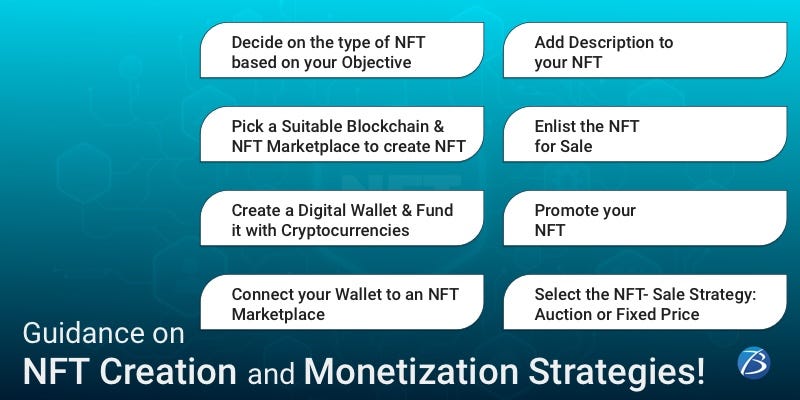
Here are the key steps that should be followed to create an NFT and earn money out of it.

  1. Decide on the type of NFT based on your Objective

Selecting the type of NFT is a very crucial move as it should seem valuable to your target audience and also be profitable for you. Take a look at some of the most popular NFT ideas. Digital works of art have been so far the most profitable NFTs ever created, and this strategy works best for individuals planning to create NFTs.

If you are a business brand selling physical collectibles, it would be a great idea to tokenize those collectibles and sell them in digital format. Digital trading cards and sports cards are good examples of this type of NFT. While physical cards are susceptible to damage, NFT cards will retain their quality forever as they are securely stored on a Blockchain.

NFT-based video games have also proved to be immensely profitable as gamers usually heavily invest in virtual gaming items.

  1. Pick a Suitable Blockchain & NFT Marketplace to create NFT

Blockchain:

You also need to select an apt Blockchain technology to mint your digital asset into an NFT. Select the Blockchain depending on the type of cryptocurrencies owned by your target audience and the transaction charges involved in that Blockchain. The commonest Blockchain used for NFTs is Ethereum; other Blockchains include Smart Chain, Binance, Cosmos, EOS, Polkadot, Tron, Litecoin, and Tezos. For example, Ethereum powers NFT platforms like OpenSea, Rarible, & Mintable; Polkadot empowers Xeno NFT hub; Wax Blockchain empowers AtomicHub; and Tezos powers marketplaces like Bazaar market, Rarible, & one of.

NFT marketplace:

The crypto space offers several NFT marketplaces, and you need to pick the one that suits you best. It has been observed that non-curated platforms are preferred over curated platforms. The reason is that NFT creators using non-curated platforms provide low-cost options – you just have to register yourself and pay the transaction fee needed for minting a token.

Here are the offerings of some of the most popular NFT marketplaces:

OpenSea:

This popular marketplace is used by a huge chunk of NFT traders as it hosts almost every kind of NFT and supports 150+ cryptocurrency payment tokens.  Furthermore, OpenSea offers advanced features and user-friendly experiences to NFT holders enabling them to create effective NFTs speedily. Here, the NFT owners can even group up with other sellers for selling off their NFTs. The platform doesn’t charge any fee for creating an NFT and enlisting it for sale. Creators need to only pay fees for one-time registration and contact approval. Authors are charged a fee when their NFTs are sold.

Rarible

This is another popular marketplace, a self-service platform that is interconnected with OpenSea. The offerings of Rarible are quite similar to those of OpenSea. However, Rarible offers limited formats and smaller-sized artworks. Moreover, Rarible users can mint tokens prior to selling them, while in OpenSea token minting is managed at the time of selling the NFT.

Mintable 

This platform is ideal for novice traders as it is one of the most cost-efficient options for creating and selling NFTs. This platform doesn’t charge any fee for registration, NFT creation, or NFT sales. Free NFT minting services make this marketplace the most viable option for artists who seek zero investment and huge returns. But this platform is not so user-friendly and requires a lengthy registration procedure.

Is it necessary to use a marketplace for NFT Creation?

You need not use an NFT platform if you are technical enough to build a smart contract, choose a Blockchain to deploy it, and use it for minting tokens. You can also hire Blockchain app development services for customized requirements. 

  1. Create a Digital Wallet & Fund it with Cryptocurrencies 

A digital wallet is an app that is used for storing cryptocurrencies as well as buying, selling, or minting NFTs. So, pick a wallet that is compatible with the Blockchain you use for minting your NFT if you are a creator/owner. MetaMask and Coinbase are the most commonly used ones.

Once the digital wallet is created, you need to add some cryptocurrencies for paying the NFT minting fees to the marketplace you’ve chosen. Ether or ETH, Ethereum’s native cryptocurrency, is the most commonly accepted currency in NFT transactions.

  1. Connect your Wallet to an NFT Marketplace

Now, you need to connect your wallet to the NFT marketplace you have chosen. For OpenSea and Rarible, this process is quite easy: you need to click the top left button for connecting the wallet. Then, you can view a list of compatible wallets; you need to select one out of these for continuing the connection process.

If you already have installed the extension of either Coinbase or Metamask, a pop-up will appear asking you to connect to your wallet, and you can connect with a few clicks. For the Coinbase wallet app, you also get the option of connecting with the marketplace using a QR code scanner that is present on the main wallet screen on the right side of your balance amount.

Remember to go for a trusted site instead of an unknown site, to prevent scammers from accessing your NFTs or funds.

  1. Add Description to your NFT

Now, you need to upload the file that needs to be converted into an NFT to the marketplace you have picked. Then add a catchy title and description to your NFT for listing purposes. Once uploaded you need to select whether you wish to mint a single token or an entire collection of NFTs.

Thereafter, you will be asked to decide on the percentage of royalty you would like to claim whenever your asset/artwork is resold in the future. But, this part is a bit tricky. If you set a high percentage of royalty for resale, it may seem profitable but individuals who have purchased your asset might be reluctant to resell it.

The last step involves adding the properties of your file; this step is optional.

  1. Enlist the NFT for Sale

After you are done with filling out the information and you have uploaded your file and minted it, you need to enlist it for sale.  Click on “create item” and then you will get the option to connect your wallet for paying the listing fee.

Once your file gets listed for sale on a particular marketplace, the platform will calculate the “gas fees”. This type of fee refers to the costs incurred by the Ethereum Blockchain network for recording transactions and the amount depends on how busy the platform’s network is. However, if you enlist your NFT during the non-peak hours, the fee will be lesser.

  1. Promote your NFT

After creating an NFT and minting it, owners need to promote it through proper channels for maximizing the chances of success. The promotional platforms & approaches include public relations, online advertisements, crypto podcasts, and social media.

  1. Select the NFT- Sale Strategy: Auction or Fixed Price

 It is important to choose an NFT-Sale strategy: Auction or Fixed Price. The fixed price strategy is simple, straightforward, and transparent – NFT owners mention a specific selling price for their assets.

Setting up an auction is a way more interesting and exciting approach for earning money from an NFT sale! Here, three options are available:

  • Increasing price auction: The price increases and the highest bidder gets to buy the NFT.
  • Timed auction: The bid for each lot is set for a definite time, the interested collectors have to submit the bid within the specified time, and finally, the person who submits the highest bid wins.
  • Decreasing price auction: The NFT price drops till a person buys the NFT.
  • Online auction without a deadline: Interested parties will submit the bid and the owner can close the auction at any time.

NFT Monetizing strategies 

 The various approaches to earning money from an NFT are:

Royalty: 

This is a crucial strategy to earn money from NFTs: the NFT creator can earn passive lifetime royalties after selling their NFT to another individual. For this, the creator must impose terms and conditions stating that royalties need to be paid to them every time the ownership of the NFT changes.

NFT Staking & Renting:

Staking is to lock or deposit an NFT for generating passive income in the form of tokens.

If your NFT is gaining popularity, renting will be a good option to earn money out of your NFTs. Here, a smart contract-empowered deal is sealed between two parties stating certain terms and conditions. The lease amount and the duration of the rental agreement are also fixed by the owner.

Liquidity Pool

This refers to a collection of digital assets locked within a smart contract. This collection can be used as loans, collateral, etc. Moreover, the users of several platforms are rewarded with NFTs that are exchanged with a liquidity pool and the owners can sell their NFT rewards for liquidating their positions within liquidity pools.

Summing Up:

The NFT platform can be leveraged by artists to get digitally recognized and can be used by business brands as a highly effective monetization strategy.  As the trend to collect NFTs is rapidly growing, the number of brands/firms applying for NFT trademarks is also on the rise. The number of NFT-related trademark applications received by the Patent and Trademark Office in the US was just three in 2020; the number rose to 1200 in 2021; 450 applications were received in January 2022.

If you too wish to make money by creating an exceptional NFT for your business brand, reach out to Biz4Solutions, a prominent software firm offering high-end mobile app development services as well as Blockchain-related services to global clientele for the last 12+ years.

Thursday, April 28, 2022

Top 10 Trending Camera Apps for Android Users in 2022!

Are you fully satisfied with the performance of your Android device’s in-built camera? Well, for most of us the answer is negative. These days, most of us capture photographs using our smartphones and we require that perfect picture/video that can be posted on social media. And, most built-in cameras of android devices fail to satisfy this user expectation.

Good news! There are a host of incredible camera apps available for Android users that allow you to click captivating pictures like a professional. This post explores the distinct offerings of the most notable photo apps that are trending in 2022!

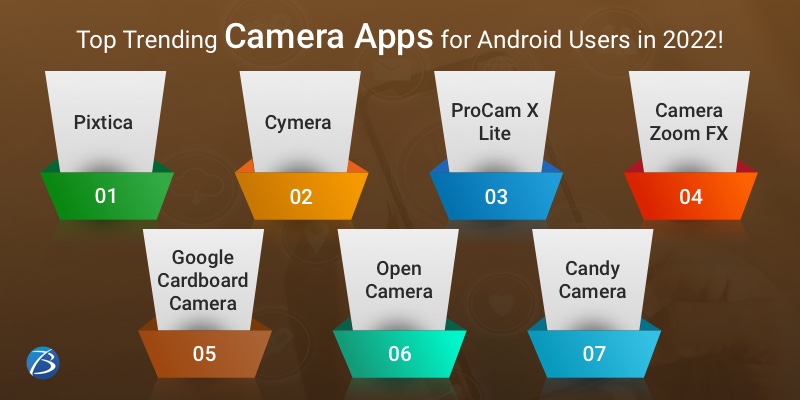
Pixtica

This is a free multimedia camera app with an intuitive design developed by Perraco Labs. It is ideal for expert photography, video creation, and adding innovation to photos/videos. The app is meant for filmmakers and photographers but can be used by novice photographers as well. Pixtica’s easy-to-use layout enables you to click like a pro even if you are a layman in photography.

The app offers amazing features like hyper-lapse, time-lapse, panoramic capture, slow-motion video recording, designing GIF animations with various capture modes, a huge variety of filters and effects including the bokeh effect, replacing a photo’s background, and scanning documents to PDF/JPEG mode. It also offers excellent manual controls just like the ones found in DSLR cameras – exposure, ISO, focus, balance, and shutter speed.

Cymera

This is one of the most amazing camera apps that comes with seven different varieties of camera lenses, a timer, a stabilizer, and a silent mode that allows users to shoot photographs quietly.

The app can be used for photo editing, beautification, and the addition of fun effects. Users can choose from a plethora of stickers, filters, and special effects, and its photo editor can reshape body structures and even add or remove facial/body features from photos. It also provides a smart gallery, loads of selfie functionalities, MEME editor, fireworks/lights effects, poster tool, collage creator, and a crop tool that helps users create Facebook & Instagram cover and YouTube thumbnails effortlessly.

ProCam X Lite

This app is a lightweight and free version of the popular Android app ProCam X. This happens to be one of the most viable options for mobile users; it offers exciting features like entire manual control on shutter speed, white balance, ISO, various focus modes, etc., various kinds of focus modes like  Macro, Manual, Infinity, Locked Focus, etc., and face detection capability. Also, there are twenty options for burst shots and elite features like exposure bracketing & interval shots; these prove handy during stop motion captures and timelapses.

Camera Zoom FX

This camera app is loaded with DSLR functions and allows users to click stable & action shots, apply fascinating filters, and compose photos.

Camera Zoom FX enables users to take RAW captures, integrate various shooting modes, adjust the shutter speed & the focus distance, set ISO, etc. Some of its USPs include HDR mode pro, burst mode, live effects, voice activation capabilities, and Spy camera. However, to avail of all its high-end features, one must download the premium version which costs 3.99 $.

Google Cardboard Camera

This is one of the unique camera apps that provides you the convenience and ease of clicking 3D photos at minimal costs and thereafter, enjoying those clicks in VR. Users can capture 3D photos and then view them on their Android screen or on a virtual reality device for achieving the best results.  Mobile app developers have put in a lot of innovation to make this app unique.

Mobile app developers have The VR photo clicking technique is quite similar to clicking panoramic shots using smartphones. One has to hold the mobile device vertically, click the camera button, and then move in a circle. Here, the Google Cardboard Camera allows you to make a 360 degree turn unlike general panoramic pictures, and also records a snippet of sound while clicking photos. The outcome is captivating as you get immersive pictures that possess depth when you view them on Google Cardboard. The objects at a distance appear far while the nearby objects appear near and users can view the captured scene from different directions - front, sides, and even behind their heads.

Open Camera

This is one of the best free and open-source camera apps available for Android devoid of ads and in-app purchases. Moreover, the app is lightweight and consumes less device storage space. What more could the users ask for? The Open camera app caters to Android smartphones and tablets.

The notable features of this app include HD video recording, the ability to geotag photos/videos, HDR, external microphone support, focus & scenes modes, automatic stabilizer, useful remote controls, configurable volume keys, and a dynamic optimization range. Furthermore, its GUI is optimized for right-handed as well as left-handed users with equal levels of perfection.

Candy Camera

This is a free camera app with ads that offer a host of enthralling beauty functions and filters for selfie clicks – various stickers, face slimming modes, makeup tools, light effects, and many more. Users can view effects live before they click a photo and also enhance the picture after capture. App users can click silent snaps/selfies and utilize the collage feature for creating beautiful collages by combining different photographs.

Vector Camera

This is a free and open-source new-age app that offers real-time alienation. This camera app is meant for adding enchanting effects while recording videos and shooting images. The app’s distinct offerings include live vectorization and after-processing vector effects, focussing on flashy coloring effects.

Users can choose from a plethora of real-time effects that can be applied to the primary interface for improving image/video quality. These effects can be further customized by the user; the background color and solid colors. Top-quality pictures can be clicked using the HQ mode. 

Vector Camera doesn’t affect your device’s battery life. However, unlike other camera apps, this app cannot be used for shooting regular photos without special effects.

Bacon Camera

This application is immensely helpful when the support for Camera2 API is absent on your Android device. This app is completely free and doesn’t offer any in-app product.

The app comes with an easy-to-use and intuitive user interface. Also, it provides full-scale manual DSLR-like controls such as focus, white balance, exposure compensation, live histogram (Luminance & RGB), semi-manual ISO speed, GIF designing, exposure bracket, etc. without requiring Camera2 API support. Bacon Camera provides support for all types of files including DNG, JPEG, and Bayer RAW.

Camera 360

This is a professional and easy-to-use camera application and one of the best photo editing apps. It is used for selfie retouching and photo editing using stickers, filters, and make-up modes. App users can select from numerous filters, choose how their skin & face looks in photos, and click candy selfies that appear more natural. The app also includes fun-filled elements like animated theme filters and Funny Augmented Reality Strikers.

A unique feature offered by Camera 360 is an Audio camera that allows users to capture standard still photographs with the sound made by the subject.

In Conclusion:

So, aren’t these photo apps remarkable? The craze for downloading high-end camera apps for captures and edits is a trend that’s here to stay. So, it’s a golden opportunity for entrepreneurs to exploit this growing demand by architecting a user-friendly camera app that offers exciting features.

If you would like to hire professional services for camera app development reach out  to Biz4Solutions, a prominent mobile app development company that has been delivering world-class apps and software products to global clients for the past 11+ years.

Monday, April 25, 2022

Top 7 Retail Technology Trends For 2022


The retail industry has transformed over the decade with the growing penetration of the internet across the globe. The retailers have been progressively involved in capturing the large population that stays online with remote devices. Online presence has become important for the business over the past few years. The COVID-19 pandemic further propelled the demand for online shopping and e-retail. The pandemic also compelled retailers to automate their inventory management and supply chain. Going ahead in 2022, several other factors are meant to influence the retail trends:

  • Generation Z: People born after 1995 have become a part of the workforce. They are going to strongly influence the retail trends

  • Digital world: Retailers are going online to capture the maximum customers

  • Convenience: Contactless and hassle-free shopping is going to be a driving point

These trends in turn are going to influence the retail technology trends. Mobile application plays an important part in developing an e-retail ecosystem. Many companies provide mobile app development services to provide a competitive UI for e-retail. So, hiring mobile app developers is the need of the hour as one has to keep a watch on other retail technologies going to trend in the coming years.

Major Retail Technology Trends


  1. Cashierless shopping

This retail technology is already implemented in many Amazon stores. The concept is meant to put an end to the waiting lines. Consumers can walk into the stores after signing in on the mobile application. All the items picked up in the shop are automatically billed and the money is deducted through the application while exiting the shop. Today, this implementation is only in small stores. In the future, it can be into larger stores and supermarkets. This technology is being associated with a positive change wherein the former cashiers at retail stores can take up meaningful and rewarding jobs that do not involve sitting and swiping vegetables.

  1. Autonomous delivery

The most talked-about retail technology, autonomous delivery, may become a reality in the coming years. Many companies have started trials for drone deliveries with successful results. Machine learning and Artificial intelligence play a huge part in redefining the delivery infrastructure in the retail sector. The management of the air traffic caused by delivery drones and bots needs to be managed. With many retail players awaiting the successful rollout of autonomous delivery solutions, many technology startups are expected to come into the picture, inviting more retail companies to opt for autonomous delivery.

  1. Virtual try-on

Augmented reality as one of the retail technology is going to take customer experience to a new height. Virtual try-on has become a reality. Social distancing and restricted movement are expected to boost its adoption in retail sector. The virtual try-on option allows the customers to make informed decisions. It can end in higher sales and lower return rates, a great benefit for the retailers. Virtual try-on also provides a means of market assessment for the garment retailers to maintain a balance between supply and demand by optimized manufacturing of products in demand.

Virtual try-on can be creatively used to suggest the best size and suitable color for the customers, cutting down their time spent in cloth trials. The ultimate result is expected to be better revenue and customer satisfaction.

  1. Omnichannel shopping

Omnichannel shopping is an interface between a brick-and-mortar store and an online store. Customers create omnichannel customer profiles which are universal to both brick and mortar stores and online stores. The selected items are placed in cloud-based smart shopping baskets that are valid for the physical and digital brand stores. The customers get the choice to select products from any medium and add them to the basket. Similarly, the items can be purchased from any medium. The flexibility of purchasing products makes the buying journey hassle-free. Omnichannel shopping gives retailers a better understanding of the customers, helping in marketing their products.

  1. Zero interface retail

It is way more personalized human-machine interaction, adopted to enhance the user experience. With technologies such as Artificial Intelligence (AI) and Natural Language Processing (NLP), the conversational interface can be the new UI for retail brands. Voice searches are already being used in different applications. Using voice as the operative base for retail brands is a good strategy. Moving ahead in 2022, voice can be used to create entirely new and unique user journeys.

  1. Automatic inventory management

Inventory management composes to be a huge part of every retail outlet. Retailers are able to reduce their manual efforts and costs in managing inventory. Data-driven analysis of the inventory helps in its management. There are several benefits that data-driven and automated inventory management can bring.

  • Reduced warehouse cost with minimal inventory stored in the warehouse, incurring less maintenance cost

  • Stock availability whenever required by a customer, enhancing customer satisfaction and fetching customer loyalty

  • Less dependency on discounts to clear the old stock

  • Greater revenue with higher sales, and reduced old/dead stock

Artificial Intelligence (AI) and other technologies can be used to tag the inventory in categories and subcategories and track the performance of each category against different KPIs. Predictive analytics can be used to ensure products availability on different channels based on the demand to optimize sales.

  1. Blockchain-based supply chain

Blockchain enhances transparency and security across all operations and transactions. It can be used to record the entire journey of the product till it reaches the end customer. Once created, this record cannot be edited. This error-less tracking allows Blockchain to address the challenges of supply chain traceability. In the coming years, Blockchain can become an integral part of supply chain management systems owing to its positive impact on transparency, auditing, and traceability.

The retail industry is evolving with an increase in the use of technology. The retailers must pay heed to these retail technologies to stay ahead in the game. Every retail technology may not be applicable to every retail business and the business owners need to chalk out the requirements before acquiring these tools. Mobile application is going to stay as an important tool for e-retail. An application with good UI and responsiveness has higher chances of retaining consumers than a normal mobile application and website. Biz4solution can help retailers in developing robust mobile applications. Our experts will devise the best UI as per your niche. We will help your business go global with world-class applications. Contact us today to own a mobile application to offer a personalized experience to your customers.


Noteworthy Features of Therapy Mobile app!

Do you consider mind over matter important? As the saying goes, you should control your mind before it controls you. Most of us have finally grokked that talking to a friend can be an enormous help. Post pandemic era, the general rise in the wide awareness about mental health has led people to take therapy. Though a little unconventional, people prefer secretly talking and consulting with a therapist privately. That is the reason why there are so many therapist apps popping up on the market.

Therapist apps provide you with the privacy you seek. Not everybody can find a suitable person to vent out their feelings. When you are in emotional chaos or crumble under problems that are too complex, it is equally difficult sometimes to find a trained mental health professional. So therapy apps help a lot to take you out of an emotional pothole. Therapy apps let you find someone having the expertise to speak to via mobile phones, formal text, or video. These kinds of effortless connectivities are like godsend for some. For some people, it can be additional support to in-person therapy and for others, it can stand alone. And the best part is these platforms are curated to have security and privacy in the conversations.

From a teenager to an adult, everybody can indulge smartly and securely to practice mental well-being. For teenagers, it may feel weird to spill your guts into a face on your mobile phone, or for people with disorders such as depression and anxiety, or women having issues with the quality of life secondary treatment, neglect at home, domestic violence, etc; therapy mobile apps add a whole new avenue to speak up about these issues. It’s not that everyone with a smartphone cares for their mental well-being. Often, people pay attention to their physical health and they do regular exercise, eat nutritional food, take a good sleep, and stay hydrated. Just like your physical health, support for your mental health helps you feel your best and up in arms.

So, these therapy apps have a universal demand. According to the report published in reachandmarkets, The Global Mental Health Apps Market size is expected to reach $10. 2 billion by 2027, rising at a market growth of 16. 3% CAGR during the forecast period.

Many mental therapy apps are effortless to use and help you secure the well-being you deserve via their features. Many mental health apps can give you suggestions, tools and advice, mindful activities, and support to help you manage your stress. Some apps effectively manage general mental health issues and complex conditions. Many of the apps are free to download but these free apps provide access to only limited features. To access all of the features of an app, user needs to go for paid subscription.

Best Features to Have in Therapy Apps

Seeking help from therapy mobile apps can be intimidating but the real challenge is the real-time problem-solving capacity via its features. So, here is the list of some real-time practical features that can help to boost the productivity of the therapy apps.

Profiles Creation

First things first. Profile creation is an absolute initial step of building a therapy mobile application to sign-up and the profile creation feature. The sign-up step should be hassle-free and should not create anxiety for the users. Guaranties of the data and content that the users are putting in may give them an extra sigh of relief. Profile content should be separate for counsellors and patients. If the counsellors are ranked according to experience and feedback then it would minimise the struggle to find the right counsellor for patients. Most important thing is that profile settings should incorporate all the necessary data for utilizing the application like full name, region, age, location, gender, disorder, chronic illnesses, allergies, intolerances and so on. The patient should be given the option to upload all their prescriptions and documents, and reports on their profile.

Calendars and Reminders

One of the great advantages of mobile devices and the digital age is that it has simplified orderly living and eased the burden on people. With this feature, patients can easily book appointments with counsellors, set targets on the app and accomplish tasks on the dashboard. Calendar features can also be helpful beyond measures for female health tracking. This coupled with reminder features may boost your productivity and timely execution of the tasks you have subscribed to. So day by day, in every way, users would be growing. With reminder features, from teenagers to elderly patients, users can set reminders for their medicines. It is helpful for people suffering from Alzheimer’s, anxiety or depression.

Variety of sessions

Apps are imperfect if they are not easy to use. Many mental therapists suggest that having a suitable session is a must as people have different and complex sets of mental issues. So to do justice to everyone’s problems, therapy apps should come with a wide variety of sessions like mindfulness, music therapy, talking sessions, etc. The add on features like meet and greet with the favourite therapist will add a game-changing solution.

Tracking self-growth

Tracking and self-monitoring the progress is one of the essential components of mental therapy. For this, therapy mobile applications can be useful to monitor complete well-being from day to day or month to month basis. Features like this are very handy to keep updated records of the sleep cycle, mood alterations, mental disorders, food intake, tracking metabolism and physical exercise, thoughts, sentiments, and so on. With an active dashboard that keeps on updating these indicators automatically, users can analyse information hustle-free or even refer them to their therapy counsellors. Other features like calendar, events tracking, and manual goal setting can help the app grow more.

Counselling via chatbox and video sessions

While the whole world was in quarantine, video calling and group chatting were the main channels by which the people managed to keep a visual and live check on their loved ones. But these features are proving to be a blessing post-covid era. Telehealth services have sprung up from the covid-19 stage. Its usage was much higher during covid-19 and even now it is 38x higher than in the pre-covid stage. From gym instructors to therapy counselling, the live video sessions are the new normal. That is the reason it is important to add chat and video meeting features when you want to build the therapy mobile application. It can increase the app engagement along with the user and counsellor connection. Other features like screen sharing, documents transfer and media sharing might double the user interaction and usage across this platform. Along with that, you can even add other features such as video recording, screen sharing, document transferring and so on to make the therapy sessions more interactive.

Video & Audio Content

If somebody asks you whether you like to watch a session or read about a session, then most of the time you would choose the first option. This feature can do wonders when it is unable for users to reach out to a counsellor. Video content is engaging, explanatory, creative and very satisfying when it comes to engagement with the audience. People are more used to listening to podcasts, video meditation and other blissful features. It is very beneficial for return on investment as it enhances your mobile app engagement. The use of video monitoring can go beyond the expectations as it can alter the mood and instructive session also helps to get rid of anxiety and loneliness, unwanted stress, and so on. Likewise, patients and counsellors can upload video and audio files from their therapy sessions on the off chance that they need to watch them once more. Users can easily scroll through the playlist and watch the content as per their needs.

Urgent Care

 For a person suffering from mental health issues, anxiety and depression-like attacks are common. If a person is having an anxiety attack or suffering from any mental disorder, then urgent care can be a godsend for them. So, now and then people having mental health disorders require urgent care. You can list the symptoms of any such panic attack and in this way, you can build an app that creates awareness. It’s a great way to build a self-care routine for users. With an urgent care feature users can get admittance to a quick emergency assistance call or somebody from an experienced counsellor.

Furthermore, you can add step-by-step directions on how to respond if there should arise an occurrence of urgent care and a tab with quick access to required contacts with a simple video tutorial or audio clip.

Sharing Data

We have learned the hard truth that sharing is caring in the pandemic. Beyond sharing the useful things, sharing thoughts, and results can push other patients to do more better. Therapy mobile apps can also let apps sync with social media accounts and share their progress, ideas, and thoughts across various social media platforms. Peer to peer connectivity can let them send data directly to their counsellor or required trained professionals and their loved ones. Add some ‘how you feel’ and ‘mood’ feature on social media platforms and it can let the users share their progress that can motivate other users as well.

Active Push Notification

Remind users and patients how well they are doing and how much more they can accomplish with push notifications. These kinds of notifications increase app interaction and also alter the patient’s mood. Such alerts reminds the users to keep their mental health in check. For the day, patients can be reminded and motivated to do work out, practice meditation, read blissful information, practice relaxation, inform about therapy sessions, energize and brighten up their mood, and so on. A good engagement with content can help patients to indulge more and more in the application. So this is a must have feature for mobile app development.

Protection from data theft

Though the digital age is a blessing, it also is a bane. Many spyware attacks, bugs and hacking tools have changed the virtues of safety and security while using digital devices. A person suffering from a mental disease should be more careful as any such security breach might create extra anxiety and stress on the patient. So, being careful about data security is a must when you build a mobile app. The therapy mobile app will have all the sensitive details about the patients and counsellor which a mobile app developer should protect at any cost. Some high-level security features like multi-factor authentication, dynamic password, biometric authentication, voice recognition, OTP verification, etc. can assure the needed security.

But remember, apps are not a substitute for professional mental health care. They can ease your way to achieve your desired targets and goals efficiently.

We at Biz4Solutions, know how to push buttons and get your business going. As a leading Healthcare app development company, we can help you create such amazing applications for mobile devices. From blockchain and IoT to healthcare, we have successfully brought a smile on many faces with our quality services. We are pioneering mobile app developers and bring not just the conventional solution but also offer smart ways to upgrade your business and increase the productivity of your business. It’s your time to say YES! Allow us to help you with Digital transformation, robotic process automation, IoT, cloud solution, mobile apps and many more state-of-the-art services. Drop your email in the comment box and relax, our experts will get in touch with you shortly.

Thursday, April 21, 2022

How Much Does It Cost to Develop a HIPAA Compliant Application in 2022?

Introduction: HIPAA Compliant Application

If you are a healthcare provider and have a mobile application that deals with protected health information (PHI), then your app would have to be HIPAA compliant.

Healthcare entities like hospitals, clinics, insurance companies, etc., or even business firms who have developed mHealths or EHealth applications revolving around PHI fall under the ambit of HIPAA – Health Insurance Portability & Accountability Act.

Well, collecting information does not require you to be compliant, but sharing the information requires you to be.

Importance: HIPAA Compliant App Development in 2022

So, if you are planning to craft a healthcare mobile application that involves PHI, make sure that it is a HIPAA app.

A HIPPA-compliant application refers to a software solution that meets the standards set by the US Health & Human Services, A HIPAA compliant mobile app ensures that the user data you hold is secured.

Most entities in Healthcare IT Services that collect and share patient information are concerned about HIPAA since non-compliance can turn out to be a costly affair.

Hospitals & companies violating HIPAA compliance attract a heavy fine that could even run into millions of dollars – there have been several instances of hospitals being levied a heavy penalty for data breaches.

The HIPAA Compliance & Its Costs

If you are planning to develop a HIPPA-compliant healthcare app, you should first evaluate what levels of HIPAA compliance you need. This will depend on the PHI (data) you hold and the amount of the data you are sharing. The lesser the sharing, the lesser the compliance.

If you are getting the app developed through a healthcare application development company, then the app development company should be informed about HIPAA right in the development stage because they have to work on privacy & security rules.

The cost of developing a HIPAA compliant app generally depends on factors like

  • The type of the healthcare Organization
  • The size of the organization
  • The Organization Culture
  • Geographic Location of the healthcare body
  • The number of Business Associates involved

For a small-sized covered entity (covered entity: doctors, hospitals, insurance companies, clinics, etc.), the HIPAA compliant app development cost would be somewhere around: $4,000 to $12,000. This cost includes Risk Management & Management Plan, Remediation, and Training & Development Policy.

For a medium or large-scale covered entity, the cost of building a HIPAA compliant app would be approximately $50,000 or more. This cost includes Remediation, Risk Analysis & Management Plan, Penetration Testing, Training, and Policy Development & Vulnerability Scans.

Alternative Option:

If the app development cost seems way too higher, the other option available is resorting to a cloud service provider, which is already HIPAA-compliant.

When choosing a cloud-based service provider, you need to check if that service provider will minimize the risk of data breaches, and whether the service provider is ready to serve you.

Although the costs of developing a mobile application that is HIPAA-compliant seem higher, it is always better to be on the safer side and avoid paying large penalties. These compliance errors are apparently too costly to be made.

Conclusion:

The penalties for security breaches are heavy due to the nature of the data that is being dealt with. Patient information is very sensitive in nature as it contains their medical history. In 2017, IBM & Ponemon conducted research that gave away some interesting facts.

They found out that on average, a single data breach costs $380 per record, which is 250% more than the data breach across other industries around the globe.

A HIPAA compliant app is trusted by patients as such an app keeps their information private & secure. If you would like to develop a new-era HIPAA compliant app for your medical facility, reach out to Biz4Solutions, a prominent mobile app development company that specializes in healthcare app development. We are having a rich experience of 12+ years in tailoring highly customized HIPAA compliant healthcare apps/solutions for our global clientele.

Tuesday, April 19, 2022

How to create a Video Consultation Healthcare App in React Native Using Twilio!


Since the introduction of mHealth apps, healthcare organizations have witnessed a sea-change in the way patients relate to doctors. Now the patients have more control over their medical decisions and the overall system has become more patient-centric. Owing to this, a variety of mHealth apps have emerged in the market and a video consultation healthcare app is one such innovation. This app enables the patients and doctors to communicate instantly in case of an emergency or when it is not possible to visit the hospital. The doctors can send ePrescriptions online and provide medical assistance. So, having an Online Medical Consultation App with a video calling facility can always be a lucrative decision for any medical body or even an individual practitioner.

So, today’s topic is about creating a video consultation healthcare app. We will consider the React Native framework for this purpose since React Native development services are a perfect pick for developing native-like cross-platform apps. Also, we will talk about Twilio as a cloud communications platform that is being widely used in video calling apps. Let’s get started with what Twilio is and then the process to create the app.

What is Twilio?

Twilio is an American cloud-based service or cloud communications platform as a service (CPaaS). It acts as a powerful communication tool and bridges the gap between various mobile devices, other systems, services, etc., and telephony. In React Native development, APIs offered by Twilio enable the developers to implement several communication services like making and receiving audio/video phone calls, sending and receiving text messages, etc. These services also include AI bots, emails, etc. In this process, in addition to audio/video calling, other features like account recovery, phone verification, in-app calls or in-app chats, etc. can also be worked upon.

To integrate Twilio into the app, React Native developers will need existing knowledge on Cocoapods, React Native Navigation, React, etc. Twilio

Here are a few top benefits of using Twilio

  • Twilio is quite easy to learn and so, there are a plethora of developers available.

  • It follows a standard method of communication: HTTP.

  • Switching between technologies is also much easier.

  • Owing to Platforms as a Service (PaaS), capital costs are somewhat lower. Even the deployment costs are lower and they increase gradually as the company grows.

Key Steps for Creating a React Native Healthcare App with Video Consultation using Twilio WebRTC

While using Twilio WebRTC for the healthcare video calling app, a React Native app development company should follow the step-by-step procedure as given below. This procedure is divided into two major parts where the first part is about generating a token using Twilio and the second part talks about installing dependencies using a React Native starter kit. Also, we will consider a React Native Android app for now. So let’s get started with the first part.

Part 1: Token Generation with Twilio

Twilio provides both IOS/Android SDKs and JavaScript. But for React Native, Twilio does not provide any direct support. So, the React Native developers can use the JavaScript SDK for a few services but this isn’t possible for other services, because to a great extent it depends on browser APIs. There is one more alternative and that would be by porting the native Android/IOS SDK to React Native. So here, we have used this combination: Twilio Video (WebRTC) for React Native.

Firstly, create an account on https://www.twilio.com/. Sign-up for a trial and verify your credentials such as phone number, email, etc. You will now be directed to the Dashboard.

You will need an ACCOUNT SID along with an API key and a Secret key for generating a token. For generating an API key, navigate to API keys through the settings. The creation of the API key here will give both the Secret key and the API key. It is now possible to generate a token by using npm install which uses npm package. The tokens can also be generated in multiple languages as well. The identity value should be changed for every token as the same token cannot be used at different places.

There is one more way to create a token by the use of Twilio tools. Click on Twilio tools and write an identity and a room name. This will generate the access token. Securely save these keys for the later part.

The Twilio part of the video consultation healthcare app ends here. Now let us start with the React Native development part.

Part 2: Installing Dependencies using a React Native Starter Kit

Here we will be using React Native starter kit that can be copied from the GitHub link- https://github.com/flatlogic/react-native-starter. You need to run the command- “npm install https://github.com/blackuy/react-native-twilio-video-webrtc –save” in the terminal project directory and then write the required code in App.js file.

Make sure that all the required dependencies are installed by the execution of the command- “npm install” in the project directory. Also, you need to make some configurations for utilizing Twilio and also use audio, camera, etc.

For making the goto Android folder, you should add the following code lines in settings.gradle file-

include ‘:react-native-twilio-video-webrtc’

project (‘:react-native-twilio-video-webrtc’).projectDir = new File (rootProject.projectDir, ‘../node_modules/react-native-twilio-video-webrtc/android’)

Now, go to Android > app > build.gradle file and search for dependencies. After that, add the below-mentioned code in the block.

compile project (‘:react-native-twilio-video-webrtc’)

Also, add the below-mentioned code in Android > app >SRC> main >JAVA> com > reactnativestarter > MainApplication.java

import com.twiliorn.library.TwilioPackage;

After this, replace the getPackages() method with the required code.

Now for requesting the permissions from the user, it is essential to modify AndroidManifest.xml by adding the required code in this file. Also ensure that in your Twilio account, the client-side room creation is enabled.

Running the Application

Finally, when all the steps are implemented and code is executed, run your React Native healthcare app by the execution of the command- “react-native run-android” from the terminal window.

Final Verdict:

Here we have developed a simple React Native app to demonstrate the video-calling capability of Twilio. But we just need to remember that a few things like user connections, user access token generation, room creation, etc. must be very diligently handled on the backend.

Would you like to develop a Video Consultation healthcare app with Twilio implementation in React Native as outlined above? We hope the aforesaid steps will be helpful to React Native developers. For any technical assistance in creating a customized doctor-on-demand video consultation healthcare app, Contact Biz4Solutions, a highly proficient Healthcare app development company with 11+years of experience in this domain.

Why is it advisable for Start-ups to pick Ionic for App Development?

Success is not very easy for the start-ups who are planning to go for mobile app development as these entrepreneurs need to look into multiple aspects like envisaging an app with unique selling points, targeting the right set of audiences at the correct time, developing the app quickly while keeping the expenses low, and the list goes on. Therefore, it’s important to pick frameworks and technologies that will ease out app development and allow the app owners to focus on core business operations.

The Ionic SDK is an ideal option that helps start-ups to save time, effort, and costs, and sail through developmental challenges with ease. Besides, this framework is suitable for architecting apps for diverse industrial domains. This post explores the distinct offerings of Ionic that make it a popular pick amongst newbie entrepreneurs developing an app.

Reasons why Ionic App Development benefits Start-ups

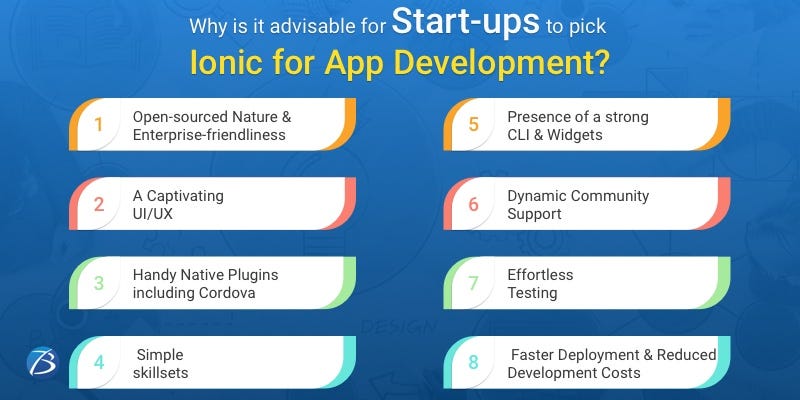
Open-sourced Nature & Enterprise-friendliness

Open-source frameworks are an ideal pick for start-ups owing to budgetary constraints and the core of the Ionic SDK is open-sourced, free, and possesses MIT authorization. As such, Ionic provides several cost-effective app development options. This framework is robust steady, reliable, and supports agile software developmental methodologies. While most of the open-source frameworks are likely to face developmental issues like sudden architectural breakdowns, Ionic is well equipped to tackle such challenges.

The framework is well-maintained and periodically updated by the Ionic team. The Ionic team also promises enterprise-friendly offerings.

A Captivating UI/UX

The UI/UX is a driving factor for an app’s success regardless of whether the app is used for marketing products/services or improving in-house employee productivity. Ionic perfectly meets this requirement as it offers loads of high-end UI elements along with multi-lingual capabilities that lead to the creation of an app with a pleasant and easy-to-use interface. Ionic app developers enjoy access to a wide range of components like themes, paradigms, etc. that help them to create visually attractive apps with a rich UX. Also, the JavaScript and CSS feature offered by Ionic allow developers to customize the app with different kinds of color schemes, menus, cards, and buttons of the app imparting a native-like look to the app.

Handy Native Plugins including Cordova

Plugins are small pieces of code written in JS format that is appended to an application and enable one to carry out tasks like in a native app. This way, plugins enhance the performance of a mobile app. Ionic app developers can access a host of native plugins and APIs to create a native-like UX. Developers can utilize as many as 120 native device features including AUTH, HealthKit, Bluetooth, and Fingerprint.

One of the most crucial plugins available in the Ionic eco-system is the Cordova plugin that allows access to OS features like camera, logs, pro-location, etc.

No need for Specialized Developers

Ionic app development uses popular technologies and programming languages such as HTML, JavaScript, and CSS. Moreover, the base of the Ionic framework is built with the outstanding technology AngularJS and Apache Cordova. So, Ionic app developers can leverage web technologies for building an app and then convert the app into an advanced and fully-functional mobile application. Owing to the use of well-known technologies there isn’t any need for developers to be trained in specific skills or SDKs. Thus, the app owner can save on hiring specialized developers and the app can be developed by regular developers with generic skillsets. That’s why most start-ups hire Ionic app developers for executing their project.

Presence of a strong CLI & Widgets

Ionic offers a built-in CLI (Command-Line-Interface). The CLI is a text-based interface that allows users to activate the “prompt” command to interact with an Ionic app through various commands.

The Ionic framework supports widget creation. Widgets help users to embed the frequently used apps to the home screens of their mobile handsets and the app can be directly triggered from the home screens.

Dynamic Community Support

Start-ups using Ionic enjoy the support of a huge dynamic community. The community lends a helping hand whenever Ionic app developers are struck or have any queries. And, as Angular and Cordova form Ionic’s base, the communities of these two technologies are also quite helpful to Ionic development teams.

A Future-proof App Development Process

Several business enterprises need to act promptly to fulfil their customers’ demands and requirements. But, making any modification, even a minor change, involves extra efforts and added expenses. Hence, companies must choose technologies and frameworks that future-proof the development process. In such scenarios, enterprises that have opted for Ionic app development are able to quickly respond to the modifications demanded by the market, users, or regulatory bodies.

For instance, an enterprise is required to update its branding style or logo. If the enterprise maintains different codebases for three different platforms – an iOS app coded in Swift, an Android app coded in Kotlin, and a web app coded using JS framework – all three codebases need to be updated separately in their respective languages. This is going to be not only time-consuming but also costly. Contrarily, if the company uses Ionic, there’s only one codebase for all three platforms; changes need to be executed on this codebase for updating all the three apps in one go.

Effortless Testing

Ionic offers effortless testing options. Ionic app developers utilize Cordova commands to perform Android app testing on the PC and simulators at the same time. For iOS apps, testing is conducted either on the Safari web browser or a mobile browser. The app can also be directly tested as a native or hybrid app, to gather clearer insights on the app’s functioning. These testing capabilities ensure the creation of a high performant and bug-free app.

Faster Deployment & Reduced Development Costs

Unlike most other frameworks, Ionic doesn’t require specialized developers to create separate codebases for native apps that target the Android and iOS operating systems. Ionic developers need to build a cross-platform app with a single codebase and then customize that codebase to function on Android and iOS. Furthermore, as Ionic involves web technologies and requires widely-practiced skills; it’s quite easy to find the necessary expertise.

On account of fewer codebases, smaller development teams, the availability of robust components & powerful plugins, lesser bugs, and effortless development; Ionic app development is speedy as well as cost-efficient.

Final Words:

Ionic app development is the one-stop solution for modern-day start-ups planning to develop a highly performant app in the least possible time and at a minimal cost. Outsourcing your development project to an experienced Ionic app development company would be a super-convenient option for entrepreneurs as it will reduce their burden to a considerable extent and allow them enough time to oversee core business functions.

Biz4Solutions, a prominent Offshore app development company in India having an industry experience of more than eleven years in Ionic app development would be a wise pick in such cases. We will remain your technology partner right from app ideation to deployment and even offer maintenance & support services post-launch.