Showing posts with label mobile app development services. Show all posts

Sunday, May 1, 2022

Guidance on NFT Creation and Monetization Strategies!

NFTs are cryptographic tokens existing on a Blockchain that can be traded or sold. NFTs involve objects or assets such as music, artwork, trading cards, pictures, tweets, memes, online gaming, virtual real estate, etc. 

This concept came to light in 2014 with the first known NFT transaction: A video clip named Quantum, registered by McCoy on Namecoin Blockchain was sold at $ 4 during a live presentation at New York’s New Museum. However, this concept didn’t attract much public attention until 2017 when the digital gaming brand CryptoKitties successfully sold tradable cat NFTs as a monetization strategy. Gradually, with the rising popularity of cryptocurrency usage, the NFT market picked momentum and by the end of 2020, the NFT market value reached 100 million $.

NFT became a buzzword around the globe ever since the most expensive NFT sale took place in March 2021: “First 5000 Days,” a crypto art by Beeple, was auctioned for 69.3 million USD.  Here’s the example of another multimillion-dollar NFT transaction in 2021: “Bored Ape Yacht Club” raised 26.2 million USD by selling a collection of ten thousand NFTs in the form of cartoon primates that can be used by their owners as profile pictures on social media accounts. The year 2021 witnessed a booming NFT market with countless profitable transactions and the market value shot to 22 billion $.

Several brands, individuals, and enterprises including Yahoo, Star Trek, NYSE, Walmart, Ticketmaster, Elvis Presley, and Panera have been trademarked for NFT. This post guides you on how to create an NFT and monetize it. So, if you too wish to trade your asset/s via NFT, this write-up is a must-read.

But, before we dig deeper, let’s get a clear idea about NFTs & the concept of minting NFTs!

What are NFTs and how do they function?

NFTs or non-fungible tokens are data units stored on Blockchain, a digital decentralized ledger. An NFT refers to a specific digital or physical asset that is virtually traded or sold. NFTs grant ownership of the physical/digital objects by recording it on Blockchain. Here, granting ownership means providing a license to use, copy, or display the asset for a particular purpose.

NFTs work like cryptographic tokens but one cannot mutually interchange them like cryptocurrencies such as Ethereum or Bitcoin. This is because, unlike cryptocurrencies, all NFTs are not the same; each NFT holds a different value if they represent varied assets.

To create an NFT and earn money from it, one needs to mint an NFT.

What do you mean by minting NFTs?

Minting NFTs is the process of creating NFTs on a Blockchain. Here, the digital file gets converted into a crypto collectible. During minting the data is recorded within a public ledger which is tamper-proof & unchangeable. As such, all NFT transactions in the future can be followed and tracked. For minting NFTs, owners have to pay the “gas fees.” However, some platforms do not charge any gas fees from NFT creators; the fee is compensated in the form of additional costs to be paid by the buyer just like VAT or airlines’ fuel charges.

How to Create NFT and Monetize it: Key Steps
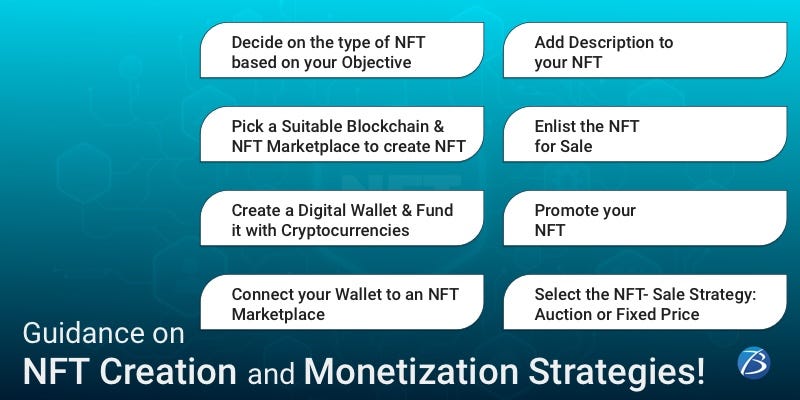
Here are the key steps that should be followed to create an NFT and earn money out of it.

  1. Decide on the type of NFT based on your Objective

Selecting the type of NFT is a very crucial move as it should seem valuable to your target audience and also be profitable for you. Take a look at some of the most popular NFT ideas. Digital works of art have been so far the most profitable NFTs ever created, and this strategy works best for individuals planning to create NFTs.

If you are a business brand selling physical collectibles, it would be a great idea to tokenize those collectibles and sell them in digital format. Digital trading cards and sports cards are good examples of this type of NFT. While physical cards are susceptible to damage, NFT cards will retain their quality forever as they are securely stored on a Blockchain.

NFT-based video games have also proved to be immensely profitable as gamers usually heavily invest in virtual gaming items.

  1. Pick a Suitable Blockchain & NFT Marketplace to create NFT

Blockchain:

You also need to select an apt Blockchain technology to mint your digital asset into an NFT. Select the Blockchain depending on the type of cryptocurrencies owned by your target audience and the transaction charges involved in that Blockchain. The commonest Blockchain used for NFTs is Ethereum; other Blockchains include Smart Chain, Binance, Cosmos, EOS, Polkadot, Tron, Litecoin, and Tezos. For example, Ethereum powers NFT platforms like OpenSea, Rarible, & Mintable; Polkadot empowers Xeno NFT hub; Wax Blockchain empowers AtomicHub; and Tezos powers marketplaces like Bazaar market, Rarible, & one of.

NFT marketplace:

The crypto space offers several NFT marketplaces, and you need to pick the one that suits you best. It has been observed that non-curated platforms are preferred over curated platforms. The reason is that NFT creators using non-curated platforms provide low-cost options – you just have to register yourself and pay the transaction fee needed for minting a token.

Here are the offerings of some of the most popular NFT marketplaces:

OpenSea:

This popular marketplace is used by a huge chunk of NFT traders as it hosts almost every kind of NFT and supports 150+ cryptocurrency payment tokens.  Furthermore, OpenSea offers advanced features and user-friendly experiences to NFT holders enabling them to create effective NFTs speedily. Here, the NFT owners can even group up with other sellers for selling off their NFTs. The platform doesn’t charge any fee for creating an NFT and enlisting it for sale. Creators need to only pay fees for one-time registration and contact approval. Authors are charged a fee when their NFTs are sold.

Rarible

This is another popular marketplace, a self-service platform that is interconnected with OpenSea. The offerings of Rarible are quite similar to those of OpenSea. However, Rarible offers limited formats and smaller-sized artworks. Moreover, Rarible users can mint tokens prior to selling them, while in OpenSea token minting is managed at the time of selling the NFT.

Mintable 

This platform is ideal for novice traders as it is one of the most cost-efficient options for creating and selling NFTs. This platform doesn’t charge any fee for registration, NFT creation, or NFT sales. Free NFT minting services make this marketplace the most viable option for artists who seek zero investment and huge returns. But this platform is not so user-friendly and requires a lengthy registration procedure.

Is it necessary to use a marketplace for NFT Creation?

You need not use an NFT platform if you are technical enough to build a smart contract, choose a Blockchain to deploy it, and use it for minting tokens. You can also hire Blockchain app development services for customized requirements. 

  1. Create a Digital Wallet & Fund it with Cryptocurrencies 

A digital wallet is an app that is used for storing cryptocurrencies as well as buying, selling, or minting NFTs. So, pick a wallet that is compatible with the Blockchain you use for minting your NFT if you are a creator/owner. MetaMask and Coinbase are the most commonly used ones.

Once the digital wallet is created, you need to add some cryptocurrencies for paying the NFT minting fees to the marketplace you’ve chosen. Ether or ETH, Ethereum’s native cryptocurrency, is the most commonly accepted currency in NFT transactions.

  1. Connect your Wallet to an NFT Marketplace

Now, you need to connect your wallet to the NFT marketplace you have chosen. For OpenSea and Rarible, this process is quite easy: you need to click the top left button for connecting the wallet. Then, you can view a list of compatible wallets; you need to select one out of these for continuing the connection process.

If you already have installed the extension of either Coinbase or Metamask, a pop-up will appear asking you to connect to your wallet, and you can connect with a few clicks. For the Coinbase wallet app, you also get the option of connecting with the marketplace using a QR code scanner that is present on the main wallet screen on the right side of your balance amount.

Remember to go for a trusted site instead of an unknown site, to prevent scammers from accessing your NFTs or funds.

  1. Add Description to your NFT

Now, you need to upload the file that needs to be converted into an NFT to the marketplace you have picked. Then add a catchy title and description to your NFT for listing purposes. Once uploaded you need to select whether you wish to mint a single token or an entire collection of NFTs.

Thereafter, you will be asked to decide on the percentage of royalty you would like to claim whenever your asset/artwork is resold in the future. But, this part is a bit tricky. If you set a high percentage of royalty for resale, it may seem profitable but individuals who have purchased your asset might be reluctant to resell it.

The last step involves adding the properties of your file; this step is optional.

  1. Enlist the NFT for Sale

After you are done with filling out the information and you have uploaded your file and minted it, you need to enlist it for sale.  Click on “create item” and then you will get the option to connect your wallet for paying the listing fee.

Once your file gets listed for sale on a particular marketplace, the platform will calculate the “gas fees”. This type of fee refers to the costs incurred by the Ethereum Blockchain network for recording transactions and the amount depends on how busy the platform’s network is. However, if you enlist your NFT during the non-peak hours, the fee will be lesser.

  1. Promote your NFT

After creating an NFT and minting it, owners need to promote it through proper channels for maximizing the chances of success. The promotional platforms & approaches include public relations, online advertisements, crypto podcasts, and social media.

  1. Select the NFT- Sale Strategy: Auction or Fixed Price

 It is important to choose an NFT-Sale strategy: Auction or Fixed Price. The fixed price strategy is simple, straightforward, and transparent – NFT owners mention a specific selling price for their assets.

Setting up an auction is a way more interesting and exciting approach for earning money from an NFT sale! Here, three options are available:

  • Increasing price auction: The price increases and the highest bidder gets to buy the NFT.
  • Timed auction: The bid for each lot is set for a definite time, the interested collectors have to submit the bid within the specified time, and finally, the person who submits the highest bid wins.
  • Decreasing price auction: The NFT price drops till a person buys the NFT.
  • Online auction without a deadline: Interested parties will submit the bid and the owner can close the auction at any time.

NFT Monetizing strategies 

 The various approaches to earning money from an NFT are:

Royalty: 

This is a crucial strategy to earn money from NFTs: the NFT creator can earn passive lifetime royalties after selling their NFT to another individual. For this, the creator must impose terms and conditions stating that royalties need to be paid to them every time the ownership of the NFT changes.

NFT Staking & Renting:

Staking is to lock or deposit an NFT for generating passive income in the form of tokens.

If your NFT is gaining popularity, renting will be a good option to earn money out of your NFTs. Here, a smart contract-empowered deal is sealed between two parties stating certain terms and conditions. The lease amount and the duration of the rental agreement are also fixed by the owner.

Liquidity Pool

This refers to a collection of digital assets locked within a smart contract. This collection can be used as loans, collateral, etc. Moreover, the users of several platforms are rewarded with NFTs that are exchanged with a liquidity pool and the owners can sell their NFT rewards for liquidating their positions within liquidity pools.

Summing Up:

The NFT platform can be leveraged by artists to get digitally recognized and can be used by business brands as a highly effective monetization strategy.  As the trend to collect NFTs is rapidly growing, the number of brands/firms applying for NFT trademarks is also on the rise. The number of NFT-related trademark applications received by the Patent and Trademark Office in the US was just three in 2020; the number rose to 1200 in 2021; 450 applications were received in January 2022.

If you too wish to make money by creating an exceptional NFT for your business brand, reach out to Biz4Solutions, a prominent software firm offering high-end mobile app development services as well as Blockchain-related services to global clientele for the last 12+ years.

Wednesday, June 9, 2021

Best React Native Developer Tools for designing Exceptional Apps in 2021!

Software firms across the globe have the privilege to choose from hundreds of libraries, tools and frameworks; while executing the process of mobile application development. However, despite the availability of innumerable options, React Native by far has become one of the most preferred choices of corporate enterprises and mobile app development companies. The reason behind its popularity is the extensive benefits offered by React Native development! Right from a simple learning curve, code re-usability, cross-platform development, high-speed development, support from a vibrant community, to the creation of native-like applications; this framework has a lot to offer. And, when we talk about its technical offerings, React Native developer tools just can’t be ignored. These tools are some of the most vital elements of React Native App Development Services.

So, this blog is all about the top-notch React Native tools available in the market. These are widely used by almost every React Native app development company out there. So let’s have a glimpse at a few of them.

8 Popular React Native Developer Tools to Know and Use in 2021

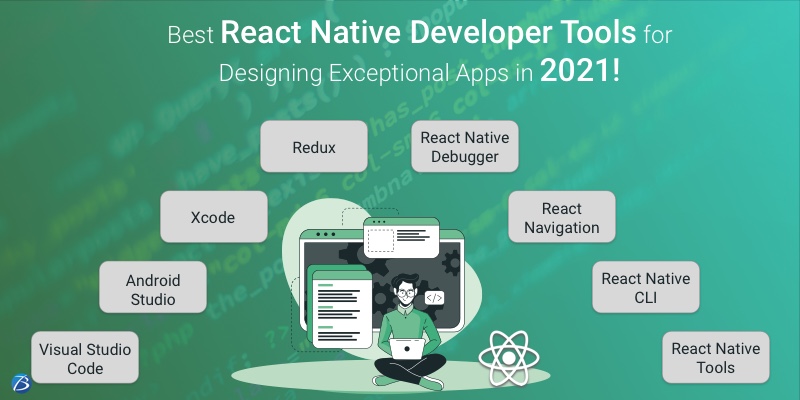
  1. Visual Studio Code

Released in 2015 by the software giant Microsoft, Visual Studio Code is lightweight; yet a robust source-code editor. It is open-source, free to use. and is written in JavaScript, CSS, and TypeScript. It works well with platforms like Windows, Mac, Linux, etc.

Visual Studio Code comes with in-built support for technologies like Node.js, TypeScript, and JavaScript. Besides, it has a huge ecosystem of extensions to support languages like C#, C++, Python, PHP, Java, Go, etc. It also supports runtimes like Unity and .NET.

  1. Android Studio

As the name suggests, this tool enables React Native development for Android. Android Studio 4.1 was the major release. The recent version of Android Studio comes with features like Kotlin DSL support in Android Gradle plugin, newer database inspector, allows running of android emulator inside Android Studio, visual layout editor, faster emulator, APK analyzer, flexible build system, smart code editor, real-time profilers, and much more.

  1. Xcode

Xcode is Apple’s integrated development environment (IDE) that contains several software development tools for building apps in iOS, MacOs, etc. This is a perfect pick for creating powerful React Native apps for iOS. It is also a great tool for debugging and installation of iOS packages. Recently, Xcode 12 was released by Apple which comes with all the more fascinating features like customizable font sizes for the navigator, new document tabs, redesigned organizer, improved code completion, enhanced auto-indentation, etc.

  1. Redux

Written in JavaScript, Redux was developed by Andrew Clark and Dan Abramov and released in the year 2015. It is an open-source tool commonly used with libraries like React, Angular, etc, for developing user interfaces. It is a very small tool whose file size accounts for hardly 2kB including dependencies. It helps in the creation of apps that run in different environments like native platforms, front-end, back-end, etc, and are quite easy to test. Also, it offers features like a time-traveling debugger and live code editing. As a result, it is highly recommended that React Native development services should use this tool for their projects.

  1. React Native Debugger

This tool is like a standalone desktop app that goes well with Windows, macOS, Linux, etc. It is probably the best debugger tool for React Native developers when they are already using Redux. It comes with default React’s Developer Tools and Redux DevTools embedded in it. Also, it is possible to edit the UI and inspect React Native elements using this tool.

  1. React Navigation

React Navigation is written in JavaScript and is quite popular amongst the developer community as it enables them to establish the navigation and routes in the native apps with the help of navigators like Drawer, Tab, Stack, etc. It is an easy-to-use tool that is highly customizable and also provides Extensible Platforms. It is used for developing alluring components for both platforms- Android and iOS.

  1. React Native CLI

Being the official CLI for the React Native framework, React Native CLI is an MIT licensed tool. This tool provides an original method for bootstrapping for creating a React Native app using the command line. This method is required if the React Native developer needs to access the native layer of the app. It is extensively used for the automation of tasks such as starting the packager, linking, creating the apps, etc. It is used as a debugging tool as well sometimes. It supports custom configurations. For instance, it can be used for the installation of React Native project pre-configured with a particular package such as TypeScript or even complete boilerplates.

  1. React Native Tools

It is also a free tool developed by Microsoft but kind of an extension of the Visual Studio Code. This tool provides a supportive environment for developing as well as debugging the React Native projects. It allows debugging styles in React Native and also enables debugging for React components, making it one of the best debugging tools. Besides, it runs the react-native command with the use of a “command palette.”

8 Additional React Native Tools explained in Brief:

  1. Nuclide:Nuclide is a free and open-source tool that is highly customizable and helps React Native developers to make improvements in the code. Its top features include - context view, working sets, remote development, a task runner, quick open, health statistics, a debugger, code diagnostics, etc.
  2. Bit:This tool is quite useful for the creation of advanced React Native component libraries. It resolves issues related to collaborating and sharing UI components across different repositories.
  3. Expo:This is an open-source tool-chain that has its own CLI and offers easy-to-use components and APIs. It also provides several services like accelerometers, real-time updates, fine documentation, powerful community support, etc.
  4. React devtools:Though this tool is more concerned with React and Reactjs, it is also useful for debugging the React Native code. Also, its latest version provides support for inspecting React native styles, live editing, etc.
  5. Vim Editor:This tool comes with a highly configurable text editor and provides a complete set of features for designing React Native apps. It is easy to work with and helps in effectively changing any kind of text.
  6. Sublime Text:This is another amazing text editor that has numerous plugins and functionalities for app development. It also has features like “Goto Anything” for faster navigation to files, lines, symbols, etc. Other goodies that Sublime Text offers are “Command Palette” and support to multiple programming languages and markup languages.
  7. Jest:Developed by Facebook, it is actually a testing framework for JavaScript but also works well with React Native, especially for functions like unit testing. Its features like Built-in code coverage, zero-configuration, and snapshot testing make it a rich tool.
  8. Reduxsauce:This tool is helpful to the developers when they work on Redux codebases and need to create Reducers and Actions in Redux.

Final Words:

The React Native developer tools that we have mentioned in this blog play a significant role in not only building captivating apps but also in accelerating the development process to a great extent. These are some of the finest tools and React Native Developers need to have the fundamental knowledge of at least the ones noted here.

Along with these tools, the knowledge of React Native component libraries is an add-on. For detailed insights on these, please have a look here.

To know more about our other core technologies, refer to links below:

Angular App Development Company

Ionic App Development Company

Blockchain app developers

Tuesday, December 22, 2020

Trending technology stacks of 2020!

The software market is flooded with myriad outstanding technology stacks. However, businesses, particularly those with lesser experience, find it quite challenging to decide on the right technology stack that would prove profitable for them. Typically these businesses are unable to keep up with the pace of technology updates as the older technology stacks that were once ruling the roost are being constantly replaced by emerging new technologies. So, before jump-starting the mobile app development process, it is very important that companies understand the trending technologies that are available in the market, get a thorough knowledge about them and then take the informed decision on which technology to go for.

My write up provides handy insights on the offerings of the trending technology stacks of 2020. Reading this article would prove immensely beneficial to a mobile app development company, mobile app developers, and entrepreneurs planning to develop trendy applications.

The offerings of trending technology stacks of 2020

MEAN stack

MEAN stack is free and one of the most popular stack. This stack uses a single JavaScript language end-to-end.It follows a modern approach to crafting robust and speedy apps. MEAN comprises MongoDB (NoSQL database), Express.js backend web framework, Angular.js frontend framework,and Node.js cross-platform server. It supports MVC pattern and owing to Angular JS it is also mobile-friendly. MEAN proves particularly beneficial for use in calendars, news aggregation sites, mapping, and location-finding, etc.

Advantages

  • MEAN, being an end-to-end JavaScript stack enables Mobile app developers to use a single language throughout the stack. Hence the code can be reused across the whole app, thereby reducing the chances of unnecessary rework.
  • It is an ideal option for creating scalable, flexible, and agile apps on account of the JS module library of Node.js and NoSQL, hence ideal for cloud hosting.
  • It provides developers flexibility in structuring data. This enables effortless switching between the document-based NoSQL and SQL.
  • Deployment of this technology stack becomes easy as it uses its own web server.
  • A mobile app development Company using MEAN can manage by hiring a sole team of JavaScript developers who are capable of working adaptively.
  • MEAN enjoys the support of a vibrant and active community that helps developers with issues and queries.

MERN stack

The MERN stack is similar to MEAN with the difference that React is used in place of Angular.js. React is a powerful library that creates SPAs and high-end applications having interactive interfaces.Moreover, MERN offers full-stack development and is capable of using codes on servers and browsers simultaneously. However, the React eco-system offers limited core features and so developers have to utilize third-party services.

MEVN stack

MEVN stack is another version of the MEAN stack wherein Vue.js is used as the front-end frameworkin place of Angular JS. Vue.js combines the best functionalities of React and Angular; and is has garnered popularity in recent years. Its key offerings are:

  • A rich set of tools
  • An easy learning curve
  • A clear programming style
  • Creation of highly performing web apps.

LAMP stack

LAMP stack happens to be one of the earliest open-source software stacks for building web apps that had stood the test of times and is used extensively even today. Drupal and WordPress are examples of Content Management System Platforms using LAMP.

LAMP comprises Linux, Apache, MySQL, and PHP.

Key highlights

  • Open-source and non-proprietary platform.
  • Components can be chosen as per specific business needs. 
  • An apt platform for building customized web applications owing to its simplicity, stability, and proficiency.
  • Efficient handling of dynamic pages in which the content gets changed each time the page is loaded.
  • Linux can be replaced with (1) Microsoft Windows as the OS to form a WAMP stack or (2) MAC as the OS to form the MAMP stack.
  • PHP can be replaced by Perl or the newbie Python.

Ruby on Rails stack

Ruby on Rails stack is a rich archive of open source tools and library integrations that boost the app development speed. RoR enables you to architect complete web apps by integrating JavaScript, CSS, HTML, AND Ruby. Writing the code and debugging it becomes simpler and quicker with RoR. Check here for the role of RoR in web app development.  The frameworks and tools used in the Ruby on Rails stack are JavaScript, CoffeeScript, Bootstrap, jQuery, HTML, CSS, Redis, Node.js, Middleware, MongoDB, and JVM. One of the most popular app Airbnb has been developed using this stack.

Serverless stack

Going serverless ie. building apps on the cloud infrastructure is the latest mantra. The services and tools offered by Serverless computing platforms ease-out infrastructure management and scaling. AWS Lambda is an example of one of the earliest serverless platforms. Google Cloud is another popular provider of cloud computing.

Flutter for Web

Flutter for Web is a revolutionary cross-platform framework, that employs the same business logic and UI on every platform. Usage of Flutter allows one to add new functionalities, create interfaces, and fix bugs without spending time on deployment. Check here to know more about Flutter for the web.

.Net stack

.Net stack facilitates the creation of a bug-free framework decked up with rich features that lead to the creation of interactive and robust web apps. It is interoperable, language-independent, speedy, secure, and portable. However, this tech stack lacks multi-platform support, easy migration, and efficient code management.

Final Verdict

I hope this article has provided you comprehensive knowledge about these prevalent technology stacks and will help you to choose the right one for your up-coming project. We will give more insights into other technology stacks in the next version of our article.

For expert guidance and technical assistance reach out to Biz4Solutions, a prominent mobile app development company at sales.enquiry@biz4solutions.com.

To know more about our other technologies, refer to the links below:

React Native App Development Company

Angular App Development Company

Ionic App Development Company

Monday, May 11, 2020

Critical App Development Mistakes that Could Ruin Your App


Nowadays, mobile apps have become goldmines for businesses. Haven’t they?

Whether interacting with potential and active customers or promotion of products/services or revenue generation through sales and marketing! Everything is effectively possible using a dedicated and customized mobile app.

Consequently, enterprises- small or big- are largely using the mobile technology to meet their business goals. No wonder why so many mobile app development services are popping up across the globe at a fast pace.

Moreover, hundreds of new mobile apps are getting launched in the market regularly. But why just a few are loved by the users?

Before we dive deeper into it, let us understand the app development process. It is a time and money intensive process involving budget management, choosing the right technology, handling the team of analysts, developers, testers, etc., designing a marketing strategy, etc. The companies need to think carefully about every step while keeping in mind the purpose of the app, its advantages to the users, its scope of improvement in the future, etc. But, even a few mistakes during the app development can ruin the app and cost a fortune.

So, how does a company ensure that its app is an outstanding one that outwits others?

One of the best ways is by avoiding the common mistakes a mobile application development company makes. So, let us have a glimpse of them in detail.

Top Mobile App Development Mistakes that a Company must avoid

Not doing enough Market Research
Research is the key step in the success of an app. It is imperative to do thorough research on elements like:

·         Need of the App in the Market
·         Competitor Analysis
·         Analysis of Target Audience and Potential Customers
·         Latest Trends
·         Brand Posting
·         SWOT Analysis

Google research isn’t enough. The companies should conduct surveys or even consult experts before starting the development. It will help determine the right track to an impeccable app and also help your Unique Selling Proposition (USP) to hit the right place. Market research will help you know how your buyer’s persona and the USP will go hand-in-hand to develop the perfect app for your target audience. Excluding market research will be the biggest mistake a company can make.

Developing an app for Many Platforms at a Time
It is highly tempting to reach a large number of users in one go and you may attempt to build your app for multiple platforms. However, without knowing the customer response, you may not be able to do justice to your app and the hard work your team does. You may release the app on one platform, get the customer feedback and imply the changes accordingly and then release the app on other platforms. Building the app for several platforms will take a longer time and involve more money as well.

Designing a Poor UI
The user interface design forms the first impression on the users. A good mobile app must always be backed by a great UI. It should have decent color combinations of the pages. The symbols, font size, buttons, icons, etc. should be placed correctly. This will make the app look attractive, help the users navigate through the app with ease and thus enhance the customer satisfaction. However, a bad user experience can do the exact opposite and ultimately affect the revenue generation. 

Integrating Irrelevant or Too Many Features
Features are crucial to make an app useful and attractive to the users. However, some companies may complicate the app by adding unnecessary features. Bad features or too many features will confuse and annoy the users. It can force the user to kill the app faster because of unconnected features. So, make sure to only include the features which meet your business objective and are relevant to the users. Developing an MVP i.e. the minimum viable product is a wise decision so that you can add the features after testing the scope of the app in the market.

Creating an App that Uses a Lot of Space
Mobile phones have a limited storage capability and these limitations must be considered during the app development process. Developing an app that consumes a lot of space can be one of the worst mistakes. Users in the first place may not install such bulky apps looking at the size or such apps can be uninstalled by users without a second thought. To ensure that the app is of smaller size, optimize the web assets, reduce unnecessary code, reuse resources, breakdown the APK, Compress PNG and JPEG files, etc.

Inadequate Testing
Testing the mobile app holds pivotal importance in the complete app development process. A dedicated team of quality analysts must evaluate the work done by developers. They should test the app from various perspectives and fix all the bugs before its release. Rushing through this phase can cause a blunder leading to a failed product.

Not Designing a Good Market Strategy
Have you designed a good marketing strategy?
How will your target audience know that your app exists?
Will your app reach maximum user retention?
Well, all the app development efforts can go in vain if a good marketing strategy is not in place. A sound marketing strategy will lead to the broad awareness of the app, ensure more downloads, avoid future uncertainties, and promote the app successfully.

Neglecting the Updates
Releasing the app in the market is not the end. To ensure that the app reaches the heights of success, it is essential to continually meet the customers’ expectations. It must be updated from time-to-time to increase its life span. One must collect the user-feedback and accordingly work on improving the app performance and features. These improvements must be released in the market in a timely manner through the updates.

Wrap-up:
Designing and developing a mobile app is not an easy job. An in-depth understanding of the business, the sound experience of app development and best testing practices are necessary to develop a flawless app. Along with that, whether you are developing the app yourself or hiring a mobile application development company, you should not ignore the above-mentioned parameters.

Do you want to hire app developers  for developing your dream app? Or do you want to outsource the mobile app development services? Biz4Solutionscan partner with you and develop a world-class mobile app. Contact us now!