Tuesday, August 24, 2021

An Overview: Architecting a Feature-rich On-demand Delivery App!

The on-demand market has emerged to be a fiercely competitive market in recent years. Almost all existing industrial domains, whether food, grocery, health, and medicines, education, entertainment industry, home service, transportation, or even freelancing jobs, have been captured by the on-demand economy in a very short period of time.

You would be amazed to know that the on-demand economy in the year 2016-17 accounted for 14 billion USD for just the transportation sector in the US alone. This report by a renowned portal- Statista, aptly proves the potential of the on-demand sector.

Also, as stated by a PWC report, by the year 2025, the on-demand apps and websites market will cross the revenue of $ 335 billion.

These numbers depict how massive the future scope of this industry is. So, it is essential for budding entrepreneurs and start-up companies, and even the big players in the corporate world to have knowledge of this economy. And this article is a brief guide on this topic- on-demand app development. Here we will be covering details like on-demand app benefits, their types, features, working, etc. Please read ahead to know more.

Top-notch Benefits of the On-demand Apps

  • Unlimited business opportunities in diverse domains
  • Scalability and security
  • Cashless payment facility
  • Ease of ordering the products or services for customers
  • Real-time tracking
  • One-click cancellation of orders
  • Enhancement of customer service
  • Reports and analytics of users’ activities
  • Measurable online presence

Step-wise Workflow of the On-demand Apps

All varieties of on-demand delivery applications have similar work principles. Here are the fundamental steps that explain the working of such apps.

  1. Registration- Firstly, the consumers, as well as the service providers, need to sign up using either their mobile number or social media accounts, or other available options.
  2. Inquiry or Order Placement- Next, a consumer searches for the required products or services and then, places his/her inquiry or order on the app.
  3. Acceptance/Denial of Request- Then the service provider accepts or denies the order. Usually, denial happens in rare cases when there occur some internal or technical issues. Once the order is accepted, the service provider can approve it for further processing.
  4. Payment- Payment delivery depends completely on the consumer’s wish. Some consumers may make online payments in advance and in some cases, they may opt for cash-on-delivery after the order is completed.
  5. Order Tracking- Next, the consumers, as well as the service providers, can track the order in real-time using the on-demand app. During this stage, the consumers can connect with the service providers if required. They may even cancel the order if they want.
  6. Final Delivery- Finally, when the product gets delivered to the consumers, the process is complete. After this, the consumers may drop reviews on the app, but this is optional.

Basic Types of On-Demand Service Apps

Consumer to Consumer (C2C): This kind of on-demand mobile app is an interface between the local service providers and end-users or consumers. Examples of these types of apps include Airbnb, Tinder, and even some ride-sharing apps.

Business to Consumer (B2C): This type of business model connects the consumers directly with the businesses. These apps are usually created by individual businesses, for instance, a restaurant creating a food delivery app for its consumers, or a pharmacy creating a drug-delivery app for its customers.

Business to Business (B2B): In this type of application, one business enterprise sells its products or services to other businesses or enterprises. Walmart is an apt example of this category. It has its own on-demand app for tracking and managing its products while dealing with other businesses.

Tech-stack used for creating Futuristic On-demand Applications

For creating an impactful app, it is vital to use an advanced tech stack. The on-demand app developers and the concerned team should be equipped with some of the core technologies like the below:

Frameworks: Angular, React Native, React, jQuery, Bootstrap, Node.js, Ionic

Programming Languages: Java, Swift, Laravel, PHP, Kotlin, JavaScript, Flutter, HTML5, CSS3

Database: MySQL, MongoDB, PostgreSQL

Hosting Platform: AWS

Web Server: Apache HTTP Server

Utilities: Microsoft Azure, Cloudflare

Analytics: Google Analytics

Payment Gateway: Stripe, PayPal

Push Notifications and SMS Integration: Twilio

Must-have Features of the On-Demand Mobile Applications

For Consumer App

  • User profile for the customers to register and sign in
  • Searching products/services and booking orders
  • Push notifications and alerts of their orders, latest offers, discounts, etc.
  • GPS for live tracking of orders
  • Secure and flexible payment models like credit cards, debit cards, wallets, cash, etc.
  • Order history to check previous orders, refund data, etc.
  • Reviews, ratings, and feedback
  • Customer support

For Service Provider App

  • Profile creation for the service providers to easily register and sign in
  • Accepting and declining requests within a stipulated time
  • Alert messages and push notifications
  • Choosing online or offline status for showing their availability for any service
  • Payment module for having a record of their earnings
  • Chatting feature to communicate with customers
  • Special panel for vendors or service providers for managing their riders, staff, services, end-users, billing, etc.
  • Informative dashboard for viewing service histories, performance, earnings, losses, and related statistics

For Admin App

  • Interactive admin dashboard
  • Panel for customer management- customer information management, order cancellation, payment management, discounts, etc.
  • Panel for management of service providers- managing the listing of earnings, penalties, coupon codes, discount offers, etc.
  • Information of pricing and commissions
  • Real-time service tracking
  • Tracking analytics and reports for business decision-making

Procedure to Fabricate a Full-fledged On-Demand Delivery App

Determining Business Goals and Target Audience

Before starting with the technical part of the app development process, it is necessary to decide on the purpose of the project, the end goals, and the details of your target audience. For this, research about your competitors, get data from online surveys, and get ideas from similar apps in the market.

Creating a Checklist for Executing the Development Plan

The next step is to prepare a checklist for your development team to ease out the execution of the project. This checklist should include the following:

  • Products or services to add to the app, their availability, details of catalog, etc.
  • Feature list as required
  • Confirmation of order requirement from the customer point of view
  • Details of integration
  • Third-party suppliers
  • Costs of products/services
  • Deadline of project completion

Preparing a Business Checklist of Vital Project Considerations

What type of application software do you want to develop? A flower delivery app? A travel on-demand app? Or what else? Also, what features do you want to integrate into the app? Are there any other considerations? Ask these questions to yourself and create a checklist accordingly; the checklist may include:

  • Customer support service
  • Logistics and suppliers
  • Merchant data
  • Flexible hours
  • Delivery charges
  • Discounts and offers
  • Any legal authorities and standards to abide by
  • Security considerations

Hiring the Right App Development Partner

Now you are set to begin with the technical responsibilities. So, it is time to hire your technical partner i.e. the apt app development firm, if you do not have an in-house team. This partner must have the proven experience, skills, and expertise to develop a modern-day on-demand application. So, perform thorough research and hire a dedicated team.

UI/UX Design and Technical Considerations

Discuss your concept with your designers and developers for them to create a wire-frame of the project. Also discuss with them all the technical aspects of the project like programming languages to be used, app platforms, etc. before beginning with the project development.

Creation of MVP or a Full-fledged App

It is always a better idea to develop an MVP i.e. a Minimum Viable Product because it helps to test your app idea in the market and gain early customers on low budgets. Creating an MVP is comparatively a low-risk idea. But, if you have the flexibility of time and money, you may opt for a full-fledged app as well.

App Development

Once you have decided on whether to develop an MVP app or a feature-rich on-demand app, it is time to begin with the development process. Make sure that your team follows agile development techniques for an organized approach and optimum output.

Testing and Launching the App

Test the app at every stage of development and also after the development process is completed. The quality analysts should get all the bugs and errors fixed to ensure successful project delivery and also make sure that the app offers the best possible user experience. Finally, launch the app on the respective platforms.

Concluding Words:

On-demand apps are flourishing more than ever and they are surely going to be the next big thing in the mobility world. Moreover, the pandemic situation due to the outbreak of coronavirus has given rise to numerous on-demand platforms in almost every business sector. So, undoubtedly, there is tremendous scope for new on-demand ideas and apps.

To know more about our core technologies, refer to links below:

Java App Development

.Net App Development

Node.js App Development

Friday, August 20, 2021

Onshore, Nearshore, and Offshore Software Development: A Comparative Study of the Advantages and Downsides!

Today, a major chunk of IT firms prefer outsourcing their software projects to skilled professionals or a dedicated development team. Outsourcing refers to the process of hiring a vendor agency for executing the process of product development. Herein, the vendor provides the client firm with the necessary resources including proficient developers, a project plan as well as the necessary technological tools. 

Business enterprises choose to outsource owing to the following reasons.

  • The lack of adequate financial resources, scalability, and flexibility
  • A dearth of in-house expertise and the requirement for specific skills
  • The increasing demand for uninterrupted services and the urgency to enhance productivity

Outsourcing undoubtedly helps a company to reduce their operational costs, enhance product quality, access a huge pool of talent, and enable a firm to concentrate on core competencies. However, to reap the benefits of this strategy, one must pick the right one amongst several lucrative outsourcing models available.

This post compares the pros and cons of the most popular outsourcing models and will help you to select the best-suited outsourcing model based on your project/business requirements.

Prominent Outsourcing Models: An Overview

The three most prominent outsourcing models are - offshore software development, onshore software development, and nearshore software development. Check them out!

Onshore Outsourcing: Under this model, companies outsource product development tasks to service providers based in the same country.

Nearshore Outsourcing: This model involves outsourcing projects to countries that lie in close proximity with similar or minimal time zone differences. For instance, a nearshore location for a US-based firm looking to outsource would be either Mexico or any of the South American nations.

Offshore Outsourcing: This model indicates outsourcing projects to countries that are located far away with substantial time zone differences. To cite an example, an offshore software development agency in India or other South Asian countries would be the ideal offshore location for a U.S. firm seeking outsourcing services.

Comparing the Advantages and Downsides of Various Outsourcing Models

Onshore Outsourcing

Advantages

Since the client and their technology partners are located in the same country, there are no chances of encountering barriers concerning language, culture, or time zone differences; resulting in an easy, speedy, and comfortable communication process. Moreover, this approach enables the client firm to closely monitor the product creation process in real-time, makes it easy to touch base with the development team, and allows them to apply new changes quickly.

Downsides

The onshore model incurs huge expenses and turns out to be way more expensive as compared to offshore and nearshore models. Furthermore, the range of services offered by an onshore development agency is narrower because of the lesser talent pool available, leaving the client firm with much lesser choices.

Nearshore Outsourcing

Advantages

Nearshoring promises geographical proximity and minimal time-zone differences between the client and the vendor agency. Therefore, it allows better communication with the vendor and more convenience and flexibility in controlling the development process; in comparison to the offshoring approach. Besides, despite the presence of some cultural differences, these are not significant enough to affect the project’s functioning.

In comparison to the onshore model, nearshoring involves lesser labor costs and greater access to development expertise.

Downsides

Nearshore development may involve risks concerning Patent and Copyright violations on account of different copyright rules followed by the country in which your vendor is located. Furthermore, clients nearshoring a project have to incur more expenses than the clients who choose to offshore their project.

Offshore Outsourcing

Hiring an offshore software developer for IT projects is the most preferred and trending practice as client enterprises can reap the benefits of premium quality software development services at budget-friendly rates. Given below are the benefits and drawbacks of this approach.

Advantages

  • Cost reduction: The most popular outsourcing pools are concentrated in locations with lower hourly rates for developers. This allows you to reduce project costs to a great extent and hence provides significant savings for long-term as well as short-term collaborations.
  • Access to better skillsets: Clients can access a humongous talent pool, harness the potential of a wider range of skillsets, and also hire experienced, specialized, and trained developers who are capable of architecting top-quality software products from scratch.
  • Effortless scalability: Software development happens to be quite tricky as it’s difficult to predict the exact resource requirement prior to the commencement of the project. Offshoring resolves this issue by allowing the clients to easily scale their development team up or down as per the need. Remember that it’s way more convenient to add extra developers to your offshore development team instead of appointing new employees for your in-house team.
  • Reduced time-to-market: The client company saves time as hassle-prone responsibilities like hiring and training employees passes on to the vendor agency.
  • Adherence to deadlines: The right Offshore vendor firm will ensure the creation of a top-notch product and maintaining strict product delivery deadlines at the same time.
  • Gain innovative opinion: Companies working with offshore development teams will benefit from the innovative opinions of offshore professionals for obtaining another vision to enhance the final product.

Downsides

  • Communication woes: Communication woes are likely to crop up due to differences in time zones and language barriers. Moreover, it may not be always feasible to visit the offshore production site. However, this issue can be resolved by streamlining the communication procedure using advanced technologies.
  • Cultural differences: The work culture of an offshore team may be different and in such cases, adjustments are needed from both sides.

Advice on Choosing the Most Befitting Option

The most befitting outsourcing model entirely depends upon your priorities and the specific needs of the project. So, you need to ponder; “Which of the following are you looking for – The best price, highly proficient developers, more security, the least amount of hassles, or a uniform blend of all of these aspects?”

Onshoring allows you convenience but involves high expenses. Contrarily, offshoring allows you to leverage skilled development services at lower costs, but the time-zone differences may create roadblocks at times. Nearshoring, on the other hand, perfectly balances the advantages of offshoring and onshoring. However, the offshore model happens to be the most popular outsourcing option.

Final Verdict:

Outsourcing, particularly the offshore model, has turned out to be immensely profitable for several start-ups as well as the big market players. Thanks to innovative technologies for digitally connecting the entire world regardless of cultural and time differences, the strategy of hiring an Offshore Software Development services Company for executing software development projects, has ushered in unprecedented gains and provided a competitive edge to client firms.

In case you require assistance in picking the right outsourcing agency, contact Biz4Solutions, a prominent Offshore Software Development firm and reliable technology partner!

To know more about our core technologies, refer to links below:

Swift App Development Company

.Net App Development Company

Java App Development Company

Tuesday, August 17, 2021

Medical APIs and their Significance in Revolutionizing the Healthcare Sector!

Did you know that before EHRs i.e. electronic health record systems came into the picture, interoperability of the medical information was carried out using fax machines and phone calls? But today, there are various EHRs used by healthcare facilities to cope up with this challenge. For instance, one EHR is in the office, another in the hospital, another in some other branch, or Sr. specialist in the hospital may be using another one. The principal drawback of the old method is that the crucial patient data is mostly fragmented and spread across several chambers. However, to deliver the best possible patient experience, it is of immense importance to have all the records in one place so that the complete picture of the patient’s health conditions and past treatment is easily available.

In regards to this issue, the experts in the healthcare industry realized that there is a need for more robust interoperability standards and medical APIs can be an apt solution for this. These APIs can facilitate data exchange and its processing between numerous systems in medical firms.

So, this article will take you through what are APIs in healthcare, how they are used in healthcare software applications, and how they benefit healthcare app development firms. Let’s commence.

What are Medical or Healthcare APIs and their Potential Benefits?

APIs i.e. Application Programming Interfaces are a set of protocols and definitions that helps a software system to communicate with other services and products without knowing how it is implemented. Likewise, medical APIs can be integrated within a medical software for elevating the effectiveness and the overall efficiency of that product. It helps the data systems like EHRs communicate seamlessly and transfer the medical information between each other and thus, improve interoperability.

What else does a Medical API do?

  • It helps to provide collective medical information required for creating reports.
  • It ensures that a software system receives or sends the medical data and automatically updates the patient information in the system.
  • It enables accessing and storage of medical information in a secure manner.
  • It allows the healthcare app developers to integrate the medical applications with specific devices and even the entire ecosystem. The developers can utilize predesigned API integration features and tools during the app development.
  • APIs help the doctors easily find the complete patient history in one place for providing the most appropriate treatment; thus facilitating medical decision-making.
  • Patients too can benefit from these APIs. They can access and provide their medical records to a new organization for diagnosis and treatment, without making any unnecessary calls to receptionists or so. Thus, they can have better control over their health information.
  • These APIs enhance international collaboration of the medical data for facilitating research. This helps the scientists and researchers study different cases and discover advanced therapies for chronic or genetic health conditions.
  • Furthermore, a medical API can be employed by a host of service providers for managing staff requirements, reducing paperwork, eliminating errors, and thus, elevating the overall efficiency of the healthcare sector.

These were the key benefits of medical APIs. These APIs prove beneficial to numerous parties like individual clinics, large healthcare bodies, medical app development companies, health clubs, other medical service providers, drug developers, patients i.e. end-consumers, pharmacies, health payers, transaction services, and even the concerned government agencies.

Now, let me take you through several types of medical APIs being used in the industry.

Types of Medical or Healthcare APIs

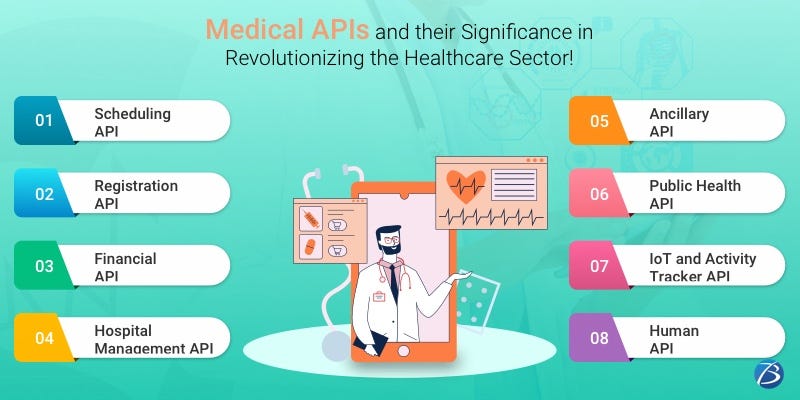
Scheduling API

The appointment scheduling feature is one of the most liked, rather mandatory features of the new-age medical apps. Scheduling API comes with features meant for incorporating the appointment booking feature, cancelling or rescheduling appointments, sending reminders, synchronizing the available slots with the calendar, etc. in the medical apps or software systems.

Registration API

These APIs are utilized for handling the functions related to registration processes involved with various EMR/EHR systems. These APIs can be embedded with EMRs for exchanging patient-specific data. Both patients and physicians will be able to easily register using the Registration API.

Financial API

As the name suggests, this API is used for managing money transactions between patients, medical institutions, pharmacies, or insurance agencies. It helps to generate invoices and bills, send prescriptions, and also manage claims related to insurance. It can further be narrowed down as claims API or billing API, depending on the functions it is used for. However, the healthcare app development firms must make sure that they choose the financial API that has robust security features.

Hospital Management API

This API is purposed to managing clinical data exchanges and other related operations within a medical facility. This API helps in sending and receiving medical information from various units as and when required. This information covers patient records, immunizations, treatment plans, family medical history, etc. Clinical API is another API used for performing similar kinds of tasks.

Ancillary API

There are several processes in a medical facility that lie outside of the organization; for instance, pharmacies, laboratories, radiology units, etc. Using the Ancillary API, the concerned healthcare professional can communicate with these external units, refill the requests with them, and also gather the required data from them. A good example of this is when a hospital wants to exchange some medical information like prescriptions with external pharmacies and refill requests. Ancillary API can be helpful in this scenario.

Public Health API

Such APIs are utilized for exchanging reportable clinical data records with the professional, public, or federal registries, and also with research institutions. Public Health APIs can also be employed for gathering public health records in the scenario of a rampant widespread threat like the ongoing Coronavirus Pandemic. Due to their ability to easily exchange data, these APIs can also be utilized for public health surveillance from data systems like EHRs.

IoT and Activity Tracker API

Wearable Health apps use these APIs for data collection from several IoT-enabled devices like activity trackers, wearable devices, etc. Such data streams help in the monitoring and management of personal health, especially for fitness enthusiasts.

Human API

This API is usually employed by doctors and physicians for viewing test results, prescriptions, patient profiles, and similar other important records. This helps the doctors to access the medical data easily, save time and money, and refrain the patients from longer wait times during appointments.

Some API Challenges

Though APIs have resolved the interoperability issues to a great extent, there are still a few technological gaps.

Since there is a lack of data standards in the healthcare sector, it is essential to create customized APIs that aptly caters to the needs of the concerned service.

In case a system incorporates myriad APIs, then data transformation into a readable format could take several months or even years.

Furthermore, when there are multiple APIs in a system, it can become tedious to manage those APIs, especially when the systems need to be replaced or upgraded.

Testing of these APIs could pose another challenge because healthcare systems usually deal with complex data; which at times, may not be replicated in the testing environments.

There could also be challenges in the privacy and security of the medical data and so, the APIs must be developed to provide safe data storage and exchange, using technologies like Blockchain, encrypted protocols usage, advanced authentication, etc.

Experts have also predicted that there could be some financial concerns, lack of proper documentation, lack of tools for designing, testing, etc.

The Future Scope of Medical APIs and Interoperability

Though there are several challenges coming up, medical APIs are going to be the key when it comes to interoperability and data security. Needless to say, medical APIs have a bright future. Besides, the data exchange laws of the 21st Century Cures Act, are supportive of these APIs. They encourage the proliferation and standardization of these APIs. So, it is expected that healthcare APIs will expand and develop to deliver the best possible services to patients as well as service providers. 

Final Words:

It's evident that medical APIs can boost the communication, overall performance, and efficiency of healthcare organizations. It is expected that these APIs in healthcare will expand to enhance the patient experience, connect healthcare providers to complete data, enable the patients to easily and safely access their medical records, etc. and thus, be advantageous to every medical & healthcare application development company competing to deliver the best services. So, medical APIs are the future of this sector.

With this, I would like to wrap up my article. Do share your views and experiences about the medical APIs in the comments below.

To know more about our core technologies, refer to links below:

WordPress App Development

Node.JS App Development

Flutter App Development

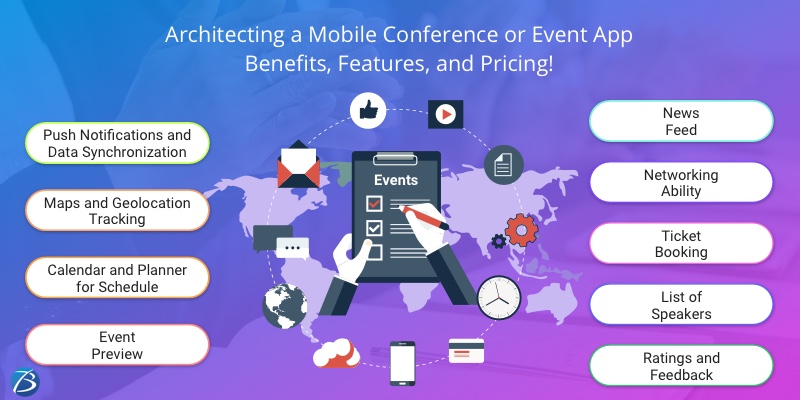
Architecting a Mobile Conference or Event App: Benefits, Features, and Pricing!

As per a study, 37% of event planners make use of mobile event apps for event-related tasks. This is a sign of the rising demand for mobile conferences or event apps for organizing the events. Whether private meetings or large conferences, these mobile event applications are transforming this event planning sector at a fast pace.

So in this blog, we will have a glimpse at several aspects like vital features of the event apps, and their pricing. But before that, we will have a quick look at the key reasons behind the popularity of these apps. Let’s begin.

Significance of Event Planning App Development

  • One App for Multiple Events: A single branded event application can be utilized for organizing a host of events. It can become a trusted channel for the event planners, their staff, and all attendees.
  • Simple and inexpensive way to gather and deliver information: An unlimited amount of event-related information can be easily added to the app. This information can also be edited and immediately conveyed to the attendees through the app.
  • Enhanced Engagement and Interaction: A feature-packed event app comes with features and functionalities that enable high-quality meetings, better interaction, engaging activities, etc. Besides, conducting surveys, questionnaires, asking for ratings, generating reports, etc. is possible with such an app and this boosts user engagement.
  • Advanced Planning: The app acts as a smart resource for proper planning of events and streamlining the event hosting. It helps to efficiently implement the best-known project management practices.
  • Better Networking Capabilities: An event management app offers a great opportunity for attendees to build a strong network in their arena.
  • Creating New Revenue Streams: Event apps help to open up new opportunities for growing partnerships with sponsors and creating additional revenue streams as well.

Top-grade Features of the Best Conference or Mobile Event Apps!

Push Notifications and Data Synchronization

Like other apps, push notifications are one of the most useful features available in the event apps too. These notifications help in informing the attendees of the event details well in advance and also remind them a day before the events. Besides, the data synchronization with the server, it enables informing the attendees regarding any modifications in the event program, time, schedule, location, etc. in real-time.

Maps and Geolocation Tracking

This feature helps the attendees to aptly reach the location of the event.

Besides marking the event location in the integrated map, you can also do the following:

  • Employ live directions for assisting the participants in real-time.
  • In case the event is held over a larger area, build an inner map in the event app with different points of interest.
  • Also, try making the geo-location feature work offline for the attendees to use the app navigation even during unstable network connections.

Calendar and Planner for Schedule

It is of utmost importance to display the details of the event program in the calendar and add them to the schedule. This feature is immensely important for users to remain informed of the event. Also, the planner i.e. customizable notification system will ensure that the users won’t miss any program.

Event Preview

Several people will decide on whether or not to attend the event based on the final preview of the event. So, the event preview should include some interesting content that resonates with the target audience and allures them to participate.

News Feed

The basic purpose of every mobile event or conference app is to inform and entertain its audience and ‘News Feed’ can help to do this well. It also helps to keep the users of the app updated with the latest news or modifications about the events or other important announcements. Besides, this feature enables the organizers to share event photos, videos, interviews, ads, etc. for keeping the users excited about the event.

Networking Ability

Most of the time, the attendees are looking for developing networks through an event, especially corporate events. Rather, networking and building contacts are some of the major reasons why professionals attend events. So, the app must allow the attendees to freely connect, chat and share content with others. At the same time, make sure that spam or unnecessary sales pitches are avoided.  

Ticket Booking

This is a powerful feature that can be used for better event planning for participants and monetization purposes as well. The in-built ticket booking feature of the event app saves the participants from the efforts like finding tickets from other sites or offline locations, printing tickets, payments, etc. All this can be done easily through the app.

List of Speakers

For a mobile conference app, it is a must to add a list of speakers, especially when the events are corporate and could include open-air lectures or so. Technically speaking, integrating this feature is not much difficult. A single-screen needs to be added that has the speakers’ details, photo elements, text, social media links, etc.

Ratings and Feedback

Reviews, ratings, and real-time feedback by the attendees are essential for every budding event planner or event app owner. It helps to get insights for improvement of the app as well as particular events that were organized using the app. By using this feature, the participants can chat in real-time with the speakers or experts in the events and rate them too.

Event App Development Cost Considerations

Architecting an impactful event app is no easy task. It depends on a plethora of factors like types and numbers of features to be integrated into the app, location of the development firm, experience of event app developers, app platform, API integrations, app security measures, UI/UX design, devices that the app supports, usage of smartphone hardware, support and maintenance requirements, and much more.

However, here are a few aspects based on which you will be able to get a rough idea about the event app development pricing.

  • Companies offering Event app development services can take 8-10 weeks for creating a good event management app.
  • The hourly rate of developers can range from $20 to $50 or more, depending on the location and reputation of the offshore software company.
  • A simple event app can cost anywhere from $20,000 to $40,000. An app with medium complexity can cost from $40,000 to $60,000 and a full-fledged app with complex features can cost $ 60,000 and above.
  • Additional costs can be incurred for features that are related to attendee engagement, brand awareness, etc.

But every project has individual specifications and requirements. So, if you want to get an exact estimate for your mobile conference app project, get in touch with Biz4Solutions, we will provide you the estimates within 48 hrs.

Final Thoughts

Mobile technologies have advanced to their best capacity and have disrupted the event management industry in myriad ways. Mobile event apps or conference apps have become a must-have for modern-day event professionals. But without the right set of engaging features, these apps cannot provide better attendee engagement, real-time insights of events, and thus, increased business. So, in this blog, we have made an effort to list down those features, with event app benefits and also explained the event app development cost considerations.

Hope this blog helps in making important decisions in your event planning app development journey.

For any further assistance on this topic, comment below or drop us a mail.

Friday, August 13, 2021

Handy Tips on Choosing the most Effective Hospital Management System (HMS)!


Present-day patients expect services like receiving reminders via email/text messages, accessing their electronic health records whenever needed, and availing of online video doctor consultations from their medical consultants and physicians. Practitioners too, prefer advanced and smart Healthcare management software solutions for easing out their workload. Therefore, it has become necessary for hospital bodies to revamp their traditional infrastructure and implement a technology-infused approach. And, what can be a better option than employing a comprehensive HMS (Hospital Management System)?

A digitally smart HMS has been garnering popularity in the healthcare industry for the last few years. However, for receiving optimum benefits, it’s crucial to employ the right HMS that perfectly aligns with the requirements of your medical facility. So, while selecting the vendor agency that offers Healthcare Development Services, there are certain factors to consider and some standard practices to follow. My write-up provides all-inclusive guidance on how to pick the right HMS (Hospital Management System) for your healthcare facility. But, before we delve deeper, let me provide you useful pieces of information on HMS and its benefits.

Hospital Management System: Overview

A Hospital Management System, commonly known as HMS, refers to an app or a software system that is employed for gathering and digitally storing patient data and keeping the diverse departments of a healthcare facility connected on a common platform. An HMS offers several modules like Patient management system software, Doctor Management System, Online Appointment Management System, Lab Test System, Invoice Management System, Administrative Rights Management System, Drug Management System, etc.

An HMS executes the following functions.

  • Assists in tracking, planning, and carrying out daily activities in a healthcare organization
  • Minimizes management burdens through automation of processes and the availability of information to all stakeholders
  • Manages the entire lifecycle of patients’ treatment starting from their hospital admission till their discharge.
  • Records medical data, stores medical reports, generates e-prescriptions, processes bills, maintains patients’ contact details, tracks appointment schedules, saves insurance information for future reference, etc.

Hospital Management System: Benefits

Take a look at the key benefits ushered in by an HMS.

  • Provides easy access to patients’ healthcare data as well as the accurate medical history of patients
  • Minimizes chances of errors and enhances the efficiency of medical practices resulting in improved patient care
  • Ensures security of sensitive data and retrieval of data whenever required
  • Saves time and turns out to be cost-efficient
  • Reduces the documentation workload
  • Exercises better audit control and compliance to healthcare policies
  • Ensures better revenue management and accountability for hospital bodies

Picking the Right HMS (Hospital Management System): Best Practices

Identifying the Requirements

It is crucial to identify the specific requirements based on the workflow of your healthcare facility before you proceed to select an HMS for your hospital. This can be done by holding discussions with your hospital management staff and other stakeholders on the necessary functionalities as well as additional features needed by your organization. These brainstorming sessions will not only assist you to pick the best suited HMS; but also provide you a clear understanding needed for comparing and analyzing the pros and cons of different HMS products.

A Thorough Background Check

Before selecting an HMS it is important to conduct a thorough background check of various HMS available in the market as well as the recognition and previous work experience of the vendor agency. For this, you need to check online ratings and reviews and feedback from the company’s existing/previous customers.

Live Demo of HMS Software

Before finalizing the HMS for your medical organization, your vendor must present a demo of the HMS features. Such a demo will not only enable you to validate the specifications from the products but also determine if that HMS will prove useful and reliable for your patients and organization. Prior to the demo, prepare a report containing your concerns and pain points and keep this report handy during the demo. This strategy will help you comprehend during the demo how usable the HMS will be for your facility and what problems will it address.

HMS Implementation: Standard Practices

The effective implementation of HMS involves processes like establishing the basic setup, training of staff, and pilot testing. The conventional approach of implementation includes commencing with a modest beginning and then implement an enhanced automation prospecting. On the other hand, the phased approach of HMS implementation empowers the hospital management to reduce the workload of hospital operations bit by bit.

Training of Hospital Staff

Improper knowledge and understanding of the HMS by the hospital staff may result in disastrous outcomes. Therefore, train your staff well for educating them about its functioning and maintaining the privacy and security of medical data. The training session may include fundamental setup and pilot testing and can be customized for various departments as per their needs.

Opting for a Customized HMS

Even if you have finalized HMS software after careful scrutiny of requirements and features, you’re likely to miss out on certain indispensable functionalities. Moreover, you might need to implement advanced features down the line to cope up with changing times. Such issues can be resolved if you opt for a customized HMS. Customization happens to be a crucial prerequisite when automating your hospital functions. As such, it is advisable to pick a vendor who will craft customized HMS software tailored to meet the needs of your hospital’s workflow and allow you to add advanced functionalities as and when required.

Cloud-based System for Hospitals

When installing an HMS solution for your medical facility, you need to decide on its location – whether a client-server or a cloud-based system. Also, it’s advisable to go for cloud-based HIS software. The reasons are as follows:

  • It can be effortlessly be scaled and will help you to accommodate the growth of your organization in the coming years.
  • This system provides remote access via a browser and hence is accessible from any location.
  • Furthermore, this model turns out to be a cost-efficient solution as it involves paying monthly charges and rules out the need for investing in resources and managing them.

However, while finalizing the HIS/HIMS software, do not forget to validate its scaling abilities.

Upgrading the existing HMS instead of replacing

‘Your hospital already possesses an HMS, but needs to be enhanced as per the latest practices!’ Well, in this case, there isn’t any need for reinventing the wheel by replacing the existing software. Instead of investing in new software, look out for vendor firms who will upgrade your existing HMS as per your need and integrate the additional features in the old version itself.

Support and Updates

Your hospital’s HMS software is subject to real-time scenarios as well as the loads which mandate the reputation of your workforce post-implementation of the HMS. Several spontaneous and unanticipated issues are likely to crop up. Such issues need correct handling within the right SLA (service level agreement). Additionally, HMS systems need auto updations from time to time. Hence, select a vendor who provides the facilities of updations and support.

Key Takeaways:

Times are changing and so are the expectations of patients, doctors, and also the hospital staff! Ever since the HMS solutions have transformed the functioning of the healthcare sector, the doctor-patient community prefers the digitally functioning hospital set-up over the traditional one. So, it’s high time to adopt a highly functional HMS that fulfills the needs of your hospital body.

Looking for reliable healthcare app development services to craft a customized HMS for your healthcare body? Contact us!

To know more about our core technologies, refer to links below:
.Net App Development

Java App Development

ROR App Development

Tuesday, August 10, 2021

Best Countries to Consider for Offshore Software Development in 2021!

It was in the year 1989 when outsourcing i.e. offshoring the projects started becoming a popular approach, and today, in 2021, it has become an integral part of global business operations. This trend is growing exponentially. So, let’s have a glance at a few statistics on offshore development.

  • Before the Covid-19 pandemic, the market size for global offshoring services crossed $92.5 billion.
  • In the USA, every year almost 3 lakh jobs get outsourced.
  • During the pandemic too, outsourcing of IT services increased from 12.7% in the year 2019 to 13.6% in the year 2020.
  • IT outsourcing market is estimated to rise to $98 billion, at a CAGR of 5%, from the year 2020 to 2024.
  • About 46% of the firms who outsource the projects say that outsourcing gives them access to talented and skilled professionals who aren’t available in-house.

These estimations by Fortunly.com, a well-known portal for news, reviews, and market analysis, give us a peek into the rising scope of offshore software development services and their demand.

So, this blog gives you a deep insight into the world of offshoring as we have enlisted the top locations across the globe for hiring software offshore development firms. We will also share some tips on how to begin with offshore development. So, if you are an entrepreneur or a start-up company willing to outsource your software project, then this post is for you. Let’s begin.

List of the Best Outsourcing Destinations for Software Development


Asia

Asia is like a paradise for global companies to hire world-class offshore software development services. In Asia, there are approximately 7 million developers and the average rate of these offshore software developers ranges from $20 to $40 per hour. Below is the list of popular Asian countries for outsourcing:

  • India
  • China
  • Vietnam
  • Indonesia
  • Philippines
  • Malaysia
  • Nepal
  • Sri Lanka
  • Pakistan

Bangladesh

Out of these, India is one of the most popular destinations across the globe for outsourcing, due to its budget-friendly prices, availability of talented developers, advanced infrastructure, favorable government policies, etc. Today, the technology and engineering graduates in India are about 2.6 million. Furthermore, India consists of almost 5 million experienced software developers and their charges are comparatively lower ranging from $20 to $30 per hour. Due to all such reasons, today, approximately half of the fortune 500 firms prefer India.

Eastern Europe

East European countries possess a huge talent for outsourcing software services. There are more than 40 tech universities in Romania alone, producing 5,000+ software professionals per year. In Bulgaria, this number is about 3,500 graduates.

Overall, there are almost 1 million software professionals in Eastern Europe and they possess the broad commercial experience required for delivering world-class services. They are also equipped with the latest programming languages like JavaScript, Java, Python, and more. Their hourly rate is from $25 to $40. Besides, their convenient time zones, huge talent pool, cultural similarities, etc. make East European countries a top choice for outsourcing. A host of East European countries that outsource their services are listed below:

  • Ukraine
  • Czech Republic
  • Russia
  • Hungary
  • Belarus
  • Poland
  • Romania
  • Bulgaria
  • Estonia
  • Slovakia

Latin America

In recent years, Latin America has experienced a growing demand for offshoring its software services. The hourly rates of the developers vary from $30 to $55 per hour, depending on their work experience, and qualification. The countries in Latin America have similar time zones like North America and so, there is very little difference in time zone.

Here is the list of top offshoring countries from Latin America:

  • Brazil
  • Argentina
  • Chile
  • Costa Rica
  • Panama
  • Colombia
  • Peru
  • Mexico

Africa

Amongst all the destinations, African countries are the cheapest to hire offshore software developers as the hourly rates of the developers are lower than $20. There are approximately 20,000 software professionals in Africa. But a few professionals with good experience can even charge around $40 - $50.

Here is the list of African offshore development countries:

  • Egypt
  • Nigeria
  • Morocco
  • Kenya
  • South Africa

Australia

Australia has steadily emerged as a preferred zone for outsourcing software services. As compared to other Asian countries, Australia has a geographical advantage. Also, their native language is English, which is another huge advantage. However, the hourly rate of developers can be very high ranging from $100 per hour to $180 per hour.

Some Tips to Begin with Offshore Software Development

How to Start with Offshore Development?

While choosing the apt offshore destination for you, you first need to finalize your project requirements and then, choose the best-suited destination to hire offshore software developers. Next, you need to research for deciding the offshore company by looking for client reviews, the company’s specialization, their years of experience, company reputation, team size, etc. Also, before starting the project, you should have a rough picture of your project goals, the budget, and the timelines. This will help to avoid any miscommunication with the offshore team and help achieve the results as required.

Criteria for an Offshore Team

Here are some criteria that you should look for while selecting an offshore software development firm:

  • Technical education and expertise of the professionals
  • Ranking of software developers and their firm
  • Time zone and location differences
  • English language expertise
  • Experience in highly complex projects
  • Tech competency diversity

Final Thoughts

The outbreak of the Covid-19 Pandemic has brought a massive shift in the work culture and forced countless entrepreneurs to partner with offshore software development services for their development needs. And why not? Offshoring saves costs while delivering top-quality services and allowing businesses to focus on their core competencies.

So, in this blog, we have shared some of the top-notch locations for offshore development that will help budding entrepreneurs find the right tech partner for their projects.

So, was this blog helpful? Do share your feedback with us.

For any assistance on hiring an offshore software development firm, get in touch with us.

To know more about our core technologies, refer to links below:
Node.js App Development Company

Flutter App Development Company

PHP App Development Company

How will an On-demand Mobile App boost the profitability of your Car Repair Business?


The vehicle repair sector has undergone a rapid transformation in last few years. With the advent of technologically advanced luxury cars decked up with avant-garde software systems, the task of repairing has become no less than a high-tech occupation.

Moreover, in today’s fast-moving era, tech-savvy car owners are reluctant to pay visits to the repair facility and prefer obtaining hassle-free repair services at their desired location instead. As a consequence, on-demand car mechanic apps are trending these days.

A well-crafted app proves highly profitable and advantageous for a car repair store. Therefore, several automobile businesses are roping in an experienced on-demand app development company for designing customized auto care and repair software solutions.

This post enlightens you about the reasons why developing a customized car repair app proves to be an intelligent business strategy. Before we proceed further take a sneak peek into how an on-demand automobile repair app work and the must-have features of a car repair app.


How Does an On-demand Automobile Repair App Work?

  • The vehicle owner i.e. the customer logs into the app and chooses the model of their car.
  • The customer chooses the service required and instantly receives a fair quote for the opted service.
  • The customer books an appointment.
  • The technician provides the desired services for the car and drops the car back.
  • The user makes an online payment using the app


Car Repair App: The Essential Features to Include

  • Inclusion of apps for admin panel, car owners as well as mechanics
  • Advanced search filters and an in-app messaging facility
  • Real-time GPS tracking for tracking mechanics and easily reaching the customers’ location
  • Transparency in pricing so that customers get to know about the actual value of parts changed and the service charges separately
  • In-app wallet facility and secure payment options
  • Facilities of fare estimation and invoice generation
  • Support for multiple languages and even currencies if required
  • Online support and push notifications
  • Customer reviews and ratings
  • Discounts and offers


Business Benefits of a Customized Car Repair app


Establishes Digital Presence

Modern vehicle owners rely on the web or smartphone apps for obtaining every product or service they require. Hence, possessing a mobile app or even a web version showcasing your car repair services; enables your business to appear in the market search. This increases your visibility in the local area resulting in more customers; this can be achieved using the QR codes in smartphone apps. Thus, this approach not only establishes your online presence but also allows you to effortlessly expand your customer base.


Delivers User-friendly Services

An on-demand car repair application proves super convenient to users. Users can instantly book skilled mechanics with the help of a few clicks on their smartphones. Once the consumers submit their vehicle details and choose the required service, garage owners send repair personnel for service assistance to the customers’ home, office, or any other desired location. Besides, there are times when vehicle owners encounter sudden hassles like a car breakdown or a flat tire in the middle of a highway; and it becomes a daunting task to find a nearby garage or repair services. During such situations, an on-demand car repair app turns out to be the savior; as vehicle owners can book repair services via online channels at any time, from anywhere. Additionally, the car owners enjoy the facility of scheduling future appointments digitally, for follow-up service and maintenance.


Enhances the Productivity of your Services

Thanks to the vehicle repair software embedded within apps, one gets portable access to all data and technical information concerning auto repair. As such, technicians don’t need to leave their current location while repairing; for accessing desktops/laptops. This eases out complex tasks, thereby saving the technicians’ time and enhances the overall productivity of your car repair facility.

Take a detailed look at how this process is executed!

  • Smartphones utilize their in-built Bluetooth connection adapter to establish connectivity via a particular port which is used by the mechanics for searching methodologies, wiring diagrams, illustrations, videos, technical service bulletins, diagnostic data, etc. within a couple of minutes.
  • A wide variety of auto mechanics models, ranging from basic guides to advanced mobile apps, are available. These assist the engineers in creating new ideas and products concerning vehicle repair.
  • You can convert all the models and data into electronic files using WiFi, and this data can be easily managed by various systems of car repair facilities.


Secure Paperless Store Management

CRM software (customer relationship management software) is immensely beneficial for your auto repair business. It helps in providing you clear visibility of every customer interaction, and enables you to track sales, eases out collaborations with different teams, organizes/prioritizes opportunities, etc. Furthermore, the adoption of CRM software enables vehicle repair stores to execute paperless operations while maintaining safety protocols. Also, it provides backup which is a sigh of relief for the owners.

The technical offerings of this software include the following:

  • OBDII scanner through Bluetooth
  • Quick estimator
  • VIN scanner tool and License plate
  • Custom service palette and custom packages
  • Ordering of accurate parts
  • The facility of exporting data, wiring diagrams, and videos
  • Order usage history, sales tax reports, and service bulletins

The aforesaid goodies have modernized the car industry operations to a great extent. And surprisingly, such a modernized car repair solution proves to be far more cost-efficient as compared to the erstwhile manual approach of executing the required tasks.


Ensures Accuracy while Scanning of Data

Vehicle repair and maintenance, call for loads of hassles. This is because, for addressing issues like bug fixes, providing smart vehicle specs, and service bulletins; there arises a need to collect and store a host of data, export wiring diagrams, and videos for implementing ingenious solutions. All these action items become quite challenging if the human workforce is involved and things are executed manually.

However, the vehicle repair software has simplified these tasks. It provides the onboard diagnostic scanner (OBDII scanner/OBD2) via Bluetooth. As such, technicians can easily scan a collection of information for creating specs that include VIN Barcodes, speech to text conversion, and diagnostic trouble code (if any). The software can also display live data streaming from the camera as well as impart a bi-direction control - capacity of the controllers to execute actions other than normal operations with fingertips.


Maintains Records for Custom Vehicle Reports

An intelligent vehicle repair application offers the facility of auto repair care services to dealers, fleet managers, and vehicle owners unanimously. Its real-time car maintenance authorization tool works wonders in fulfilling customer demand and expectations. Coming to the task of vehicle repair, the software version digitalizes all the functions of the entire process.

For instance, key functionalities available to customers are customer authorization, balance reminders, service bulletins, reminders concerning legal documents, preferred service providers with ratings, etc. While providers enjoy features such as a searchable database with specs of vehicles, digital inspection including wiring diagrams, a database including parts and items, workflow status, and many more.


Concluding Views:

The evolution and expansion of mobile app technologies have opened up new horizons for delivering exceptional user experiences and expanding the customer base. So, it’s a golden opportunity for automobile businesses too, to leverage the potential of phenomenal app solutions for generating revenue and promoting business growth. The ones reluctant to adapt themselves to changing times are bound to fall behind in today’s dynamic and competitive market. So, it’ll be a smart move to seek the assistance of on-demand app development services for fulfilling your objective.


Have you already smartened your car repair business with futuristic app solutions? If so, do share enlightening occurrences you’ve experienced.