Wednesday, May 18, 2022

A GUIDE TO KNOW ALL ABOUT FULL STACK DEVELOPERS


Full-stack developer, frontend developer, and backend developer are some of the words common for any individual involved in software development. However, the case is not same for job seekers and employers. Job seekers end up being confused about the stream they should take up. They keep wondering if they can apply for full stack developer position. Similarly, the employers are in confusion about whom to hire for software and web application development. There is a lot of hue and cry around full stack developers. With this blog, we aim to provide more insight into full stack developers, and educate everyone about it.

What is Front-End and Back-End Development?

Every web application can be broadly differentiated into two parts: front-end and back-end. The front-end is the face of the software that interacts with the user. It includes UX and GUI. The front-end developers mostly work on HTML, Javascript, and CSS3. Front-end developers work on improving the user experience.

The back end includes the database and server. Back-end developers are responsible for the performance of the application. They create the backend using multiple languages like Python, PHP, .Net, Ruby, etc. The backend server act as the base for the front-end development. The addition of new features and new users is managed by the backend developers.

Who is a Full-Stack Developer?

While many developers specialize in front-end or backend, there are developers who have knowledge and experience in working on both front end & backend stack. They have extensive knowledge about creating a seamless overlap between the front-end and back-end development. A full-stack developer will have a higher skill set and proficiency in development stacks which is the reason behind their high demand in the market.

Responsibilities of a Full-Stack Developer

  • Front-end development using CSS, HTML, and Javascript frameworks. They must deliver a highly interactive application that offers a great user experience.
  • Backend development to create a robust architecture capable of interacting with the servers and fetching data.
  • Database and server development, resilient to function with more functionalities and users
  • Establishing cross-platform compatibility to ensure that the application runs smoothly on every compatible device and operating system
  • API development for seamless and robust client-server interaction
  • Implementing all the client requirements for front-end and backend

Why Become A Full-Stack Developer?

As a software developer, one gets multiple streams to grow into. We can choose to be front-end and backend developers. The industry has opportunities for both. However, having expertise in both domains can be more advantageous in terms of growth and remuneration. Being experienced in both the domains can fetch you fatter paychecks since you will be solely responsible for the performance and success of the web application. The second advantage is in terms of opportunities as you will have the chance to work as a front-end developer, back-end developer, and full stack developer. The third advantage is learning. With time, the full stack developers acquire expertise more than any front-end or backend developer of a similar experience. This raises the market value of full-stack developers.

How to Become a Full-Stack Developer?

Acquiring the right skill is the primary requirement for becoming any type of software developer. As a pre-requisite, you should outline the necessary technical skills for any full-stack developer. To start with, here are a few skills that must be on your resume ahead of a job search as a full-stack developer.

  • Front-end development : HTML, CSS, and Javascript
  • Backend development: Python, PHP, and Ruby
  • API development: REST and SOAP
  • Database creation: JSON, NoSQL, and SQL
  • Knowledge about version control systems such as SVN and Git, and different servers
  • Graphic design and other skills for visual communication

These are some of the basic skills that one can learn to get hired as a full-stack developer. You can pursue part-time and full-time courses to learn these skills. Moreover, there are many online courses designed for the user to learn the skills on their own. The interesting aspect of software development is that the organizations are keen to hire developers based on their skills rather than their certificates. Anyone can start learning and practicing these languages to become a full-stack developer.

Why Should an Organization Hire a Full-Stack Developer?

A full-stack developer is equipped with every skill set that one can find with a front-end developer or backend developer. Two different employees for web application development would consume twice for each resource like workstation, internet, air conditioners, conveyance, etc. The companies can save expenditure on all of these with a single employee for application development. Moreover, a full stack developer may develop a better backend architecture and front-end design since they will have visibility about both aspects. In addition to this, a full stack developer will have better expertise in handling front-end and backend overlap since everything would be developed by them. Hiring a full-stack developer is a better deal in every way.

How to Hire the Best Full-Stack Developer?

Every full-stack developer may have a similar skill set with a different level of experience. We generally give an upper hand to more experience. However, full-stack development is about expertise, and developers with lower experience can have higher expertise. Given below are the steps a company can follow to hire the best full-stack developers:

1. Connect with the developers using every channel

Today job portals are counted as just one way of hiring the right candidate. Besides the job portals, the organizations can reach out to the developers on different business-related social media platforms such as Linked in, and Freelancer.com. You can explore your social media groups on every platform to find the developers with the desired experience.

2. Conduct face-to-face technical interview

A technical interview can act as the passing stage for any developer. The organizations should let the architects and tech leads question the potential candidate about their knowledge and experience. They can be asked questions such as difficulties faced during development, the domain of expertise, and the development approach they would adopt for your project. The speed of development is the important query that can be made.

3. Hire software development companies

Many organizations choose to hire external companies for software development as they provide a complete package of application development that includes testing and support. The organizations can connect with different companies with their requirement and budget. The process gets easier in this case as a software development company brings in trust and expertise.

Conclusion

Being a full-stack developer is about being an expert in every aspect of application development. These developers are also good designers who help the companies in providing a higher user experience that directly influences the revenue. Hiring a software development company instead of a developer is also a great idea. You can connect with us for all your software development needs. We are one of the esteemed outsourcing software development companies with years of expertise in different domain. Our front-end and full-stack developers will ensure that you get the most robust and scalable application. Contact us today to build a mobile/web application that lets you stand distinguished in the industry.


Sunday, May 15, 2022

The Significant Advantages of Cloud Computing in Healthcare!


Cloud computing
in Healthcare is growing at a rapid rate. It refers to a third-party provider offering a ready-made cloud storage infrastructure consisting of remote servers, databases, and repositories to healthcare organizations or individual practitioners. Cloud services are used to store, manage, and process healthcare data. The healthcare entities availing of Cloud services usually pay as per the services consumed. With a growing trend for EMR integration to store patient data, Cloud computing services have become indispensable for customers.

Consequently, the demand curve for Cloud computing services is on the rise. Take a look at these amazing stats as reported by the online portal prnewswire.com:

The estimated market value for Cloud computing in healthcare for the year 2022 was 40.1 billion USD. The market value is expected to grow at a CAGR of 18.7% and reach 76.8 billion USD by the year 2026.

This post outlines the key offerings of Cloud computing services and their noteworthy benefits to Healthcare Service Providers.

What are the different kinds of Cloud Computing Models in Healthcare?

The core models of Cloud computing in Healthcare revolve around distribution and deployment.

The Cloud distribution models available are:

IaaS (Infrastructure as a Service) – Customers are provided with an IT infrastructure as well as an OS that is used for deploying their apps.

SaaS (Software as a Service) – The customer deploys their app or software solution using the IT infrastructure offered by the provider.

PaaS (Platform as a Service) – The customer gets an entire ready-made platform that includes OS, IT infrastructure, software apps, and all other components needed.

The Cloud Deployment models available are:

Public Cloud (all stakeholders can access), Community Cloud (can be accessed by a group of medical entities), Private Cloud (can be accessed by a single healthcare organization and other facilities belonging to the same chain), and Hybrid Cloud (a combination of the existing deployment models).

Cloud Computing in Healthcare: Noteworthy Benefits

Effortless Collaboration & Seamless Interoperability

Earlier patients’ healthcare records were documented and maintained in files. There were separate files for every practitioner or specialist consulted, and each hospital or imaging lab visited. This complicated matters for patients as well as doctors. Patients had to carry every file for each doctor visit and physicians found it difficult to collaborate whenever they had to review a patient’s previous treatment history.

Cloud computing resolved this challenge by storing medical data on a secure platform with hosting solutions as well as virtual machines to enable quick access. Healthcare firms can either use Azure’s Blob storage or the AWS S3 service for storing and retrieving medical records. Patients’ medical records collated from different sources are consolidated in a centralized storage system powered by Cloud. These records can be collaboratively accessed and shared in real-time via web portals; by authorized stakeholders including doctors, nurses, and caregivers from any location. Cloud also offers additional perks like remote conferencing, providing prompt updates on patient conditions and healthcare developments.

Cloud computing saves time and efforts of both patients and doctors. Once patients’ medical records and lab reports are saved in EMR (Electronic Medical Records), they do not need to manage or carry files for doctor visits. Moreover, it becomes easier for specialists to review cases as the results of all previous doctor interactions are available in one single place. Improved visibility into patients’ medical history helps specialists to effectively co-operate with one another whenever there’s a need for consultation or recommendation. Furthermore, cloud storage allows physicians to analyze patient treatment data for future reference as well as research.

Storing patients’ medical data in the Cloud facilitates interoperability between various departments of a hospital and different sub-domains of the healthcare sector such as insurance firms, pharmaceutical companies, and imaging centers regardless of their geographical location. Cloud computing improves the overall efficiency of medical care and clinical decision-making and minimizes costly mistakes.

New and Effective Means of Big Data Implementation

These days most healthcare bodies employ healthcare app development services to digitalize their operations. This leads to the generation of loads of Big data that is accumulated via patient EMRs. This data holds a huge potential to elevate healthcare outcomes. Cloud-powered solutions for data storage have opened up new possibilities for effective implementation and utilization of Big data that was inaccessible during yesteryears. This is because the volume of data collected is humongous and could not be managed by one single server.

Cloud’s contribution to big data utilization is enormous. Big data, if effectively implemented, proves beneficial in detecting subtle correlations in patients’ ailments. This enables doctors to identify the correct cause of the disease and get insights into the most suitable treatment options for a specific set of symptoms. Big data also helps in predicting the occurrence of epidemics much before the epidemic manifests its obvious signs; this way the healthcare industry can detect public health threats well in advance and save lives.

Facilitates Medical Research and Data Analytics

Cloud computing allows researchers and medical professionals to reap the advantages of a high computing capability in storing and manipulating structured as well as unstructured data; and that too, at much lower expenses. With Cloud, huge volumes of relevant patient data collected from various sources can be securely stored and quickly processed using AI algorithms and Big data analytics tools for obtaining actionable insights. Therefore, it becomes easy for researchers to store data collected from various fields and condense this data to get a clearer and more advanced visibility of the research subjects. Advanced data analytics enables healthcare service providers to provide highly customized patient care, suggest personalized treatment plans, and make faster clinical decisions.

Minimizes the Cost of Data Storage, and Operational Overheads

Healthcare facilities that handle mobile apps, electronic medical records, patient portals, big data analytics, etc. can select from two options for the storage and management of data – an on-site data storage mechanism or services from a Cloud Provider. Medical companies opting for on-premise data storage need to spend heavily on setting up the required software infrastructure and investing in top-quality hardware drives for data storage so that data is securely stored and accessible whenever needed. And, since a huge amount of data is generated, all in-house software solutions are not capable of handling it. As such, medical bodies often have to invest in additional physical servers when the data load increases, ending up incurring extra expenses.

But, Healthcare firms availing of services from reliable Cloud providers get a good bargain - secure, efficient, and scalable services at much lower costs. Cloud providers manage all data storage prerequisites on behalf of the healthcare firm. Therefore, by hosting their ERP in the Cloud, healthcare providers can avoid infrastructure costs and the need for maintaining complex protocols, and they can pay for only those services that they avail of. Cloud computing also offers better support for operational functions like HR and administrative processes. Hence, cloud services are a cost-efficient option for medical providers who can outsource operational burdens and concentrate on their core service - patient care.

Elevates Patient Experience

Cloud computing improves patients’ engagement, communication, and awareness about their medical conditions. Patients can remotely access their healthcare data in real-time including treatment details, test outcomes, and doctors’ notes, they also receive instant notifications on updates. Cloud-based solutions ensure that no patient is overprescribed or advised unnecessary lab testing. Furthermore, Cloud computing supports telehealth solutions, the most popular and convenient healthcare service category amongst patients.

Cloud computing centralizes data storage so that patients can control and participate in decision-making processes. Moreover, Cloud simplifies data recovery; it offers automated data backups, and the data is maintained in a manner that there isn’t any single touchpoint of the stored data.

Enhances Scalability

Self-hosted storage solutions come with limited data capabilities and so, healthcare organizations using such solutions are unable to expand their bandwidth as per the scaling need and often need to employ extra servers during increased caseloads.

Contrarily, cloud models offer the flexibility to upscale or downscale the data storage capacity as per the demand based on the patient inflow. This way, medical providers can promptly respond to and handle surged loads arising due to unforeseen situations like increased patient activity during a pandemic. And, if medical services opt for the pay-as-you-go approach, this strategy proves cost-effective as well. Cloud providers also handle tasks like data security, patching, and upgrades on behalf of their clients.

Ensures Data Security

The more digital data, the more is it vulnerable to security breaches and cyber-attacks. And, it has been observed that healthcare data and sensitive patient information are soft targets for carrying out malicious practices. Here, Cloud computing plays a crucial role in securing data.

Cloud being a storehouse of sensitive data, providers adopt additional security measures and comply with mandated standards like HIPAA (Healthcare Insurance Portability and Accountability Act), GDPR (Europe’s General Data Protection Regulation), and HITRUST to protect their servers from cyber security violations. Cloud services also provide facilities like automated data backup, risk management plans, disaster recovery options, and continuous security monitoring. Hence, even in cases of data breaches or unauthorized access healthcare firm can recover their data effortlessly.

Final Thoughts:

Cloud Computing is the most viable option for Healthcare Service Providers to securely collect, store, manage, and maintain the PHI (personal health information) of patients. Cloud solutions come with endless offerings for consumers including customized patient care, data analytics, Big data utilization, and most importantly reduces operational costs. Cloud solutions enhance the overall efficiency of healthcare services and provide them a competitive edge over peers. So, it’s high time healthcare entities should seek technical assistance from dependable Cloud computing services.


Thursday, May 12, 2022

Significant Telemedicine App Monetizing Strategies you need to consider in 2022!

Telemedicine app development has gained momentum over the last decade owing to several reasons. Young entrepreneurs and even giant companies are looking at this as an opportunity and are developing high-end telemedicine applications for healthcare organizations.

However, developing an exceptional telehealth app is not enough; you also need to monetize your app. And, one of the trickiest jobs for entrepreneurs or a telemedicine app development company is selecting the right monetizing model or strategy that would boost their ROI. In this article, we are going to give you insights on trending app monetization models and strategies that will prove beneficial to telemedicine app owners.

Trending Monetizing Strategies for Telemedicine Apps

Freemium Applications

This category comprises a combination of free and premium apps – offering two versions of the same app. The free version usually provides access to the basic features, while the premium or paid version comes with additional offerings like advanced features.

The key objective behind this model is to encourage users to download the app for free initially and learn about its usability. Once the app succeeds in engaging the users and fulfilling their needs; the free users will most likely get converted into paid users for accessing enhanced features. This enables the users to get information on what kind of services they are paying for. Moreover, positive feedback by users adds value to your app.

Premium Applications

This model involves charging users for downloading apps and is an ideal option for niche apps with a narrow target audience. Just create a merchant account in the Google Play Store or the App Store and then set the price for downloads. However, this kind of model may limit the monetization potential of your app.

Promotion of Certified Content

This monetization strategy is applicable for apps that provide peer-to-peer services, and that sell certified content that is vital for the practice of care providers instead of selling features. Take a look at this example. In telehealth apps, a fixed amount of free content is displayed for doctors. But, for gaining access to comprehensive content that is periodically updated, practitioners need to sign up and pay a recurring amount as a subscription.

Gamification

Introducing gaming into a telemedicine app enhances the app’s user-friendliness. This is so because the games are designed playfully as per the app’s basic idea and the users participating in these games have to achieve some levels based on the story created by the telemedicine app developers. The offerings through gaming include reminders about daily exercises, medicines, and doctor visits, and even provide fitness status after weeks of medication intake or exercising. Besides these, several innovative strategies like discounts, free prizes, or advice by practitioners can be also included. Thus, integrating gamification in a telemedicine app development solution enables users to set goals concerning fitness or healthcare as well as track their progress, thereby enhancing user engagement.

In-app Purchase Options

This is one of the commonest monetizing strategies for free applications. In telehealth apps, in-app purchases include refilling prescriptions, buying supplements, arranging for pre-pay doctor visits, etc. As such, this approach not only proves profitable for app owners but also benefits users. But remember that your app should function even if the users do not opt for additional purchases.

Fees for Subscription and Registration

Free healthcare applications that serve as effective platforms connecting patients to physicians can charge a registration fee from practitioners who use the app for filling in their free time slots. Moreover, you can establish a subscription monetization model which enables users to select the subscription plan based on their requirements and pay a fixed monthly/yearly/quarterly charge for app usage.

Sponsorship

This strategy refers to integrating sponsorship in your application. It includes embedding the sponsors’ logo within the application in the form of a pop-up or an icon on the splash screen or the footer. It may even include providing special offers or promoting the sponsors’ posts. Telemedicine app owners can rope in influential sponsors from the healthcare domain itself and establish a kind of barter system where they offer products, services, discounts, etc. based on the business domain. This approach proves highly profitable in the medical sector as it not only arouses users’ interest in the healthcare app but also enables app owners to accumulate crucial and valuable data.

Data Accumulation

Big data and AI are trending these days. Big data in the healthcare domain refers to all data concerning the patients’ health and is a valuable asset for several pharmaceutical firms, medical enterprises, fitness training centers, insurance agencies, etc. for effectively running their businesses. And, the healthcare app owners profit by selling this data to the interested parties. For instance, an app tracking the lifestyle of patients who were obese earlier and had gastric bypass surgery can sell the accumulated data to pharmaceutical/insurance companies, or fitness experts. Furthermore, this data serves as important statistics for usage in medical journals, reports, and magazines, and for assessing the advancement of the medical industry.

Localized Advertisements

The advertisements in telemedicine apps must be relevant to user interests, or else the UX may get hampered badly. Certain mobile advertising partners employ beacons, GPS, and Wi-Fi to localize advertising to allow mobile ads that target customers in real-time. These ads allow the apps to connect to the users on the spot. For example, users within close vicinity of a pharmacy store with a beacon may get a notification on their smartphone device informing them about the availability of a medication coupon or any other such healthcare-related stuff. However, users should be provided the flexibility to choose the brands from which they wish to receive notifications. This will not only increase the users’ interaction with ads but also enhance the value of the ad spaces, thereby attracting more brand partners.

Free Gifts

The words “Free services/products” are never missed by any user whereas complex or costly stuff is likely to be overlooked by most. So, free services are a smart way to attract new customers and motivate existing customers to use the app more often. They include:

  • Providing free weight/calorie calculators to daily users

  • Free consultation, advice, and tips for minimizing the risk of getting infected by various diseases

  • Offering a free medicine kit comprising personalized medicines for a week to daily users who strictly adhere to their fitness/healthcare regime.

Conclusion:

It is important for healthcare app owners to pick a suitable monetizing strategy. It is advisable to choose a combination of monetization models for maximizing adoption and optimizing profitability. But, if you are not technical enough or require a customized telemedicine solution, seeking assistance from an experienced Telemedicine app development company will prove beneficial.


Sunday, May 8, 2022

7 Profitable and Evergreen On-Demand App Ideas for 2022

On-demand apps have become a part of our daily lives. Our daily lives and economic activities are getting centered on online platforms where independent sellers are offering plentiful services using mobile applications. A recent report suggests that the on-demand economy is attracting 22.4 million consumers every year and this number will increase as we head towards a tech-savvy economy. Service providers are hiring on-demand app development companies to enhance their market reach and consumer penetration.

What Is an On-Demand App?

On-demand apps serve as the first layer of connection between the service provider and consumer. It offers two major benefits for the consumer. Firstly, the consumer gets to connect with the service providers directly. Secondly, they get time-efficient services. The service providers benefit in terms of marketing, branding, and profits. On-demand apps have shattered the conventional methods of online services where the platforms were crowded with multiple service providers, curtailing the chances of any one particular service provider garnering attention. These apps have proved their efficiency in meeting the rise in demand across multiple sectors including food, car rental, health services, etc

How Does It Work?

On-demand apps generally focus on one particular area. For instance, Airbnb helps people in finding housing. This defined domain area makes it easier for the consumers to use it. These apps provide different options to the users. Consumers can make service-based payments or get a subscription. Again, there are different types of subscriptions. The non-involvement of third parties or agents makes these apps very profitable where the service providers can directly pitch to the target audience. To cover the maximum audience, the service providers launch mobile apps as well as web applications.

 Evergreen on-demand App ideas


  1. Transportation apps

We have been using dial-a-ride services for many years. We have pre-booked taxis for airports and out-station movement. Transport is an evolving domain where the demand for services only increases. As technology penetrated the transportation sector, the transport companies started using applications. Today, we have on-demand applications for transportation of goods as well as people. These applications help the service providers to serve the customers in real-time and enhance the customer experience. Have a look at one of our transportation app that monitors the weight of the load that truck is carrying and alerts the user if it goes beyond the baselined truck load weight.

  1. Healthcare apps

Healthcare is inclusive of different types of on-demand services including on-demand doctors, medicine delivery, and fitness trainer. COVID-19 pandemic has further escalated the demand for these solutions where the user can get most of the necessary healthcare services from home. On-demand doctors and medicine delivery save a lot of transport and waiting time. The millennial and Gen z is more inclined towards fitness which increases the demand for fitness trainers. The middle-aged office-going generation and housewives who do not have the time to visit gyms are looking for such solutions. Healthcare is a very beneficial domain for on-demand apps with the rise in e-pharmacies and e-consultation culture.

  1. Food delivery apps

Food delivery got instant hype amid the COVID-19 pandemic where everyone was restricted to homes. Consumers are enjoying the privilege of eating their favorite food in the comfort of their homes, miles away from any kind of physical contact. Takeaway counters can be easily seen in restaurants. However, many people wish to save time invested in traveling to these takeaway counters. Food delivery apps have emerged as a necessity for the working population. The demand for food delivery will continue in years to come, making it a great investment for food companies and restaurants.

  1. Instant errand running delivery apps

We have dozens of errands to complete in one single day. Errands running apps have emerged lately and seem to be a profitable solution. Millions of people wish to save their time on running errands, visiting shops for very small work. They can rely on these delivery apps. The errand running services are marketing their services as fast solutions. For instance, the consumers can get all their orders within 10-15 minutes. The fact that these on-demand apps can deliver anything from grocery to medicines makes them a very profitable proposition. In the future, they may replace food delivery apps and grocery delivery apps.

  1. Liquor delivery apps

People who consume liquor prefer it for every party and gathering. Currently, the liquor delivery is a very restricted space owing to the strict laws and regulations. However, going ahead in 2022, this domain may populate. There is a great profit margin in selling alcohol. The alcohol sellers are pushing to go online and kick start their business after the pandemic. The liquor delivery app can be very profitable in the coming years as the demand for alcohol will keep rising at its pace. The sellers can offer premium products and delivery casings to earn more profit.

  1. Home services apps

On-demand home service makes a very lucrative area. It includes a variety of services including cleaning, repair, babysitting, pet care and many more. People have started experiencing the benefits of home services in recent years. An on-demand home service app offers many options such as price comparison, ratings, and premium services which are expected to increase the demand for these apps in the coming years. Moreover, these apps are a source of livelihood for millions of people. The on-demand app providers can give livelihood to thousands of people and make money from their fees.

  1. Beauty Services apps

Beauty is an evergreen segment where the demand for beauty products and services never dies. People want quality services. This domain has a huge potential for service providers as there are only a few solutions in the market. At-home salon services and make-up professionals save a lot of time on traveling to the salons. Also, anyone can get services at the desired time in contrast to the conventional way of waiting for an appointment.

These 7 on-demand apps are expected to stay evergreen in the coming years. While the technology trends might change, the demand for the services will continue at its pace. On-demand apps are a great way to connect to the target consumers. The service providers can market new services, promote new offers, offer loyalty points, collect feedback and do many more things to increase their profits. Anyone can get started with these apps with the help of any developer or an on demand app development company. We can help you develop a highly responsive and user-friendly on-demand apps. We are an established software development company with 12+ years of experience. Our experts will help you design the most exclusive and attractive applications. Contact us today to launch an on-demand app to enhance your market presence.

Wednesday, May 4, 2022

How can a mobile app benefit your Pharmacy Business?


Thanks to the advancement in the Healthcare Sector, the pharmacy segment too, has undergone transformative changes. Today,
pharmacy applications have gained immense popularity and have been widely accepted globally. A pharmacy app delivers a rich experience to online buyers – individuals can obtain home delivery of medicines effortlessly and within a short time; without having to visit the store.

 As per a survey by Global Market Insights, a distinguished research portal, “the size of the ePharmacy market crossed 68 billion USD in 2021 and is predicted to grow at a CAGR of 16.8% from the year 2022 to 2028”.

 So, it’s high time entrepreneurs should consider building a pharmacy app, isn’t it? This post outlines the benefits of investing in pharmacy app development, and also provides insights on the must-have features to include in a sound pharmacy app.

Essential Features that add Value to Pharmacy Apps

Besides the regular functionalities like customer login, push notifications, customer feedback, etc. your app needs to integrate some additional features that will add value to your pharmacy application. Check them out!

Medicine Description

A comprehensive description of medicines including dosage, usage methodology, possible side effects, storage directions, and reviews from other consumers; will provide assurance to individuals purchasing a specific medicine.

Easy Ordering

The process of placing an order must be plain sailing and easy to execute. For this, it’s recommended to have a virtual cart for consolidating patient orders, an order tracking feature, and several secure payment options for consumers.

Smart Search Feature

Running the smart search feature simplifies the medicine search process - a consumer can find medicines based on the kind of medicine, the type of equipment, the preferred location, and so on.

Uploading and Refilling of Prescriptions

It’s advisable to provide patients the facility of uploading their doctor’s prescription directly on the applications and have the search engine take care of the rest of the actions. This way, patients can save the hassles, time, and effort of looking for each medicine separately. Refilling of prescription is also a crucial feature to include; it will save patients the efforts of visiting a store.

Advice from a professional

This feature is highly desirable and helpful for customers using pharmacy apps. Here, consumers may seek advice from a professional pharmacist, in case they have any queries on certain medication, or come across some issues while finding a particular medicine. This facility can be offered through chat or calls.

Reasons to Build a Mobile App for your Pharmacy Business

Brand Awareness, Marketing, and Recognition

A well-designed pharmacy application with a visually attractive & SEO-friendly interface, your logo, pictures of your store, easy purchase options, and other details about your business; works wonders in branding, effective marketing, and gaining widespread recognition.

The traditional practice of showcasing your brand’s product/ service offerings through catalogs and brochures has been replaced by apps these days. And, an app serves this purpose more effectively. Customers who download your app can easily access your digital catalogs and get notified about the latest deals or new offerings through push notifications since your app is downloaded on their devices. Customers may miss commercials, emails, or social media posts; but not a push notification. Most importantly, you are always in your customer’s mind. And, this strategy works better than website marketing.

Furthermore, providing customers the incentive of sharing your app with their friends will further establish your digital presence.

More Transparency

Pharmacy apps providing comprehensive information about their offerings and functional standards, help to build trust amongst customers. This is because this approach makes your services all the more transparent and attractive. An app that is organized, effortlessly accessible, and contains minute descriptive details about medicines increases transparency.

Gaining Insights on Buying Trends and Improvement Areas

Several pharmacy applications integrate an analytical tool into their app for studying user behavior. This tool provides pharmacy businesses with useful information on the current buying trends and patterns of consumers. Pharmacy store owners can also identify the weak points in their business offerings and identify the areas of improvement in their business model. And, updating the app from time to time with relevant features, accelerate sales.

Pharmacy owners can also learn about their customers’ requirements and preferences through digital feedback forms.

This way, it becomes easy for businesses to improve their efficiency and service quality, broaden their service offerings, and implement relevant consumer engagement strategies for attracting more customers. So, isn’t it a smart approach for your business growth?

Gaining Customer loyalty and Promoting Sales

Pharmacy apps help business owners convey important information concerning sales, discounted offers, new stock arrival, and promotional offers to customers through push notifications. This strategy helps pharmacy owners to effectively reach out to customers as they carry their mobile handsets wherever they go. Moreover, if you customize customers’ shopping experience, the online traffic of your app will accelerate.

Pharmacy apps elevate consumers’ shopping experience beyond the confines of store premises as they are capable of delivering round-the-clock services. The online catalogs are updated constantly providing timely information to the customer. Also customers can avail of personalized discounts, thereby giving better value to the customer.

Providing a Rich Customer Experience

Advanced pharmacy apps offer a responsive solution that caters to every requirement of modern tech-savvy consumers in every possible way and increases the number of touchpoints as well.

With apps, getting medicines delivered at the doorstep or booking an online consultation with pharmacists; is a few finger clicks away. This allows patients to manage prescriptions in a better way and improves the PDC (proportion of days covered) scores of patients. The app notifies the customers on when to reorder medication via automated refill reminders and enables them to instantly refill prescriptions without having to visit the store physically. With a HIPAA-compliant app, consumers can choose amongst multiple secure payment gateways. Some apps store customers’ card information and enable access to payment apps like PayPal to simplify payment hassles for online buyers.

An app facilitates online consultations between a patient and the pharmacist. It reduces friction in the workflow of the pharmacy and, as a result, every patient who has booked a consultation receives quality care without having to spare any waiting time.

Online Pharmacy App: Lower Investment Costs and Minimum Risks

Businesses that operate on-demand medicine delivery apps need not invest heavily in renting physical spaces, equipping their stores with necessities, or hiring a workforce for running the pharmacy. They only need to invest in proficient mobile app developers to build a responsive, scalable, and feature-rich pharmacy app that will execute sales and fetch revenue; rope in deliver personnel, or team up with a delivery service aggregator.

Moreover, entrepreneurs planning to launch their digital pharmacy enjoy the benefits of a shorter launch time, immense flexibility, and lower risks as compared to physical stores.

Preventing Misuse of Sensitive/High Dosage Drugs

Pharmacy store owners must implement measures to ensure security concerning purchases and prevent misuse of medicines. But, this activity becomes quite challenging for pharmacy owners who run physical stores. It takes a great deal of time and effort to track the purchases of customers visiting the store in person. However, today’s pharmacy apps simplify this task. Advanced app features allow linking identity cards of customers before delivering sensitive drugs or high-dosage medicines so that prescriptions and previous purchases can be auto-monitored. A pharmacy mobile app records every consumer’s purchase history including the current/previous orders and amount of medicines purchased. This way, pharmacists can effortlessly regulate or limit the purchase of sensitive drugs and prevent their misuse.

Constant Supply

The constant supply of medicines is a necessity, as patients need medicines instantly or within a short time. So, pharmacy providers must ensure that there’s a constant supply of medicines. This prerequisite is easy to maintain with an app, as here, the orders are directly placed to pharmaceutical companies or bulk medicine suppliers. This helps to eliminate the issue of shortage when individuals or retailers place orders through an app.

Saves time of Consumers as well as Providers

Customers using pharmacy apps can check the availability of medicines by browsing through online catalogs that provide comprehensive information on products; and then can directly place the order for home delivery of medicines. This saves a great deal of their time and effort.

The digital channels opened up by apps, distribute the workload of pharmacy businesses. The self-service approach for consumers and the automation of certain manual store-related tasks save time and allow businesses to focus on core activities.

End Note:

Thus, developing a pharmacy app is a great tool for marketing, branding, attracting customers, providing better services, and the quickest and most cost-efficient way of generating revenue for businesses.

All you need to do is team up with an adept and experienced pharmacy app development company like Biz4Solutions. We have helped several businesses throughout the globe to build profitable apps.

Tuesday, May 3, 2022

Automation Testing and Its Benefits for Software Development with Frequent Code Changes

As we progress towards 2023, we witness a surge in the number of startups. The technology-driven era is giving way to more software development and an agile environment. The software development companies are flourishing with new technologies and products in the market. The market has grown competitive and any development idea may not survive for long, especially in product-based startups. This is the reason that the development codes keep changing every sprint. While the developers get started with development in sprint, it is the testing that bears the brunt. In projects with frequent code changes, the testers do not get time to test every change. This is the reason that many companies are even outsourcing software development where the third party takes care of testing. Can automation testing be applied to such scenarios? Yes. Let us understand the details about applying automation testing in software development projects where codes change very frequently.

Challenges in Testing

Manual testing is preferred only for some use cases. Every company is adopting automation testing to save time and enhance efficiency. However, projects with frequent code changes pose a challenge to the testers to automate test cases.

  • The continuous changes in application code and GUI results in addition and modification of test cases, making test automation difficult.
  • The code may change every sprint, putting pressure on the QA team to get a fully functional new build, create new test cases for changes, and test them. Every new feature requires thorough testing which requires time. The frequent code changes give minimal time for testing.
  • With time, the product becomes more complex, creating bottlenecks in testing and analyzing software performance in a limited time.

Automations That Support Such Development (frequent changes in code)

Selective automation testing is advised for projects that change codes very frequently.

Unit testing

Developers generally write and run the unit test cases. It is imperative to test the smallest function in an application to ensure that the application does not fail. As the codes and functionalities increase, unit testing becomes even more important. Unit testing can be automated for all the successfully implemented functionalities.

Smoke Testing

It is high priority activity for every new build. Smoke testing can be automated without hassle for any kind of project. The critical functionalities are defined at the initiation of the project. It is best to automate the testing of these critical functionalities as they are the most permanent aspect of any project. Even if new features are added, new critical functionalities can be added to the test suite.

Functional Testing

This is another important test to ensure that the implemented features work according to the requirements of the software. Functional testing is a recurring process and automation can be the best solution. After new codes and features are added to the solution, these tests are re-run to ensure that the new codes do not change anything in the existing functionalities. Functional testing of the implemented and stable features can be automated to run after every fresh build in a sprint. New cross-functional testing can be initially tested manually. But as the product/solution becomes stable, these test cases can be added to the automated test case suite.

Load Testing

Load testing becomes a priority for products such as mobile applications and connectivity-based solutions. The performance requirement is identified as one of the requirements of the project. So, it is something that is not expected to change with time. It can be automated and performed after a new functionality is added or there is a significant change in the code.

API Testing

The client/server interaction is defined and it does not change with any changes in the frontend or backend. The automated API tests can be run when required to ensure that the product runs correctly. The aim is to save the developer’s and QA team’s productive time in identifying the impact of new codes on the implemented features and then correcting them.

Advantages of Automation Testing in Such Projects

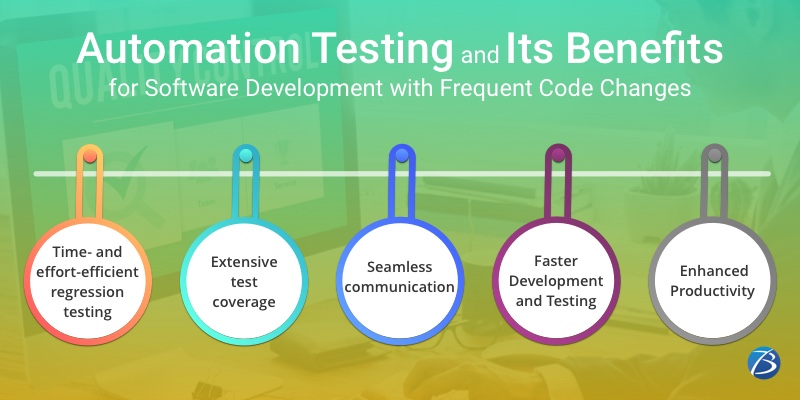
  1. Time- and effort-efficient regression testing

Regression testing consumes a lot of productive time. Moreover, the steps are repetitive and do not add anything to the skill set of the performer. These steps when automated save a lot of time and effort.

  1. Extensive test coverage

Many products/solutions have the requirement to be tested across multiple browsers and devices. The extensive test scenario and devices take time for testing. Dedicating a lot of time for covering every device and browser for every test case may not be possible in manual testing. Automation/ automated testing covers every testing aspect without dependency on any individual.

  1. Seamless communication

Automation/automated testing yields results at a faster pace. The QA team is capable of providing the development team with results after every change. This helps in assessing the performance of the product at every stage. Fast results lead to faster and more meaningful communication between the QA team and the development team. This helps in doing faster development and delivery to the client.

Scenarios for Automation Testing

Not every product whose code changes regularly requires automation testing. And not every test case can be automated. Automating the test cases can be time-consuming. Also, the company has to spend money on the automation testing suit. Put together, automation/automated testing can be time- and money- intensive. So, the software development companies should consider automating only the required test cases.

 The projects can consider the following scenarios for automating the test cases:

  1. When the regressive test cases are already identified. Test cases for the functionalities which are going to remain unchanged till the project ends can be automated.
  2. Automation/automated testing can be performed generally for the smoke testing for every project as the basic critical test cases remain unchanged.
  3. Cross-functional testing can be added to the automated testing framework. After the addition of every new feature, a cross-functional test can be performed manually. Then it can be added to the automation framework to repeat the test after every build.

Automation/automated testing is a great feature for the QA team of every software development project irrespective of the model of development. The only difference can be in the degree of automation. Automation has a lot of benefits that result in better time efficiency, higher productivity, and greater customer satisfaction. Biz4Solutions is one of the leading software development services company. Our QA experts ensure thorough automated testing using popular automation tools like Selenium, Apiium, SoapUI, etc and manual testing of the product to deliver a robust product. Contact us today to get the best software development services led by expertise and experience.

Sunday, May 1, 2022

Guidance on NFT Creation and Monetization Strategies!

NFTs are cryptographic tokens existing on a Blockchain that can be traded or sold. NFTs involve objects or assets such as music, artwork, trading cards, pictures, tweets, memes, online gaming, virtual real estate, etc. 

This concept came to light in 2014 with the first known NFT transaction: A video clip named Quantum, registered by McCoy on Namecoin Blockchain was sold at $ 4 during a live presentation at New York’s New Museum. However, this concept didn’t attract much public attention until 2017 when the digital gaming brand CryptoKitties successfully sold tradable cat NFTs as a monetization strategy. Gradually, with the rising popularity of cryptocurrency usage, the NFT market picked momentum and by the end of 2020, the NFT market value reached 100 million $.

NFT became a buzzword around the globe ever since the most expensive NFT sale took place in March 2021: “First 5000 Days,” a crypto art by Beeple, was auctioned for 69.3 million USD.  Here’s the example of another multimillion-dollar NFT transaction in 2021: “Bored Ape Yacht Club” raised 26.2 million USD by selling a collection of ten thousand NFTs in the form of cartoon primates that can be used by their owners as profile pictures on social media accounts. The year 2021 witnessed a booming NFT market with countless profitable transactions and the market value shot to 22 billion $.

Several brands, individuals, and enterprises including Yahoo, Star Trek, NYSE, Walmart, Ticketmaster, Elvis Presley, and Panera have been trademarked for NFT. This post guides you on how to create an NFT and monetize it. So, if you too wish to trade your asset/s via NFT, this write-up is a must-read.

But, before we dig deeper, let’s get a clear idea about NFTs & the concept of minting NFTs!

What are NFTs and how do they function?

NFTs or non-fungible tokens are data units stored on Blockchain, a digital decentralized ledger. An NFT refers to a specific digital or physical asset that is virtually traded or sold. NFTs grant ownership of the physical/digital objects by recording it on Blockchain. Here, granting ownership means providing a license to use, copy, or display the asset for a particular purpose.

NFTs work like cryptographic tokens but one cannot mutually interchange them like cryptocurrencies such as Ethereum or Bitcoin. This is because, unlike cryptocurrencies, all NFTs are not the same; each NFT holds a different value if they represent varied assets.

To create an NFT and earn money from it, one needs to mint an NFT.

What do you mean by minting NFTs?

Minting NFTs is the process of creating NFTs on a Blockchain. Here, the digital file gets converted into a crypto collectible. During minting the data is recorded within a public ledger which is tamper-proof & unchangeable. As such, all NFT transactions in the future can be followed and tracked. For minting NFTs, owners have to pay the “gas fees.” However, some platforms do not charge any gas fees from NFT creators; the fee is compensated in the form of additional costs to be paid by the buyer just like VAT or airlines’ fuel charges.

How to Create NFT and Monetize it: Key Steps

Here are the key steps that should be followed to create an NFT and earn money out of it.

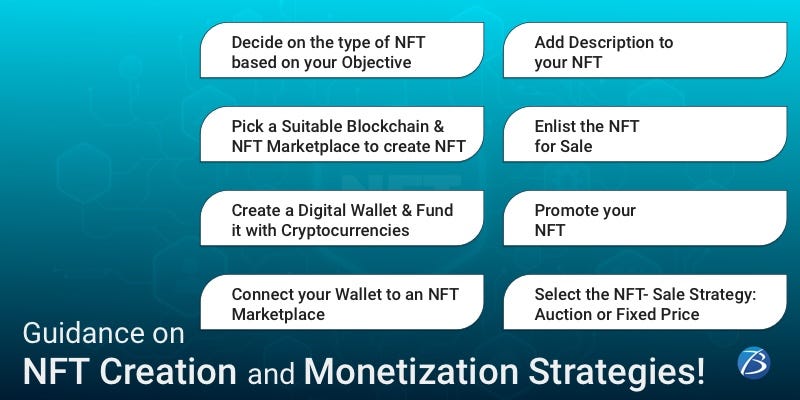
  1. Decide on the type of NFT based on your Objective

Selecting the type of NFT is a very crucial move as it should seem valuable to your target audience and also be profitable for you. Take a look at some of the most popular NFT ideas. Digital works of art have been so far the most profitable NFTs ever created, and this strategy works best for individuals planning to create NFTs.

If you are a business brand selling physical collectibles, it would be a great idea to tokenize those collectibles and sell them in digital format. Digital trading cards and sports cards are good examples of this type of NFT. While physical cards are susceptible to damage, NFT cards will retain their quality forever as they are securely stored on a Blockchain.

NFT-based video games have also proved to be immensely profitable as gamers usually heavily invest in virtual gaming items.

  1. Pick a Suitable Blockchain & NFT Marketplace to create NFT

Blockchain:

You also need to select an apt Blockchain technology to mint your digital asset into an NFT. Select the Blockchain depending on the type of cryptocurrencies owned by your target audience and the transaction charges involved in that Blockchain. The commonest Blockchain used for NFTs is Ethereum; other Blockchains include Smart Chain, Binance, Cosmos, EOS, Polkadot, Tron, Litecoin, and Tezos. For example, Ethereum powers NFT platforms like OpenSea, Rarible, & Mintable; Polkadot empowers Xeno NFT hub; Wax Blockchain empowers AtomicHub; and Tezos powers marketplaces like Bazaar market, Rarible, & one of.

NFT marketplace:

The crypto space offers several NFT marketplaces, and you need to pick the one that suits you best. It has been observed that non-curated platforms are preferred over curated platforms. The reason is that NFT creators using non-curated platforms provide low-cost options – you just have to register yourself and pay the transaction fee needed for minting a token.

Here are the offerings of some of the most popular NFT marketplaces:

OpenSea:

This popular marketplace is used by a huge chunk of NFT traders as it hosts almost every kind of NFT and supports 150+ cryptocurrency payment tokens.  Furthermore, OpenSea offers advanced features and user-friendly experiences to NFT holders enabling them to create effective NFTs speedily. Here, the NFT owners can even group up with other sellers for selling off their NFTs. The platform doesn’t charge any fee for creating an NFT and enlisting it for sale. Creators need to only pay fees for one-time registration and contact approval. Authors are charged a fee when their NFTs are sold.

Rarible

This is another popular marketplace, a self-service platform that is interconnected with OpenSea. The offerings of Rarible are quite similar to those of OpenSea. However, Rarible offers limited formats and smaller-sized artworks. Moreover, Rarible users can mint tokens prior to selling them, while in OpenSea token minting is managed at the time of selling the NFT.

Mintable 

This platform is ideal for novice traders as it is one of the most cost-efficient options for creating and selling NFTs. This platform doesn’t charge any fee for registration, NFT creation, or NFT sales. Free NFT minting services make this marketplace the most viable option for artists who seek zero investment and huge returns. But this platform is not so user-friendly and requires a lengthy registration procedure.

Is it necessary to use a marketplace for NFT Creation?

You need not use an NFT platform if you are technical enough to build a smart contract, choose a Blockchain to deploy it, and use it for minting tokens. You can also hire Blockchain app development services for customized requirements. 

  1. Create a Digital Wallet & Fund it with Cryptocurrencies 

A digital wallet is an app that is used for storing cryptocurrencies as well as buying, selling, or minting NFTs. So, pick a wallet that is compatible with the Blockchain you use for minting your NFT if you are a creator/owner. MetaMask and Coinbase are the most commonly used ones.

Once the digital wallet is created, you need to add some cryptocurrencies for paying the NFT minting fees to the marketplace you’ve chosen. Ether or ETH, Ethereum’s native cryptocurrency, is the most commonly accepted currency in NFT transactions.

  1. Connect your Wallet to an NFT Marketplace

Now, you need to connect your wallet to the NFT marketplace you have chosen. For OpenSea and Rarible, this process is quite easy: you need to click the top left button for connecting the wallet. Then, you can view a list of compatible wallets; you need to select one out of these for continuing the connection process.

If you already have installed the extension of either Coinbase or Metamask, a pop-up will appear asking you to connect to your wallet, and you can connect with a few clicks. For the Coinbase wallet app, you also get the option of connecting with the marketplace using a QR code scanner that is present on the main wallet screen on the right side of your balance amount.

Remember to go for a trusted site instead of an unknown site, to prevent scammers from accessing your NFTs or funds.

  1. Add Description to your NFT

Now, you need to upload the file that needs to be converted into an NFT to the marketplace you have picked. Then add a catchy title and description to your NFT for listing purposes. Once uploaded you need to select whether you wish to mint a single token or an entire collection of NFTs.

Thereafter, you will be asked to decide on the percentage of royalty you would like to claim whenever your asset/artwork is resold in the future. But, this part is a bit tricky. If you set a high percentage of royalty for resale, it may seem profitable but individuals who have purchased your asset might be reluctant to resell it.

The last step involves adding the properties of your file; this step is optional.

  1. Enlist the NFT for Sale

After you are done with filling out the information and you have uploaded your file and minted it, you need to enlist it for sale.  Click on “create item” and then you will get the option to connect your wallet for paying the listing fee.

Once your file gets listed for sale on a particular marketplace, the platform will calculate the “gas fees”. This type of fee refers to the costs incurred by the Ethereum Blockchain network for recording transactions and the amount depends on how busy the platform’s network is. However, if you enlist your NFT during the non-peak hours, the fee will be lesser.

  1. Promote your NFT

After creating an NFT and minting it, owners need to promote it through proper channels for maximizing the chances of success. The promotional platforms & approaches include public relations, online advertisements, crypto podcasts, and social media.

  1. Select the NFT- Sale Strategy: Auction or Fixed Price

 It is important to choose an NFT-Sale strategy: Auction or Fixed Price. The fixed price strategy is simple, straightforward, and transparent – NFT owners mention a specific selling price for their assets.

Setting up an auction is a way more interesting and exciting approach for earning money from an NFT sale! Here, three options are available:

  • Increasing price auction: The price increases and the highest bidder gets to buy the NFT.
  • Timed auction: The bid for each lot is set for a definite time, the interested collectors have to submit the bid within the specified time, and finally, the person who submits the highest bid wins.
  • Decreasing price auction: The NFT price drops till a person buys the NFT.
  • Online auction without a deadline: Interested parties will submit the bid and the owner can close the auction at any time.

NFT Monetizing strategies 

 The various approaches to earning money from an NFT are:

Royalty: 

This is a crucial strategy to earn money from NFTs: the NFT creator can earn passive lifetime royalties after selling their NFT to another individual. For this, the creator must impose terms and conditions stating that royalties need to be paid to them every time the ownership of the NFT changes.

NFT Staking & Renting:

Staking is to lock or deposit an NFT for generating passive income in the form of tokens.

If your NFT is gaining popularity, renting will be a good option to earn money out of your NFTs. Here, a smart contract-empowered deal is sealed between two parties stating certain terms and conditions. The lease amount and the duration of the rental agreement are also fixed by the owner.

Liquidity Pool

This refers to a collection of digital assets locked within a smart contract. This collection can be used as loans, collateral, etc. Moreover, the users of several platforms are rewarded with NFTs that are exchanged with a liquidity pool and the owners can sell their NFT rewards for liquidating their positions within liquidity pools.

Summing Up:

The NFT platform can be leveraged by artists to get digitally recognized and can be used by business brands as a highly effective monetization strategy.  As the trend to collect NFTs is rapidly growing, the number of brands/firms applying for NFT trademarks is also on the rise. The number of NFT-related trademark applications received by the Patent and Trademark Office in the US was just three in 2020; the number rose to 1200 in 2021; 450 applications were received in January 2022.

If you too wish to make money by creating an exceptional NFT for your business brand, reach out to Biz4Solutions, a prominent software firm offering high-end mobile app development services as well as Blockchain-related services to global clientele for the last 12+ years.