Wednesday, June 30, 2021

React: Commonest Security Flaws and Remedial Measures!

Released in 2013, React, a robust front-end web library, became quickly popular amongst technical professionals worldwide. Today, this library is extensively being used by giants like Netflix, Facebook, Instagram, BBC, Whatsapp, and many more, owing to the myriad advantages it offers, as listed below:

  • Component Reusability
  • Routing and Templating
  • Speedy Rendering
  • Good Flexibility
  • Easier Learning Curve for Complex Procedures
  • Synchronization of app and interface status
  • SEO-friendliness

Besides these goodies, this technology is also considered to be highly secure due to the availability of several in-built protective mechanisms. Yet, some vulnerabilities can occur in the React apps and lead to unpredictable security leaks; which the React App development agencies must be aware of.

So, this blog will take you all through some common security flaws in React and guide you with the potential solutions as well. Let’s get started.

Crafting an app in React: Security Vulnerabilities and their Remedial Measures 

SQL Injection Attack

This is another type of attack where the attackers can play with the user’s data regardless of their knowledge and approval. The attackers can extract sensitive user data, create new user credentials, replicate fake credentials, and thus, get admin authorities for accessing the server. SQL injections are of several types viz. time-based, logic-based, error-based, etc.

Possible Solution:

  • Using an SSL certificate from authorized sites
  • Validation of API call functions for particular API schemas
  • For time-based SQL injection, conducting timely validation of the schema for getting rid of the suspicious code injections

Cross-site Attacks

Cross-site scripting attack is a common yet serious security flaw that React Apps have to go through. It occurs when the attackers or hackers trick a website by executing an arbitrary JavaScript code. These attacks are of two types- stored attack and reflected attack.

  • Stored cross-site attack: In these, the attacker accesses the server and extracts the data from the client’s web page when the code is executed.
  • Reflected cross-site attack: In these attacks, the attackers place a link with sensitive user information that will run in the browser.

Possible Solution:

Cross-site scripting can be performed only when the code execution is done in a browser with some particular instructions. So the mark-up that holds the instructions for code execution needs to be disabled by the React app developers.

Server-side Rendering Vulnerability

In case a developer renders an application from the server-side, the server-side rendering attack is likely to take place. It can lead to the unknown monitoring of the application, data leakages, etc. This issue is quite difficult to detect when the context data is not found properly.

Possible Solution:

  • utilizing the serialize JS with NPM module for escaping the rendered JSON
  • cross-checking and monitoring regularly if any issues persisting in server-side data validation are reported and worked upon

Execution of Arbitrary Code or Commands

When the attackers run the arbitrary codes or commands on a particular process, the application can get highly vulnerable. It usually takes place in the software or the hardware that processes the arbitrary code. ‘Arbitrary code execution exploit’- a special program is used for this security issue and if it gets exposed to public products and services, it can expose the data of all the concerned individuals who buy and use those products and services.

Possible Solution:

  • making sure that the application only reads the tokens that are previously stored while developing the app
  • ensuring that the system can only create relevant headers by authentication of the request by making a request to the server

Inadequate End-to-End Encryption

Lacking end-to-end encryption is the major cause of security lapses and data breaches occurring in the apps made using React. The inclusion of third-party APIs also leads to these issues affecting the safety and privacy of data.

Possible Solution:

  • utilization of private and public-key encryption
  • utilization of the encryptjs and cryptojs libraries
  • using asymmetric algorithms like RSA for encrypting the primary key of a react app

‘Insecure Randomness’ Issue

This issue takes place when the attackers add a malicious code that begins with JavaScript or a link in the apps. This script runs in the browsers as soon as the users click the planted link. Thus, attackers get the admin authority and they can pull sensitive data or alter the data and hence makes the application very insecure. Also, they get control over the uniform resource identifier and several elements in the apps are vulnerable to threats.

Possible Solution:

  • conducting integrity investigations for inspecting and avoiding the injection of suspicious links and codes
  • creating links with the usage of whitelisted protocol and using HTML entities
  • employing strict restrictions to create code objects that can avoid insecure randomness
  • isolating the code from other codes

Significant Security Measures for React Application Development

Diverse security vulnerabilities can occur in the React apps and identifying their reasons can be impossible at times. Hence, the firms using the React Library can proactively follow some preventive actions as below:

  • Install and configure Linters to automatically detect the security lapses in code and provide remedial advice.
  • In the past, some versions of this library possessed high-risk vulnerabilities, however, they have been removed in the latest versions. Hence, it is a good practice to use the updated version always.
  • Some dependencies and third-party components may be more prone to security issues and so using their latest versions is recommended.
  • Zip Slip issue crops up due to the overwritten arbitrary files along with the directory transversal issue. For this, the developers can either use fixed versions of the archive processing libraries or can utilize a dependency vulnerability checking tool like Snyk.
  • Library codes are used for threatening operations like inserting HTML into the DOM. Developers should avoid libraries that use unsafe patterns like ‘innerHTML’ and ‘dangerouslySetInnerHTML’ or other unvalidated URLs.
  • It is necessary to avoid suspicious or dangerous URLs. For avoiding URL-based script injection, use validation, and ensure that the used links are ‘https:’ or ‘http:’

Key Takeaways:

In today’s digital era, the security of software apps holds monumental importance. Security lapses can result in data leaks and high-risk cyber-crimes. So, it is essential to consider the security pitfalls right from the initial stages of developing a React application. The developers and the quality analysts as well should keep an eye on such vulnerabilities and eliminate them from time-to-time.

All this requires not only the knowledge and experience of the development teams but also needs attention to detail and thoughtful decision-making when these vulnerabilities crop up.

Also, have a glance at our blog here for gaining insights on general security tips in mobile applications.

To know more about our core technologies, refer to links below:

Angular App Development Company

Ionic App Development Company.

Node JS App Development Company

Monday, June 28, 2021

What is the Cost Estimated for Architecting a Video Conferencing App?

In the year 2020, after the pandemic hit the world, businesses of all kinds rapidly started switching to remote work to successfully carry out their operations during lockdown situations. Owing to this, video conferencing applications like Zoom, Slack, Skype, Google Meet, Cisco Webex, etc. gained momentum and their usage surged exponentially.

Since then, the demand for various kinds of video conferencing apps is high in the market. Today, entrepreneurs and business ventures across the globe are seeing this as an opportunity and are keen on creating top-class video conferencing applications.

So, in this article, we are going to shed light upon costing for video conferencing app development that would prove helpful to the entrepreneurs and mobile app development companies who plan to create such apps. We will also have a look into what features must be considered while developing a full-fledged video conferencing app, the monetization models, etc. Let’s begin.

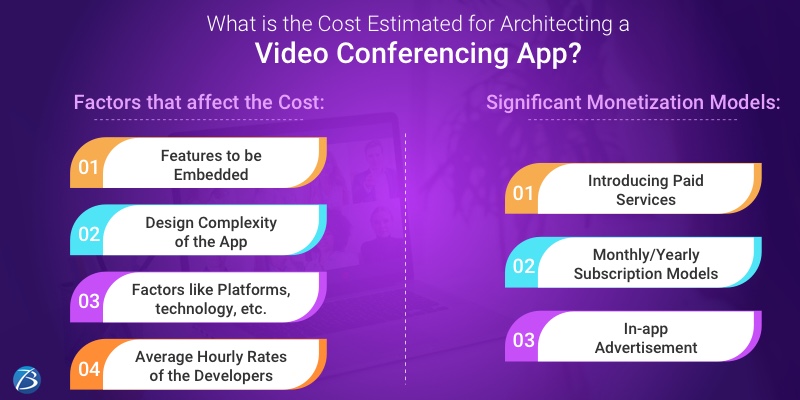
Factors that affect the Cost of Developing a Video Conferencing App

  1. Features to be Embedded in the App
  2. Design Complexity of the App
  3. Factors like Platforms and Devices, Development Architecture, Technology Stack, App Design, Testing, App Hosting and Security, Maintenance and Updating, etc.
  4. Average Hourly Rates of the Developers

The hourly rate of the developers varies as per their locations. If you want to outsource your project to a country like India, the charges could range from $20 to $150. Countries from regions like Europe, Asia, Australia, etc. charge anywhere from $35 to $150. The highest rates are charged specifically by the app development companies located in the United States and Canada and their charges range from $90 to $230.

Key Features of a Video Conferencing App

Any video chat app or video calling app requires some fundamental features in the app. Besides, to make the app stand out amongst the competitors, the app should include some unique features. So, if you are going to develop an MVP model, you can consider the basic features to start with. Also, depending on your budget, you may think of integrating advanced features in the app.

Basic Features

  • Personal and Group Chatting
  • Personal and Group Audio/Video Calling
  • Adding Contacts
  • Searching New People, Messages, Groups, etc.
  • Group Creation
  • Screen Sharing
  • Media Sharing
  • Mute Participants
  • Compatibility with Multiple Devices
  • Scheduling of Meetings
  • End-to-end Encryption
  • Enter Meeting IDs and Join Meetings

Advanced Features

  • Unlimited Recording of Meetings and Presentations
  • HD Videos for High-quality Meeting Experience
  • Dynamic Presentation Features: Note Sharing and Uploading Various Files like PPTs, MP4 Videos, etc.
  • Branding Features like Adding Logo during a Webinar
  • Feedbacks and Performance Metrics, Attendance Report, etc.
  • In-meeting Messaging
  • Whiteboard Camera System
  • Auto-framing for Adjusting Participants to Fit the Screen Properly
  • Zoom-in and Zoom-out during Meetings
  • Noise-blocking

Cutting-edge Features Expected in Future

  • Live Video Editing
  • Green-screen and Virtual Background in the Meetings

Estimated Cost of Developing a New-age Video Conferencing App

The price of developing a video chat/calling application is determined by a host of factors. Let us have a look at the approximate costs of the apps.

  • A simple app with basic features would cost anywhere from $20,000 to $40,000. Such an app may not have API integration, no essential UI components, etc.
  • A moderate application may range from $40,000 to $80,000. It would come with custom UI/UX features, backend servers, API integration, and a few other features.
  • A high-end full-fledged app with complex functionalities like third-party integrations, complex backend, custom animations, real-time features, etc. may approximately cost from $75,000 to $150,000 or more.

This was an approximate estimation of what a professional video chat app would cost. Besides knowing the cost, it is also vital to know the ways to earn back the money you invested. So let us quickly run through some monetization models.

Significant Monetization Models

Introducing Paid Services: 

You can introduce paid services after a certain limit. For instance, for adding more than 50/100 people in a meeting, charge the clients with extra cost. Or, ask the users to pay when they want to extend a set time limit for the meeting. You may even charge them for availing elite services.

Monthly/Yearly Subscription Models:

Subscription models are one of the best ways to generate some extra income. To cite an example, Zoom comes with a monthly subscription model and offers additional services like voicemail and call recording feature, secure HD conversations, IVR tools, and auto-attendants, automated call management, etc.

In-app Advertisement:

In-app advertisements are not a very good idea to make money, especially in professional video meeting apps. However, you may use the white space to display small image-based advertisements at times, depending on your target audience.

Concluding Views

So, how much does it cost to create a compelling video conferencing app? Well, there is no ‘one fit for all’ answer to this question. The development cost is usually the amalgamation of a number of factors like features and functionalities of the app, its design complexity, tech-stack, geographical location of the development teams, and much more. Finally, it completely depends on what you are looking for and what are your particular requirements.

With this, we wrap up this article. It was an attempt to solve your queries regarding the cost of the creation of a video-conferencing application. Hope we have been able to help you with that. If you have any other queries, get in touch with us here.

Also, let us know your views on this article in the comments section below.

If you want to create an innovative video conferencing application, reach out to Biz4Solutions, a renowned mobile app development agency. The company has vast experience in architecting next-gen software solutions for businesses of all kinds.

To know more about our core technologies, refer to links below:

Angular App Development Company

Ionic App Development Company

React App Development Company

Thursday, June 24, 2021

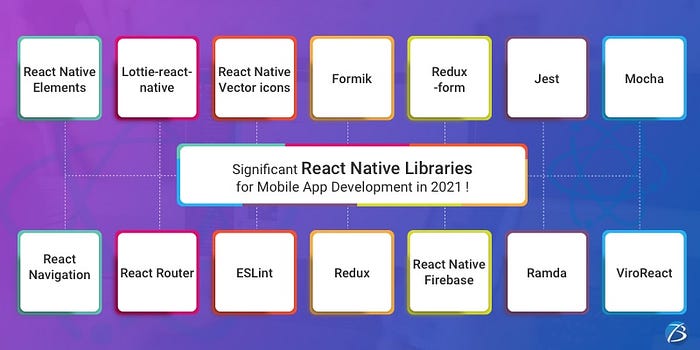
Significant React Native Libraries for Mobile App Development in 2021

React Native happens to be one of the most sought-after app development frameworks across the globe as it comes with a host of advantages like a cost-effective developmental cycle, faster time-to-market, high performance, modular and intuitive architecture, and many more.

One of the unique benefits of this framework is the availability of countless third-party libraries that expedite the development and prove highly convenient for every React Native App Development Company. However, owing to the presence of thousands of React Native libraries, selecting the apt ones becomes a herculean task. As a consequence, development teams often have to spare a great deal of time and effort for picking the right tool or library that would prove fruitful.

For easing out this task, I have penned down the most significant tools and libraries that complement the React Native framework. A quick read will help you to find the perfect match that suits your requirement.

Tools and Libraries for Various React Native App Development Categories

Category: User Interface

React Native Elements

  • This UI library, built using JavaScript, has earned 20.5k stars and 4.2k forks on GitHub.
  • This library comes with cross-platform compatibility and supports Expo.
  • It is easy to use, customizable, and community-driven.

Lottie-react-native

  • This library created by Airbnb enables adding attractive animations to React Native applications.
  • React Native developers can either select from the free animations available or design and add their animations employing “Adobe After Effects.”
  • Functioning: The animation data is exported in JSON format with Bodymovin and rendered natively on mobile.

Styled Components

  • This library enables developers to write CSS code for styling components
  • It removes the mapping between styles and components, thereby easing out the usage of components as a low-level styling construct.
  • The styles can be reused several times resulting in lesser coding

React Native Vector icons

  • React Native Vector icons is a library that offers numerous icons of various types, designed for the React Native Apps.
  • Each element can be fully customized

Category: Forms

Formik

  • It’s a small library that helps to build forms in React
  • Formik enables to validate the form values, display error messages and helps to submit the form.

Redux-form

  • Redux-form enables proper state management in Redux
  • It helps in tracking the commonest form states like fields contained in the form, focussed field, field values, fields which the users have interacted with, etc.

Category: Testing

Jest

This is a popular testing framework, designed and maintained by Facebook, and is used for testing JavaScript code. This versatile testing tool is compatible with any JavaScript framework or library, including React, Angular, VueJS, etc. Uber, Airbnb, and Intuit are some of the top brands that have leveraged this tool. Its offerings are:

  • High-speed performance
  • Standard syntax with report guide
  • Mocks functions, with the inclusion of third-party node_module libraries
  • Conducts parallelization, snapshot, and async method tests
  • Enables managing tests with bigger objects, by using live snapshots

Mocha

Mocha is a JavaScript test framework, used for testing React and React Native apps. It provides the Developers full control over what plugins and tools they choose to use while testing applications. Its major highlights are:

  • Runs on Node.js
  • Provides support for asynchronous front-end and backend testing, test coverage reports, and the usage of any claims library
  • Helps to track errors
  • Excels in mocking tests

Enzyme

  • Enzyme is another testing tool developed by Airbnb.
  • It comes with API wrappers, to ease out developers’ tasks like manipulating, asserting, and traversing the React DOM.
  • It supports full and shallow DOM and also supports static rendering
  • Besides, it is compatible with several other testing frameworks and libraries like Mocha and Jest.

Chai

  • It’s an assertion testing library meant for browser and node
  • Chai employs behavior-driven and test-driven development principles
  • Compatible with various testing tools and can be paired with any JS testing framework
  • Its functionality can be extended by using several custom plugins
  • Moreover, it enables the developers to create their plugins and share them in the community

Category: Navigation

React Navigation

  • This component supports navigational patterns like tabs, stacks, and drawers
  • It is based on JavaScript and is simple to use
  • It enables developers to effortlessly set up app screens
  • Can be completely customized as well as extended

React Router

  • This is a library of navigational components which composes declaratively with the app.
  • It allows one to specify named components, create various types of layouts, and pass layout components.

Category: App’s State Management

Redux

Redux, a free-standing library, and a predictable state container is predominantly used along with the UI library components of React. Besides the React ecosystem, one can also use Redux with other frameworks like Vue, Angular, Vanilla JS, Ember, etc. Its principal offerings are:

  • Can be used with back-end as well as front-end libraries
  • Enables the developers to write consistent codes
  • Allows editing the live code
  • Functions well in various environments – Server-side, client-side, and native
  • Connects the pieces of state to the React components by minimizing the need for props or callbacks.

Category: Linting and checking Types

ESLint

  • It’s a JavaScript-based, open-source linter tool
  • ESLint is configurable and pluggable
  • It improves the code consistency and makes it bug-free
  • It helps in evaluating patterns in the code and eliminates errors by automatically fixing the code, to enhance the overall code quality.
  • It helps detect creases in the JavaScript code that don’t comply with the standard guidelines
  • It helps react native developers to create their own linting rules

Flow

  • Developed by Facebook, Flow is a static type checker JavaScript library
  • It easily identifies problems during coding
  • It proves beneficial in crafting large applications, as it prevents bad rebases when several persons are working on a single program.
  • The main objective of Flow is to make the code more precise and enhance the speed of the coding process

Category: Networking

Networking tools are used to establish a networking flow in React Native projects. Let us have a look at a few of them.

  • react-native –firebase is a lightweight layer on the top of Firebase libraries. It creates a JavaScript bridge connecting to the native JavaScript SDKs to ease out using Firebase in React Native Application Development projects.
  • Apollo Client is quite compatible and adaptable. It is required when the developers need to use GraphQL. It assists in creating a User Interface that pulls data with GraphQL.
  • Axios, a lightweight HTTP JavaScript client was built to send asynchronous HTTP requests to REST endpoints. Besides, it performs CRUD operations.
  • react-native-ble-manager is a plugin that helps in connecting and transmitting data between a mobile handset and BLE peripherals.

Category: Utils

The below-mentioned ready-made tools simplify and speed up working with Utils while developing React Native apps.

  • Ramda is a library that eases out creating functional pipelines without user-data mutation.
  • The JavaScript functions’ toolkit Lodash offers clean and effective methodologies to your development team for working with collections and objects.
  • Reselect builds memorized selectors that are needed for avoiding unnecessary recalculation and redrawing of data. This library also quickens the speed of your app.
  • Moment works with various data formats and is capable of parsing, manipulating as well as validating times and dates in JavaScript.
  • js, designed by Wrap, offers the app developers a declarative way to validate JS objects

Category: Analytics

The following libraries act as mediators enabling one to implement the trending analytical tools into their React Native Mobile App Development projects.

  • react-native-mixpanel is a kind of wrapper for the library named Mixpanel and helps the developers to reap all the benefits of the Mixpanel library.
  • react-native-google-analytics-bridge acts as a bridge for establishing compatibility between Google Analytics tools and React Native projects.

Category: Localization

react-native-i18n helps in localizing or internationalizing applications. It integrates the i18n-js library in JavaScript for React Native applications.

Category: In-app Purchases

  • react-native-in-app-utils is a small library used to implement the in-app billing procedure for iOS apps. It can be effortlessly installed and is simple to work with.
  • react-native-billing is used for adding in-app billing to applications meant for the Android platform. It possesses a simple UI and wraps anjlab’s InApp Billing library to function as a bridge.

Category: AR and VR

ViroReact is used to speedily develop native cross-platform VR/AR apps in React Native. Its key functionalities are:

  • It has an easy learning curve
  • It comes with a high-performing native 3D rendering engine as well as a custom extension of React for creating VR and AR solutions.
  • It provides support for all kinds of platforms in VR including Samsung Gear VR, Google Cardboard, Google Daydream, etc. for Android and iOS; and AR including Android ARCore and iOS ARKit platforms.
  • Needs React-Viro-CLI and React-Native-CLI for writing cross-platform native codes

Final Verdict:

I hope the aforesaid information was helpful and has given you a clear idea of which library/libraries would be most suitable for your next project.

To know more about our other core technologies, refer to links below:

Angular App Development Company

Ionic App Development Company

Blockchain app developers

Wednesday, June 23, 2021

Essential Features of a Bestselling eLearning Application!

Learning new things was never so easy. With a few clicks on the smartphone and you can learn any skill from any location at any time with the help of eLearning apps. The modern learners are attracted by the facility of easy and quick access to information outside the confined walls of the classroom which was very unprecedented in the olden times. Because of the immense potential, these eLearning solutions are providing these days, businesses across the globe are investing multifold in eLearning app development.

The significance of eLearning apps has particularly risen further during this COVID-19 pandemic. Since there is a lockdown in most parts of the world, educational organizations are switching to the virtual model of imparting education, and professionals are choosing to upgrade their skill sets using these apps for eLearning. Consequently, several businesses worldwide are investing in eLearning mobile app development to gain a competitive edge amongst peers.

So, do you want to develop effective online learning solutions for students?

Or create interactive training apps for IT professionals?

Or build flagship programs based on multiple skills for modern learners?

Everything is possible with the new-age eLearning solutions. But, for developing an eLearning app that goes viral in the market, there are some criteria. Firstly, the app must have the following qualities:

  • Learner-focussed Design
  • Customizable and Scalable
  • Engaging and Pleasing Aesthetics
  • Interactive Elements
  • Powerful And Supportive Database
  • Valuable and Comprehensive Content
  • Personalization
  • Productive and Flexible Learning
  • Quick and Easy Access to Information
  • Information Presented in Small ‘Bites’
  • Real-Time Analytics
  • High Security
  • Professional Support

Secondly, it is essential to integrate powerful features in the app that provide an uninterrupted and enticing experience to the users. In most cases, apps with lame or insufficient features are bound to fail. So, here we have shared some key features required for an exemplary eLearning app.

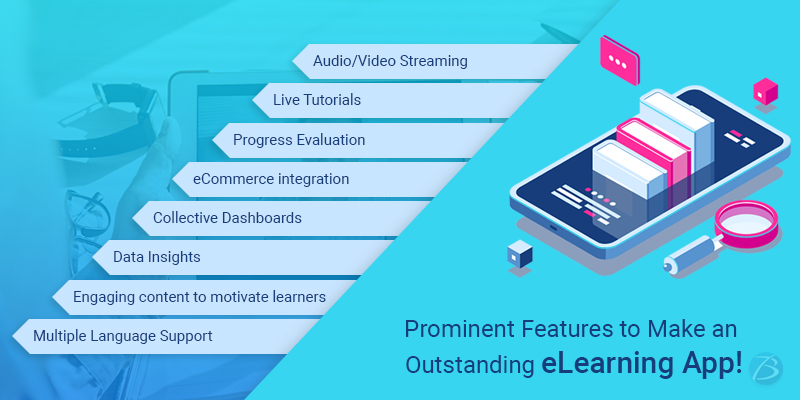
Must-have Features of a New-Age eLearning App!

  1. Elementary features

An eLearning mobile app is simply incomplete without the fundamental features. The app must have in-app chatting or messaging functionality to allow the learners to communicate with each other or tutors. It must have the feature of push notifications to keep the users aware of their progress, new achievements, timings of classes, pending courses, any new deals, and offers, etc. The app should have calendar integration for the users to maintain records of the upcoming activities and set reminders accordingly. Last but not the least; it should have social media integration to boost user engagement, promote the app, and reach a wider range of audiences.

  1. Audio/Video Streaming

Audio/video streaming has become an integral part of modern education. These are key players for accessing online education. These features help the users to connect in real-time and enable the sharing of files or documents in live sessions. This kind of learning allows the users to listen to pre-recorded lectures, rewind/fast-forward the lectures, zoom into an image, etc. making the learning process easier and convenient.

  1. Live Tutorials

Live tutorials and sessions add another dimension to the learning process. They help the learners to gain a thorough knowledge of a subject. Reading the content of a course can often become boring. However, with live tutorials, it becomes a pleasing experience. Moreover, it gives the feel of a real-time classroom making education much more effective.

  1. Progress Evaluation

Assessment and feedback are vital features for evaluating the progress of the learners. A good eLearning app solution must embed tests and quizzes to be held at regular intervals or ensure that the tutors conduct the tests and quizzes periodically. They should either be assessed automatically or by the tutors/course authors. The learners should also get live feedback and have one-on-one interactions, so that they can practice more, redo a chapter, etc. These features keep the learners connected and contribute to the success of a course. Learners should get assessed periodically to enhance their engagement and knowledge.

  1. eCommerce integration

If your eLearning app has eCommerce functionality, the tutors can sell online courses and live classes. The app owners too can generate massive revenue from this. However, it is necessary to ensure that these courses and other sensitive information like bank account details, contact details of users, etc. are highly secured.

  1. Collective Dashboard

If your eLearning app has a collaborative dashboard, the users can access their course collateral and get overall information about their progress. They can know if the course is pending or is completed. A collaborative dashboard allows the users to share study material, assignments, quizzes, useful links, etc. with others for an enriching learning experience.

  1. Crucial Data Insights

Data tracking and analysis helps to monitor the efficiency and effectiveness of the courses and the app. The app should have an efficient data tracking and reporting process in place for collecting critical data like popular courses, customer rating, clicks/views on a particular content, etc. It must also keep an eye on the attendance of the learners, their progress, assignment completion, etc. which helps in analyzing their weak areas and work accordingly. Also, these reports help the tutors or course authors generate better revenue, which contributes to the high ROI of the app.

  1. Engaging Content to Motivate Learners

Keeping the learners engaged and connected until the end of the course can be highly challenging at times. They need continual motivation through tests, assessments, feedback, evaluation of work, rewards, etc. Using motivational triggers like scores, progressing to the next levels, virtual gifts or currencies, competition with fellow learners, etc. are outstanding ways to make learners stick to the course.

  1. Appointment Scheduling

In several distant learning apps, the learners need to choose a tutor from a number of tutors available and book appointments with them. Hence these apps must have a fast and simple appointment scheduling feature using which, the learners can instantly book appointments as per the available slots of the tutors. It also helps to generate meaningful reports for tracking profitable courses and clients.

  1. Flexible Payment Options

The payment process must be kept as simple and less time-consuming as possible, but also ensure high security of the eLearning apps at the same time. The app must have multiple payment methods that include debit, credit, net banking, etc. It should also integrate new-age options like PayPal, Google Pay, Stripe, etc. Always use popular gateways to ensure the credibility and authenticity of the app.

  1. Multiple Language Support

To ensure that your eLearning app has a wider reach, the app must have multiple-language support. If the content and the videos are available in multiple languages, it can benefit a large number of users in different countries and the app owners can generate multiplied revenue from it.

Final Words:

The future of the eLearning industry is indisputably bright. The eLearning solutions are revamping the learning experiences by imparting knowledge on the go of a click. We can say, education is now in everyone’s pocket. For creating an excellent eLearning app, one should use the right blend of strategy and technology. So, to ensure that your eLearning app is one of the best online learning platforms, it should include all the features from the aforesaid list as well as the latest trends in this domain.

Was this blog helpful to you?

Let us know your thoughts through your comments.

Drop us a mail at sales.enquiry@biz4solutions.com for any other queries!

So, are you interested to build eLearning apps using various technologies, connect with a leading Mobile App Development Company, Biz4Solutions and share the ideas with them to build a cutting-edge app.

Monday, June 21, 2021

Noteworthy App Ideas powered by Machine Learning and Artificial Intelligence!

As per a report generated by PWC, there has been a noticeable venture capital investment of $5 billion in about 605 deals in the last two years and Artificial Intelligence (AI) has made an apparent impact on these investments. AI has emerged as a transformative technology influencing end-users, business enterprises, and technology markets across the globe through AI-powered or ML-based apps; where Machine Learning (ML) is an important and integral part of AI.

PWC’s report also says that about 67% of the business leaders think that in the future, AI will be fundamental for businesses and help automate mundane processes and greatly enhance productivity.

No wonder why, both these technologies- AI and ML are being widely preferred by Mobile and Web app development companies worldwide. A plethora of AI and machine learning development services have emerged in the past few years and have led to the development of some out-of-the-box apps.

So in this article, we will discuss such amazing app ideas made possible by smartly integrating ML and AI in them. Before getting started, let’s have a glance at what benefits do these technologies offer.

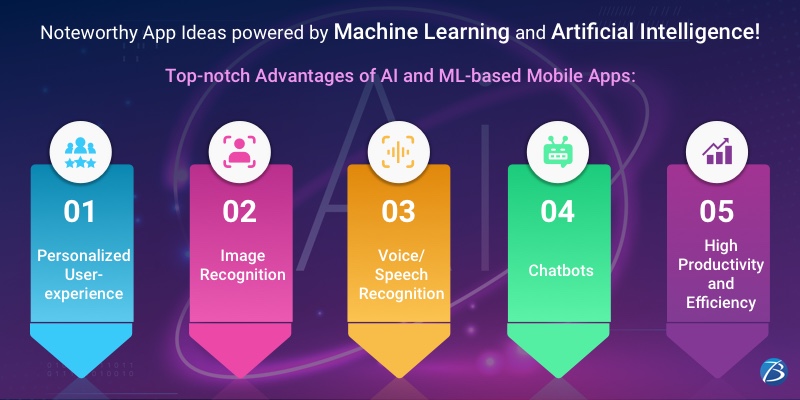
Top-notch Advantages of AI and ML-based Mobile Apps

Personalized User-experience: By gathering vital user data, and using advanced algorithms these apps serve the users with a personalized experience as per their preferences.         

Image Recognition: Using this feature, the users can detect and categorize entities within images. It helps them with face recognition, object identification, emotion detection, etc.

Voice/Speech Recognition: This feature helps to automatically capture human speech and accordingly give recommendations too. Google Assistant is one the best examples for this application.

Chatbots: This is another popular feature of AI and ML. Chatbots are extensively used for interacting with users, collect feedback from them, resolve their queries, etc.

High Productivity and Efficiency: Several people and even enterprises prefer software applications for improving their productivity. Applications based on ML and AI are intelligently designed to meet this purpose. These help the users to automate their tasks improve productivity and thus, save time efficiently.

Exceptional App Ideas Powered by AI and ML

Healthcare-related Apps: Redivus Health and BillyScreen

Redivus Health:

Redivus Health is an intuitive application based on AI and ML used by numerous healthcare providers. It helps to prevent data-related errors in healthcare organizations. Also, it offers uninterrupted support for clinical decisions on a real-time basis during medical documented events.

BillyScreen:

This renowned mobile app makes use of AI and ML tools, smart cameras, computer vision algorithms, etc. for identifying surged levels of bilirubin present in the white part of the human eyes. Besides, the app is also utilized for the identification of severe ailments like pancreatic cancer.

Photo Finding App: IntelliP

IntelliP helps the users to find high-quality photos by using an on-device detection model. This app will scan and organize all the images present in the smartphone into several categories depending on the items in the phones. Every new image downloaded in the phone is distributed in such categories.

From this categorization, the favorite images of the users will be obtained and the app will also suggest some related photos from the web. If required, the users could even buy premium images that are suggested by their phone depending on the categories of images on their phones. This app also gives insights to the developers about the types of images that the users like the most in a particular geographical location.

IT Services App: AI2

This AI-powered platform is designed by MIT’s Pattern X, Computer Science, and Artificial Intelligence Laboratory (CSIL). It comes with proactive contextual modeling which enables the platform to predict potential cyber-attacks in advance. The contextual modeling is like a continual feedback loop between a human analyst and an artificial intelligence system.

Dating App: Blind Dating

This dating app developed by Biz4Solutions uses smart match-making algorithms for the users to find a matching personality. A personality test is conducted to gather data depending on the personality traits of the users and based on this test, the app recommends the best match. Later, the users can meet their special one by setting a time and a place to meet using this app. 

Cybersecurity Apps: CrowdStrike and LogRhythm

CrowdStrike:

CrowdStrike is a brand that utilizes Falcon- a cloud-based endpoint security software. This software provides top-grade security and proactive prevention against cyber threats. The app has served diverse industries like healthcare, finance, retail, etc.

LogRhythm:

LogRhythm is another high-end security solution that serves various organizations by identifying and responding to several cyber-security issues. Its machine learning profile plays a vital role in the identification of threats and other online anomalies.

Story-telling App: StoryTeller

The StoryTeller app will tell fascinating stories to you from your favorite books at your convenience. The app would read these stories as a professional storyteller does. You just have to paste the story’s link in the app or import the story’s PDF/ Word file to the app. The app predetermines the style of narrating the story depending on a categorical analysis of the obtained story.

GeoInterest

This is an interesting app that when installed on your phone, automatically identifies, bookmarks, and saves the details of your favorite places, whenever you go on a trip or navigate any nearby area. The app tracks your location and the places of your interest. It obtains the exact location of those places on the map, and gathers data like their website address, phone numbers, emails, social media links, etc. You can mark your favorite bookmarks on the app and whenever you pass from that location, you get instant notification of your favorite place.

Luxury On-demand App

This app developed by Biz4Solutions provides various luxury services on-demand to users. The service providers accept the requests from the users and offer them more details on their luxury services. The app comes with features like flexible payment options, geo-location integration, user authentication, report generator, etc.

Concluding Words:

The app ideas mentioned in this article have the ability to transform mobile experiences and benefit the entrepreneurs or start-ups adopting them. These apps collect vital user data and offer a more personalized experience to the end-users. As a result, these aptly meet the customer expectations and also improve engagement. Also, such apps show relevant ads to users, driving higher clicks and conversions.

In case you want any assistance on building new-age apps using these technologies, connect with Biz4Solutions team. Biz4Solutions is a high-end AI and machine learning development company.

To know more about our core technologies, refer to links below:

Angular App Development Company
Ionic App Development Company

React App Development Company

Sunday, June 20, 2021

Harness the power of Angular and Ionic for Building World-class Apps!

Angular development has become one of the best approaches for designing highly intuitive applications and when clubbed with a finely-tuned Ionic framework, the combination becomes all the more powerful and leads to the creation of beautifully designed user-centric hybrid mobile apps. This combination has already being used for countless projects worldwide. Consequently, Ionic and Angular JS app development services are highly being preferred by diverse industrial domains for various applications.

So please read the following post to know more about these vibrant technologies and the benefits that their combination offers.

What is Angular:

Angular is an open-source framework maintained by Google. It is a client-side development framework and was developed by Misko Hevery, an engineer at Brat Tech LLC in 2009. The Angular framework was launched in 2012; the first version being AngularJS. This framework comes with a host of tools and libraries that enable the Angular app developers to easily create robust feature-rich apps for diverse client needs. Additionally, it helps in developing and testing the virtual platforms; and as a result, can be utilized for Enterprise apps. Some of the top features of this framework are:

  • Two-way data binding
  • Filters
  • Model View Controller (MVC)
  • Templates
  • Licensed under the Apache license version 2.0
  • Directives
  • Dependency Injection

What is Ionic:

Ionic is an open-source software development kit (SDK) that ensures faster and cost-effective app development of mobile apps, desktop apps, PWAs, etc. with the utilization of technologies like HTML5, CSS, SASS, etc. It was created on top of AngularJS in the year 2013 by Max Lynch, Adam Bradley, and Ben Sperry of Drifty Co. Thereafter, it has added the support for React and Angular; the support for Vue is still under development.

Ionic app development mainly focuses on the front-end. It is an innovative SDK that enables the development of top-grade personal and commercial apps. The development of Ionic apps is easier since the Ionic framework is simpler to learn and implement. Moreover, the Ionic App Developers enjoy working with this framework. The key features of Ionic’s are given below:

  • Platform Independence
  • Intuitive User Interface
  • Cordova Plugins
  • High Adaptability
  • CSS and JavaScript Components
  • Ionic CLI
  • Ionic View
  • MIT License

Combined Benefits of Both Technologies- Angular and Ionic

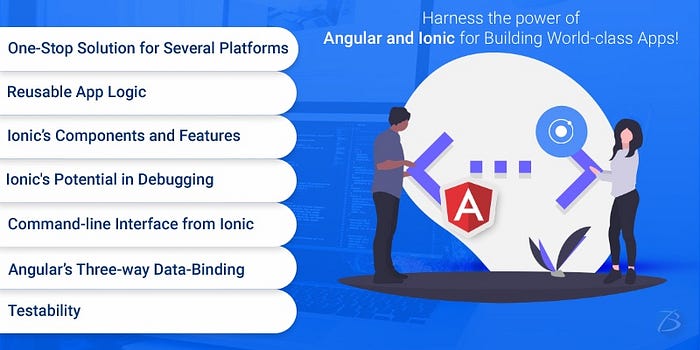
One-Stop Solution for Several Platforms:

Earlier, the developers needed to create separate codes for Android, Windows, iOS, etc. But AngularJS and Ionic changed this scenario allowing the development of multiple apps with a single codebase. Such apps can be easily downloaded from the app stores and can be run on any platform or device.

Reusable App Logic:

Fusing AngularJS and Ionic enables the developers to separate user interfaces, system logic, and data models. This means that the developers in parallel can reuse the logic and also customize the UI for different gadgets and different platforms like iOS, Android, Windows, etc. This reusability of the app logic has made the process less time-consuming and less expensive.

Ionic Components and features:

Creating innovative icons and splash screens is a challenging task, especially for hybrid app development. For developing splash screens, the developers have to consider several parameters like length, density, width, type of device, etc. Ionic is a native-style UI kit that comes with various amazing features and components for making the development process hassle-free. Ionic’s .png, .ai, or .psd extensions help in building two files that enable smooth development of icons, splash screens, etc., and aesthetically appealing designs.

Angular Three Way Data Binding:

Angular allows three-way data binding which means it enables simultaneous updating of the data model, UI as well as backend data in a hassle-free manner. So, when the in-memory data and UI are in sync with backend service data, the chances of user data staying complete across the devices are much higher. This also means that in Angular, it is easy to take the users’ inputs, process the information, save it on the server, and hence keeping the user interface synched with the backend is much easier.

Testability:

Testing is the most essential process once the apps are developed. It is a complicated and time-intensive process. But AngularJS eases out the testing process to a certain extent due to the Dependency Injection (DI) feature. This feature lets the developers fetch the pieces of the code from anywhere and duplicates the code for testing purposes. This means that the real components are replaced for the ones that fake the functionality.

Additional Benefit of Ionic app development:

Ionic plays a significant role in app development due to its potential in debugging, performance-boosting qualities, and the ability to create attractive UI. The Ionic developers can take advantage of $ionicConfigProvider elaborate transition, style, or behavioral pattern. It creates the elements as per the device’s layout and also abides by the guidelines while utilizing the elements on diverse devices. Also, Ionic apps are built in a modular fashion, hence it is easy to update and maintain the app.

Another noteworthy feature of the Ionic is the Command-line interface i.e. CLI. It enables the development, implementation, and testing of any application on multiple platforms using a single command. This improves productivity and saves time for developers.

Conclusion:

AngularJS framework is known for delivering robust performance and captivating front-end for the apps. On top of that, when it is clubbed with Ionic, it unlocks new possibilities for developing captivating apps. Ionic has attractive themes and the availability of several components that help in the creation of an outstanding UI. This ultimately elevates the user experience and also retains the end-users. Moreover, both frameworks make the development process quite easier and faster for developers and cost-effective for businesses. So, if you want to build apps using Ionic and AngularJS, connect with an Ionic app development company or an Angular app development company and share the ideas with them to build a cutting-edge app.

We hope this blog was useful to you!

Thursday, June 17, 2021

Top Video Chat APIs to integrate into your Video Chat Apps: A Comparative Study!

Today, the demand for virtual communication via audio/video chat mobile apps is higher than ever before! Especially on account of the Covid19 scenario, all sorts of communication starting from private conversations with friends/relatives, student-educator interaction, doctor consultation, to enterprise-level meetings involving clients/employees, are taking place digitally. And this trend of connecting digitally is here to stay for long owing to its numerous advantages. Therefore, integrating video calling features into an app will be a strategic move for every mobile app creator or Mobile App Development Company.

Several companies have already begun embedding this feature in their apps looking at the need of the hour. A robust video chat API and an SDK are required for integrating video chat in mobile applications. The blog gives you a peek into the top video chat APIs to guide you in picking the ideal tool for your upcoming app development project.

So let’s get started. But before we sail further, let’s take a quick look at some of the major aspects concerning video chat APIs!

What is a video chat API and SDK?

A video chat API (Application Programming Interface) refers to the tool that integrates audio and video, for enabling a device or an app to employ real-time video chat functionality. The technical infrastructure is provided by the API for setting up video communication. In other words, API is an interface that makes way for communication and data exchange between various kinds of software. A video chat API is used for directing video/audio calls and sharing files and thus ensuring a smooth communication process.

An SDK (Software Development Kit) refers to a host of tools that ease out the Mobile Application Development process. These tools include visual editors, libraries, APIs, debuggers, etc.

The key features of APIs/SDKs are:

  • Various kinds of conferencing formats
  • Messaging and voice functionalities
  • Screen sharing and recording

Reasons why You should Leverage Video call API and SDK in Your Mobile Apps

  • Both these tools enable businesses to create cross-platform live video conferencing platforms easily and quickly. Besides, robust APIs can be speedily implemented and their use can result in lesser bugs.
  • Their use saves the time and efforts of mobile app developers and they can focus on building the app instead.

How the Video Chats Function?

Video communication takes place between two clients using the VOIP i.e. Voice over Internet Protocol. Check out the steps.

  • The video chat service connected to the internet sends a request to the receiving device of the other person.
  • After receiving the call, the video and audio sent to the device get encoded and then are sent back to the other device.
  • A continual repetition of this process allows the chatting activity to go on for a prolonged period.

Top video chat APIs for Mobile App Development


Twilio

Twilio is a cloud communication platform. It offers programmable video API to craft real-time apps employing cloud infrastructure and WebRTC. Businesses integrating Twilio API can utilize the telecom system in a budget-friendly way.

Features

  • Easy-going, reliable, and properly documented
  • Just a few lines of code can trigger video calling
  • The facility of screen-sharing and co-browsing
  • Control for the media and layout
  • Peer-to-peer communication involving up to four participants
  • Group chat rooms with the capacity to scale up to fifty participants
  • The availability of a recording-storing facility in the Twilio Cloud
  • REST orchestration and webhooks enabling developers to control the creation and completion of a chat room using the REST API

Functions

  • Developers can receive or initiate phone calls via video chat APIs.
  • Supports the development of open-source apps enabling businesses to configure phone numbers for routing phone calls.
  • Provides an additional web service – ‘In the Cloud’ – which allows integration of real-time phone calls into the applications.
  • Its offerings allow one to create a HIPAA Compliant workflow

Check out our blog how to develop a video consultation healthcare app using Twilio!

PubNub

This API leads to the creation of innovative and dynamic chat applications that are reliable. It adheres to enterprise-grade security standards in the apps. PubNub serves the purposes of conducting enterprise-level meetings, conversations, and conferences virtually.

Features

  • Extensive plugins, push notifications, and end-to-end encryption.
  • Broadcasting of messages and transferring of metadata prior to calls.
  • Signaling of WebRTC.

Functions

  • The WebRTC framework facilitates data and audio/video communication across manifold browsers.
  • The “Presence” feature available in the PubNub library, displays the online or offline status of other participants.

Vonage

Vonage, one of the leading Paas companies, offers robust video chat APIs as well as SDKs that simplify the tasks of integrating and customizing video calling apps. The Vonage video API solution possesses enterprise-grade WebRTC abilities and advanced functionalities that enhance the video call experience across various platforms.

Features

  • Cross-platform compatibility, seamless integration, and high scalability
  • Instant messaging and video call encryption
  • WebRTC integration, and telephony interoperability using voice API
  • Provision for one-to-one chats, group chats as well as huge broadcast sessions.
  • Diverse types of sessions: Video and voice sessions, voice-only sessions, or combined chat sessions.
  • The facility of sharing content or screen and exchanging messages between the participants during sessions.

Functions

  • It comes with a library for core features that connects sessions, publishes streams for the sessions as well as streams subscribing sessions.
  • While the core platform for text and video chats is WebRTC, Vonage provides enterprises with an OpenTok video platform that runs on the Java API.
  • With Vonage, medical firms can create HIPAA compliant apps and also receive additional service- BAAs.

CometChat

Employing this Saas-based Video chat API, businesses can add the video chat feature to their mobile app or website. It is a perfect pick for architecting video chat solutions that help businesses exponentially expand their customer base.

Features

  • High scalability, cross-platform compatibility, and ability to integrate 90+ platforms
  • One-to-one and group video chatting/calling functionality
  • End-to-end-encryption

Functions

  • Enables developers to integrate the video chat functionality into the application using the REST protocol.
  • The Restful API ensures a hassle-free video calling process and enables one to manage CometChat on any platform.
  • Allows the processes of creation, removal, and updating users within an app

QuickBlox

QuickBlox API is a perfectly suited platform for multiparty video conferencing. It offers facilities like session creation, receiving callbacks, etc. Owing to its special offerings such as content settings, users, ratings, location, etc. this API is commonly employed by enterprise-grade and social networking applications.

Feature

  • Real-time chat facility
  • Use of WebRTC as the core technology, offering a secure peer-to-peer connectivity
  • Availability of ready-to-go modules like video calling, push notifications, etc.
  • Sophisticated Admin Panel, end-to-end encryption, and secure video/audio calling

Functions

  • This API is easy to integrate and utilizes emerging internet communication technologies.
  • Developers can easily create video chat apps.
  • QuickBlox also sells communication tools to mobile app building companies

Sinch

Sinch SDK offers enriching video chat APIs that powers the application with video, voice, verification, as well as real-time communication APIs. This platform is powered by WebRTC and VOIP and is a great option to use for adding communication into an application.

Features

  • Lightweight SDK
  • Utilizes the SaaS cloud platform
  • Seamless integration
  • Adaptive software for usage across diverse platforms
  • Peer-to-peer support
  • Functionalities like screenshot pause and resume, data calls, etc.
  • Comprehensive documentation

Functions

  • WebRTC API and an adaptive codec selection are employed to ensure premium quality audio and video selection.
  • It allows integrating voice into apps speedily employing hardly a few lines of code.
  • It enables developers to add the feature of video calling to any location around the globe into your mobile app.
  • It offers enterprises the pay-as-you-grow pricing model without any hidden costs.

MirrorFly

This custom-made solution for video calling has in-built WebRTC signaling that runs on iOS, Android, and web apps.

Offerings

  • Live broadcasting, Video conferencing, VoIP, and SIP calls
  • Provision of Screen sharing, real-time instant messaging, push-to-talk option, and Whiteboard
  • Facilities like 100% customization and On-premise/ Cloud Hosting
  • Embedded with low latency technologies and video encoders to ensure top-quality video
  • Charges a one-time license cost

Key Takeaway:

The aforementioned Video Calling APIs are some of the best APIs that can be used to integrate video chat features in the application. So, create a difference by developing a sensational mobile app with the video chat feature or enhance the usability of your existing app by integrating this function.

To know more about our core technologies, refer to links below:

React Native App Development Company

Angular App Development Company

ROR App Development