Showing posts with label e-Prescription. Show all posts

Friday, August 23, 2019

Advanced Technologies that are Driving the Healthcare Industry


A decade ago, had anyone imagined that smartphones and advanced technology would drastically change the way businesses work? If we consider the healthcare industry, today there are numerous medical app solutions for doctors and patients in the market. These solutions are time and effort-saving systems for hospitals, clinics, and similar medical organizations. These systems help manage the appointments, save medical records safely in digital format using Electronic Medical Records (EMRs) and Electronic Health Record (EHRs), enable instant payments, provide online assistance, e-Prescription, etc. They ensure better connectivity, transparent processes, and efficient operations.

Technologies like Artificial Intelligence (AI), Internet of Medical Things (IoMT), Wearables, etc. are bringing something new every year to enrich the healthcare industry. As per Statista, a leading business data platform- revenue generation from just artificial intelligence systems since 2013 to 2021, globally, will be 6.7 billion U.S. dollars. Huge scope!  

These emerging technologies have given promising solutions to handle the routine healthcare-related tasks and overcome other challenges in medical organizations. In this article, we will learn about the latest technologies influencing the healthcare industry.

Technologies Used in Medical App Solutions for Doctors:

Wearable Technology

Smart-watches, fitness trackers, etc. are very useful in monitoring and gathering essential health data of the patients. These devices and systems can be life-saving as the doctors can give proactive medical care in dangerous health situations. The wearable devices, when merged with medical app solutions for doctors, provide accurate and real-time information of the patients which helps the doctors/physicians take informed-decisions.

Internet of Medical Things (IoMT)

Internet of Medical Things (IoMT) is another new-age technology that provides digital health solutions to increase patient engagement. IoMT uses sensors and similar systems to collect and transfer health information like blood pressure, weight, oxygen levels, heartbeat, blood sugar levels, ECGs, etc. It allows remote examining of patients and thus, reduces the costs of healthcare solutions.

Artificial intelligence (AI)

Artificial Intelligence (AI) has been a game-changer in healthcare. For instance, after performing a medical test, it used to take at least a week to get the results. However, AI has dramatically improved services like body scans, diagnostic capabilities, customized treatment plans, predicting diseases, and other tests. AI plays a vital role in enhancing the practice management system in healthcare. It improves the capacity to store and process large amounts of medical data.

Other Technologies:

Blockchain, Chatbots, AR and VR

Blockchain technology has influenced online transactions while improving transparency and reducing financial business costs. This technology secures important data like Electronic Health Records (EHRs), insurance claims, etc. from breaches.
Chatbots are trained and programmed messengers which are used to chat with customers in real-time and provide information as the humans do. They help to enhance service delivery and provide faster responses to customers.
Augmented Reality (AR) and Virtual Reality (VR) technologies are taking the healthcare industry to the next level of advancement. These technologies are already being used in different treatments. For instance, to remove the tumors safely, neurosurgeons use AR technology.

Conclusion:

The motive of advanced technology is to provide preventive care, personalized medical treatment, reduce the expenses, enhance patients’ experiences, and big data processing. Using the above-mentioned technologies, healthcare IT service providers in Texas have helped several hospitals, medical practitioners, medical institutions and patients and improved care.
For instance, a practice management system in healthcare has proven to be an efficient tool in streamlining the workflow, enhanced automation and improved productivity, which has ultimately led to quality patient care. Likewise, a doctor on-demand solution helps needy patients to instantly find and book a doctor. Also, for the safety and security of the sensitive healthcare data, these solutions are made HIPAA compliant.
The future of healthcare will inevitably rely on cutting-edge technologies like wearables, IoMT, AI, blockchain, AR and VR. Many outstanding discoveries are awaited that will shape various healthcare solutions.

Friday, June 21, 2019

How Digitalization Boosts the Patient Experience

“The good physician treats the disease; the great physician treats the patient who has the disease. – William Osler, a famous Canadian physician” How true these lines are! It is so necessary to think beyond the clinical needs of the patients.
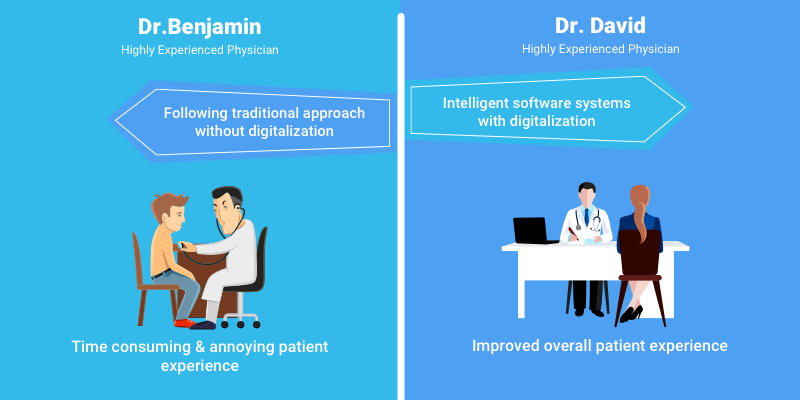
It’s all about how the patients are treated and made to feel. Let’s consider a hypothetical scenario. There are two highly experienced and popular doctors in the city, Mr. David and Mr. Benjamin. Recently, Mr. David has started incorporating some intelligent software systems in healthcare that use digitalization to improve the overall patient experience. To ensure that patients don’t wait in the long queues, Mr. David has started using a patient scheduler mHealth app. For saving their medical records, bills, etc., Mr. David has incorporated a digital system, so that even if patients forget or misplace their documents, all the records will remain intact. However, Mr. Benjamin is still following the same traditional methods to approach and treat the patients.
What do you think? Whom will the patients prefer over time?
Technology is making a massive difference in the healthcare industry. Automation, healthcare IoT and other technological advances are greatly improving the medical practices and ultimately the patient experience.

What Factors Enhance the Patient Experience in Hospitals?

Along with in-hospital experience, patients are also influenced by pre and post-treatment experience. Technology can be used to engage the patients by providing them proactive information and guidance about their health conditions or appointments with doctors through dedicated medical apps. There are mobile apps that make it easier for patients to approach the facilities of the hospital.  Likewise, to get feedback about what makes them satisfied, it is necessary to talk to them and also conduct surveys to get better information.
Today, advanced technology is playing a crucial role in enhancing the patient experience. Using digital transformation and IoT in healthcare can help to organize the patients as well as the hospital staff. A mobile app that is designed for scheduling doctor appointments enables the patients to do it sitting at their homes in their available time zones. Digitally managed clinic staff schedule software improves the communication between staff and enables them to handle more tasks without any hassle. Electronic medical records or EMRs are helpful in saving digital versions of different medical papers, charts, etc. related to patients.
When hospitals and clinics incorporate such tools and technologies, it certainly improves the quality and efficiency of care.  However, the safety and security of the data is an important factor in healthcare. So, healthcare apps need to be HIPAA compliant. The data like personal information of patients (like their names, contact details, etc.) and other medical information in the hospitals must be protected. This can be assured when the apps are HIPAA compliant.

How Digital Technology Influences Patient Experience?

  
What Factors Enhance the Patient Experience in Hospitals
Digital technology is a key enabler of a successful patient journey. Many hospitals have already started using certain tools, software, apps, etc. for enhancement of overall patient experience; a few of them are specified here.

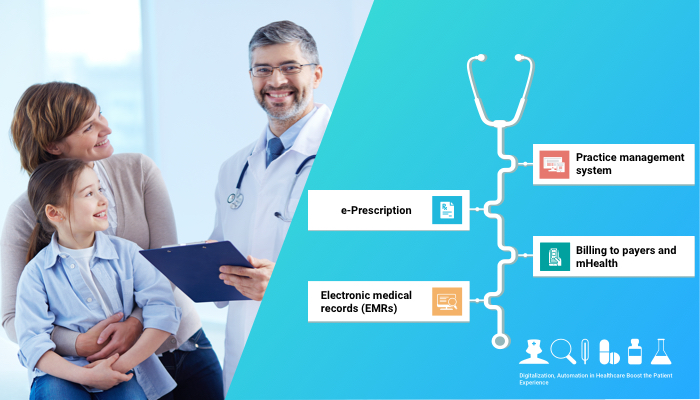
Electronic Medical Records (EMRs)

EMRs have been playing an important role in improving the healthcare industry. EMR is a tool that digitalizes patient records and keeps track of the vital information related to patients. These files and records can be accessed and used by concerned doctors to provide the care quickly and accurately. EMRs increase efficiency and they reduce documentation errors. The doctors and other staff don’t need to spend time in searching records in files, as the information is available at the click of fingertips through EMRs.

Practice Management System in Healthcare

Practice management system in healthcare (or PMS) is software that deals with several day-to-day tasks of clinics and hospitals. PMS helps to automate some tasks like paying and tracking bills, documenting clinical tasks, maintaining a list of insurance payers, measuring practice performance of doctors, etc. It can also be used in automating the tasks at multiple branches of a hospital. Practice management system in healthcare helps to streamline many time-consuming tasks which ultimately increases productivity and provides better ROI.
A good example of PMS is an emergency physician scheduler mobile app. Such an app connects the patients to doctors within minutes in case of emergency and their lives can be saved. At other times, the doctors can guide the patients to take precautions to avoid any bad health conditions.
Investment in a PMS will always be a cost-effective decision as it helps to manage multiple tasks of the staff members. Wearable technology, monitoring equipment, etc. embedded with IoT in healthcare play a vital role in tracking patient health. The reports of their health are automatically saved and reminders are sent to the concerned departments. When PMS is integrated with EMR, scheduling different tasks, billing, etc. becomes much faster and easier.

Billing to Payers and mHealth

When patients have any insurers or third-party payers involved while paying the hospital bills, billing to payers and mHealth (mobile health) facility automates some tasks. Depending on the insurance policy, that the patient has a tie-up with, a particular billing amount is automatically deducted and the patients can instantly pay the remaining amount. mHealth is also useful in guiding and educating the patients, giving reminders of appointments, taking feedbacks from them, providing remote care to them, etc. It is necessary to develop mHealth apps that are HIPAA compliant for the protection of all the medical data. HIPAA compliant apps build trust in patients.

Home Healthcare and e-Prescription

Home healthcare includes various services like monitoring health status, assisting in daily activities, medical tests, wound care, etc. which are provided to patients in their homes. An example of a home healthcare app is Phlex65. The senior citizens may find it difficult to get professional caregivers instantly in case of an emergency. Phlex65 connects them with caregivers in real-time whenever necessary. Caregivers can guide them in daily activities like personal care grooming, assisting in the transfer, taking medicines on time, cooking, assistance with bathing, light housekeeping, etc. The caregivers can also take them to doctors in case of emergency.
In case of emergency, when patients cannot visit a hospital, the doctors can instantly send ePrescription to them for time being a relief. It is directly sent to the pharmacies through dedicated software. Instead of waiting for handwritten prescriptions, the electronic prescriptions also help to avoid the errors which sometimes result in the selection of incorrect medicine or dosage and omission of certain information.
As a preventive measure, people can use wearable devices like heart rate and blood pressure monitoring cuffs, glucometer, etc. to check their fitness levels, track heartbeats, monitor glucose levels, etc. Whenever the levels are below or above the normal limits, these wearable devices send the data to patients and make them aware of it. The patients can immediately take e-Prescription from the doctors and consume preventive medicines. IoT plays a crucial role here as devices are connected to software systems to provide accurate health information.

Conclusion

Profits of a hospital are directly proportional to the satisfaction of patients. So, it has become crucial for hospitals to be proactive and incorporate advanced technology. To survive in the cut-throat competition, hospitals have to take steps to deliver special care experience to their patients. Digital technologies like EMRs, PMS, patient scheduler apps, e-Prescription, mHealth, etc. are transforming the healthcare industry at a fast pace. They give more power to the patients to choose the best for them in their convenience. These are more efficient and save a lot of time of both- the patients and hospital staff.
Ultimately, the hospitals delivering the best patient experience using digital tools will be the ones who excel and profit.

Friday, May 31, 2019

How a Mobile App Supports Practice Management?


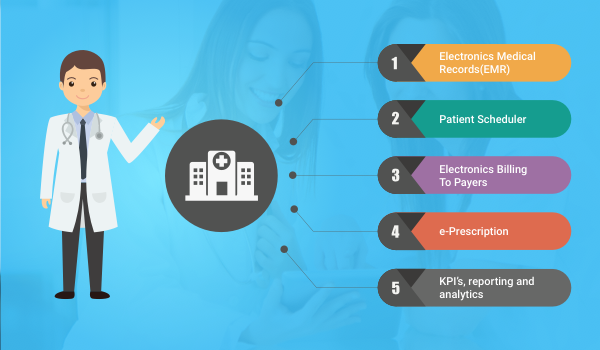
Managing the patients and staff is the most important part of a hospital. A practice management system in healthcare (PMS) can efficiently manage several tasks like booking the appointments for patients, assigning them the respective doctors, paying the bills, saving patient’s reports, giving online prescriptions, etc. This will reduce the workload of your administrative staff and they can focus on various other tasks. For instance, one of the ways to book an appointment with the doctors in their available time slot is through patient scheduler software. 
According to Statista, a popular online portal for statistics, the numbers of medical apps available on Google Play Store were 37,143 from 2015 to 2019 and these numbers are rising. Statista also estimates that by 2025, the market will grow to about 11 billion dollars. As per InformationWeek, a digital magazine, about 80% of doctors regularly use mobile phones and medical applications. 
The reason for such a huge growth of mobile apps and systems in hospitals and healthcare is the efficiency of operations they provide. A mobile app is a very effective tool to captivate the users as well as streamline the functioning of the hospitals. 
If you want to know how a medical app can help you to boost the functionality of your hospital, providing good service to patients have a look at the below points: 

Patients’ Reports in Hand
There are specialized healthcare apps and systems available for saving all the reports and prescriptions of the patients online. These patient-centric systems are called EMRs or electronic medical records (EMR) systems. So, the patients don’t need to worry much about keeping the physical papers in hand or forgetting or misplacing them. 
Also, using a PMS, the doctors can provide e-Prescription to patients in case of an emergency. Reports can be saved online and doctors of the same practice can access them at any time, from their desktops or smartphones. 
Appointment Booking for Patients
A few years back, the patients had to wait in long queues or frequently call the receptionists to fix the appointments. However, today, there are some mobile apps which display the timeslots of the doctors and patients can book appointments sitting at their homes. This saves the time of both, the patients as well as the doctors. Such apps also send reminders to both patients and doctors, before the appointment, making the whole process hassle-free.  
Convenient and Instant Payments of Bills
Bill payment in hospitals is another hectic process. Manual payment is not only time consuming, but also annoying at times. However, using mobile apps, bills can be paid immediately, cutting down the lengthy procedure of waiting in a queue to pay them. Today, billing to payers and mHealth apps have changed the traditional ways of payments. Also, the patient can have multiple payment options to pay and connect to their insurer, online through apps. It not only improves the billing experience of the patients but also helps customer relationship management (CRM).  
Higher Efficiency with Practice Management System in healthcare
With proper management of patients and doctors, hospitals can ensure higher productivity. A practice management system in healthcare is a powerful way to automate certain activities like billing, tracking, etc., documenting and recording vital data and communicating with patients. These systems have all the data at a centralized system so that any doctor can avail their electronic medical records (EMR) and provide optimal solutions to them without wasting time. The doctors can pay attention to many patients in lesser time. There are some medical apps that enable doctor-patient communication, using the facility of sending messages, live chat, video calling, sharing images or files, etc. It helps to treat the patients from another location, in case of an emergency.  
A HIPPA Complaint Medical App Increases Trust of Patients
HIPPA (Health Insurance Portability and Accountability Act) compliant apps ensure the protection of privacy and security of important data in the hospitals. It helps to reduce the errors in hospital processes, improves the quality of care to patients and increases the trust and satisfaction of the patients. Today, complying with HIPPA has been a top priority of every hospital.  
Building Customer Loyalty
An efficient medical app can ensure the loyalty of the patients. When patients can fix the appointments sitting at home, when they can do instant payments with ease and when they could get treatment immediately in case of emergency, of course, they will choose your service. They will be loyal to you and even recommend to others.  
Higher Productivity and Profits
Incorporation of PMS and advanced apps in the hospitals reduce various tasks of the doctors and enable high-quality service to patients. A hospital app helps in the effective management of tasks, setting clear goals for staff and monitoring their implementation to deliver better. Some apps also allow the patients to give feedbacks, which can be used to study customer behaviour. The flaws can be corrected to provide better service in the future. This ultimately increases the profits of the hospital. 
Build Hospital Reputation
When your hospital has a digitally advanced app, it enables a positive patient experience, improving the hospital reputation. A mobile app also collects data about the patients, which is helpful in determining any shortcomings and applying patient-centric marketing strategies. It is a great way to entice patients. 
Conclusion
practice management system in healthcare or mobile health app makes all the operations in a hospital smoother to add value to the patients. There are many hospitals in the market that have already started using a personalized mobile app for themselves. Big hospitals, private clinics, training centres, dispensaries rehabilitation centres, etc. can be more efficient with the use of a dedicated mHealth app.