Showing posts with label Robotic Process Automation. Show all posts

Tuesday, May 5, 2020

RPA Use Cases and Benefits: Redefining the Progress of Manufacturing Sector with RPA!


Is Robotic Process Automationthe next game-changer in the manufacturing sector?

The manufacturing sector, the backbone of any economy, faces numerous challenges on a daily basis. Manufacturers need to manage processes like inventory management, procurement, payroll, etc. while ensuring cost-effectiveness. Many of these time-intensive processes rely on manual efforts. But thanks to RPA Software Solutions! This technology has helped to effectively manage backend and operational processes enabling higher productivity and efficiency.

Best Use-Cases of RPA in Manufacturing Industry

Invoice Processing
Manufacturing companies need to handle massive amount of invoices. Traditional invoicing processes involves various activities like monitoring of invoices, capturing invoices, cross-checking invoices against order records, recording this information in system, make necessary settlement of payments. All these activities are not only time-intensive but can lead to critical errors as well. Correcting such errors can result in late payments and losses too. With the help of OCR technology in RPA, data can be captured and sent to different systems in a matter of seconds. So using RPA in these manual time- consuming processes can help in automating the data inputs, reduce human errors and save the processing time.

Manage the Bill of Materials (BoM)
BoM is the most crucial document in manufacturing industry. It contains the list of raw materials, components, subcomponents,assemblies, etc required for production. If there are any manual errors in the BoM, it can lead to wastage, defective products, haphazard inventory management and even delay in shipment. However, implementing RPA ensures that there are no manual errors in the BoM and its accuracy increases. This also streamlines the supply chain operations. It helps in inventory management, reducing inventory waste, increasing production efficiency and maintaining the timelines for delivery.

Data Migration
In the manufacturing sector, data migration from one system to another is required very often for regulating the policies of business. Also, when a company brings in new systems or acquired new business, data migration is needed and it may take a very long time. RPA tools are the perfect solution for migrating data. Appropriate execution of RPA helps to automate such processes while saving time for the workers and engineers.

Administration and HR processes
RPA techniques have made the administration and HR processes quite easier by ensuring all the employee reports are gathered in a few clicks and transferred to required systems with ease. RPA contributes in the enhancement of the HR processes like salary data collection, pay slip generation, workforce planning, report generation, employee performance, labor and employee relations, sorting candidate resumes into databases, evaluation and sourcing of candidates and providing necessary information to the candidates.

Maintain Logistics Records
Recording the details of every carrier and freight entering or leaving the manufacturing plant or warehouse is tedious and difficult. Maintaining records of all the transactions, notifying the clients about shipping charges, ETAs, etc. can get quite challenging especially when these processes are manually carried out. RPA in manufacturing helps to automate many such processes like recording times, shipping charges, etc. and reporting it in real-time, sending notifications to clients, etc.

ERP Automation
Integrating RPA software solutions in ERP can be highly advantageous in resource-planning. The reports for inventory management, Accounts Payable and Receivable, etc. can be generated automatically and saved digitally for smarter business decision-making.  RPA can very efficiently manage different financial services as well like Bank Reconciliation, procurement and payment, etc.

Potential Benefits of RPA in Manufacturing Sector
  • RPA software solutions help in optimization of mundane time-centric processes
  • They help to increase productivity and efficiency and thus, go-to-market speed
  • They increase the cost-savings by minimizing human errors, reducing wastage and improving ROI
  • RPA helps to enhance the agility in operations
  • By replacing the traditional error-prone systems with more reliable digital ones, manufacturing capabilities can be extended
  • RPA combines machine memory with human intelligence which leads to insightful decision-making
  • Thus, RPA contributes to delivering flawless products and upgrades the customer experience


Final Thoughts:

Robotic Process Automation is transforming the Manufacturing sector with smarter solutions. It is helping the manufacturers to unlock the potential of their management, production, administration and almost every functional sector. Powerful RPA tools are already helping various companies to improve the cost-effectiveness and maximize the ROI. 

Is your manufacturing company leveraging RPA technology?
Contact Biz4Solutions, a reliable provider of RPA software solutions. 

We can help you stay ahead of your competitors with our cutting-edge RPA services!

Monday, March 23, 2020

Why Automation Anywhere is a highly preferred RPA tool?


Businesses all over the world are looking for solutions to streamline and automate their business processes while saving time, improving efficiency and gaining profits. Robotic Process Automation aptly serves this purpose. This technology uses the virtual workforce i.e. robots software to execute the tasks instead of humans. It is being widely used in diverse industries like healthcare, manufacturing, retail, banking, Transport, Insurance, and Construction, etc. It is replacing the traditional ways of automation at a fast pace.

How RPA is better than Traditional Automation?
When compared to traditional ways of automation, RPA is considered a full-fledged automation system and can be quickly implemented. In traditional automation, the machines perform the tasks and steps of operational processes. In RPA, automation is related to the front-end of the systems and is carried out without the need to move to the back-end.

Traditional automation requires manual intervention from time-to-time as it only works on the programmatic instructions given. On the other hand, RPA is a self-managing way; it mimics user actions and takes decisions cognitively to perform actions.

Due to limitations in the programming languages in the traditional automaton, it is difficult to automate complex systems. However, in RPA, there is a lesser dependency on the system architecture.

Though, RPA will never replace the traditional automation techniques completely, yet, it is highly preferred in most industries. It is easily scalable and cost-effective investment in the long run.

Now, let us have a look at RPA tools. They play a significant role during implementation of RPA Processes. There are several tools accessible in the market, for example- Automation Anywhere, UiPath, Work Fusion, Blue Prism, etc. In this article, we are going to know in brief about Automation Anywhere.

One of the best RPA tools- Automation Anywhere
Automation Anywhere is the only cloud-native and web-based RPA platform powered by AI experience. It is being used by over 3500 customers across the globe in more than 90 countries today. It is the most widely-deployed platform amongst all other. This platform provides capabilities to automate complicated operations in businesses that are usually performed by humans. This RPA vendor is progressing at a fast pace and its future seems bright.

The Architecture of Automation Anywhere
It is a client-server based distributed architecture and has three principal components in it:

Control Room:
This is the core component or the brain of this architecture. It is a centralized control and management layer that handles Bot Creators (creation of bots) and Bot Runners (bot execution). It provides features like source control, state of bots, dashboard, license management, etc.   

Bot Creators:
This component is used for bot development and editing. Bot creators are desktop-based applications used for uploading and downloading the bots. The bot code is stored in the Control Room and all the bots can be combined and executed simultaneously.

Bot Runners:
This component is used for the execution of the bots and multiple bots can be executed simultaneously. Bot Runners are connected to the Control Room for reporting the status of the execution log.

Features of Automation Anywhere
·         It provides platform independence.
·         It ensures bank-grade security.
·         Since it automates complex business operations, human errors are reduced to a large extent.
·         It enables faster and easier exchange of data between files or applications.
·         It ensures real-time analytics and reports.
·         It enables script-less automation.
·         It has cognitive capability and re-usability.
·         It helps in increasing transaction speed.
·         It supports macro recorders for high-speed process mapping.
·         In Automation Anywhere, there is auto-login functionality to run the tasks, even though the computer is locked.
·         It allows task distribution to multiple computers simultaneously.
·         It offers high security through encryption, authentication and credentials.

Applications where Automation Anywhere is used
·         The banking industry uses this RPA tool for compliance processing, loan processing, customer account management, etc.
·         The insurance industry uses Automation Anywhere for processes like report automation, claims processing and administration, prioritize and assign claims, etc.
·         Healthcare organizations use it for forms processing, inventory management, digital invoice generation, etc.
·         The manufacturing industry uses Automation Anywhere for corporate billing reports, sales order systems, payroll processing, purchase and order processing, supply chain management operations, etc.

Key Takeaways:
We have seen an overview of Automation Anywhere. It is fastest to scale and secure by design. This user-friendly tool is already being used by several medium and large-sized organizations for automating their data entry and mundane tasks. It saves time and cost on manpower to a great extent.

Biz4Solutions is a leading RPA service provider in Texas. We have automated in-house processes of several global clients using Automation Anywhere tool. Drop us a line to know how our RPA services can take your business to the next level!

Monday, November 11, 2019

How Robotic Process Automation Is Shaping the Future of Different Businesses?


According to the prediction by Deloitte, a leading Consulting and Advisory firm, Robotic Process Automation (RPA) technology will be used by almost all the companies in some or the other form in the next five years.

This technology has been a game-changer for several industries leading to reduced risks in processes, higher efficiency and increased profits. It has transformed tedious and complex business processes into simple and easy ones. Whether recording data or transferring files or sending automated replies, RPA allows the organizations to streamline critical processes. It minimizes human errors to a large extent while managing numerous tasks at the same time.

What is Robotic Process Automation (RPA)?
Robotic Process Automation (RPA) is a revolutionary technology that uses software with machine learning capabilities and artificial intelligence (AI) to automate critical tasks in organizations. The mundane tasks which need significant human intervention can be automated using this technology.
Today, businesses are advancing and looking for solutions that enhance operational efficiencies while saving cost and time. RPA has come up as an ultimate solution to this, providing the following benefits:
  • Streamlined and standardized processes
  • Efficient resource management
  • Operational flexibility and scalability
  • Better visibility into process performance
  • Minimization of human errors
  • Better compliance with standards and regulations
  • Enhanced customer experience
  • Increased workforce optimization and satisfaction
  • Cost optimization
  • Low-maintenance of the tools
It shows how powerful this technology is. So, for succeeding in today’s fast-paced market, many companies are integrating RPA solutions in their work processes.

How Robotic Process Automation is transforming different business domains?
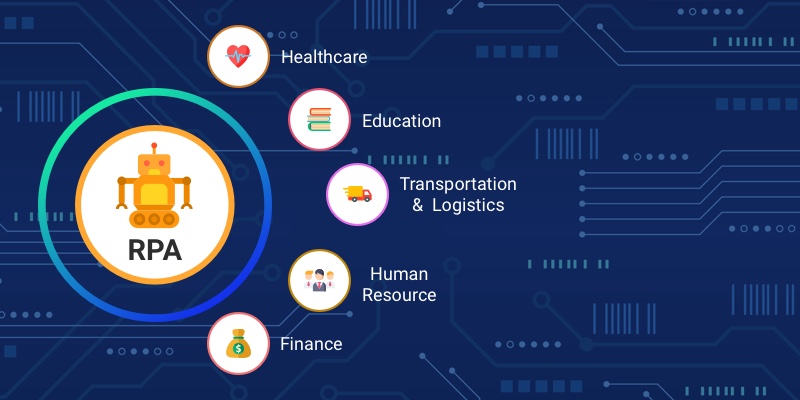
All around the world, RPA has been influencing businesses in an unbelievable way with the artificial workforce or software bots. It has impacted different industrial sectors like healthcare, transportation and logistics, finance, human resource, education, etc.

 
RPA in healthcare
RPA technology helps to automate administrative tasks for hospitals, clinics, and individual practitioners as well. It significantly contributes to improving the patient experience in the following ways:
  • Automation in claims management leads to faster and error-free processing which saves time for healthcare administrators.
  • Billing efficiency is improved as the bots perform data entry tasks with high accuracy. RPA bots can calculate billing amounts, payment delays, send updates of bill amount to the patients.
  • Digital recording of contact forms of the patients, audit procedure, etc. is possible.
  • Automatically notify discharge instructions to the patients like upcoming appointments, precautions to be taken for certain medical conditions, etc.

RPA in transportation and logistics
Transportation and logistics industry is being affected by many challenges like trucks traveling empty on the way back after delivery of load, driver shortage, and retention, etc. However, RPA is providing several solutions to tackle such challenges. Let’s see how.
  • RPA automates shipment tracking and scheduling.
  • It helps in eliminating manual processes like copying of data from load boards, extract shipment details from emails, etc.
  • It helps in speeding up invoicing by the integration of systems with customer portals.
  • RPA allows gathering of important insights that help in improving the forecasting and planning of logistics.
  • RPA bots help in giving faster responses to customer inquiries.
  • It automates order processing and payments

RPA in Finance
Processes in finance companies require lots of searching, comparing, matching and filing of data. Endless forms, applications, endorsements, and declarations need to be recorded, reviewed and processed. Manual intervention can be time-consuming and lead to mistakes. However, RPA software solution helps in faster and accurate business processes in the following ways:
  • RPA helps the finance firms to enter data into ERP systems and create standard journal entities.
  • It helps in financial planning and analysis.
  • Collect and manipulate information to support regulatory reports.
  • RPA bots help in sending reminders and notifications of late payments to concerned individuals and organizations.

RPA in Human Resource
Human resource departments include several manual processes and repetitive administrative tasks that can be automated. RPA software solutions free the employees from the burden of such tasks and make the workplace more human-centric. These solutions can be implemented in HR processes like payroll, on-boarding, tracking feedback forms during recruitment, tracking in-out timings, etc. in the ways mentioned below:
  • RPA bots handle tedious processes like resume screening, candidate shortlisting, etc. while recruiting. Bots transcribe new hire data from different systems and record it at a centralized system with accuracy.
  • RPA solutions help in tracking and validating the employee data, in-out timings, etc. and document it in multiple systems.
  • Adopting RPA in payroll processes helps in salary data collection, benefits disbursal, payslip generation, etc., while adhering to regulatory payroll norms and standards.
  • Robotic solutions manage workforce planning, employee performance, compensation and benefits, report generation, employee health and safety, labor and employee relations, etc.

RPA in Education Industry
Today, modern education systems are applying automation in various tasks that are rule-based, time-consuming and frustrating. RPA solutions improve the efficiency of processes like admissions, attendance, emailing, scheduling meetings, grades, assignments, admin, and finance, etc. Let’s explore how.
  • RPA solutions help in managing students’ and staff’s attendance, schedule meetings, timetables, etc.
  • It automates tasks like sending notifications, exam updates, event updates, and progress reports to students and parents.
  • In the enrolment process, RPA tools can check application forms, student’s eligibility criteria, validate the documents and shortlist the candidates.
  • RPA chatbots help in replying to general queries related to the admission process, admission schedules, course information, contact person, etc. to the students, staff members, website visitors, etc.

Final Words:
To stay competitive, all businesses need to boost their operational efficiency. If the tasks are partly or entirely automated, the workforce can be well-utilized to increase productivity and reduce service costs. RPA software solutions have potential to make this possible. They also enable proper documentation of the processes which help in tracking data insights for smart decision making. Needless to say, RPA has a huge potential and many organizations are implementing it at a fast pace.
 Biz4Solutions is a global Robotic Process Automation Company providing cutting-edge automation solutions to various industries. If you want to leverage the RPA automation in your business, we can be your technical partner. Get in touch to know more.

Friday, July 12, 2019

How RPA Improves the ROI in Various Industrial Sectors?


Automation has been playing an exceptional role in improving business processes in multiple industrial domains. Process automation isn’t new to the industries, but, Robotic Process Automation (RPA) is an advanced way to automate the business processes with the help of “software robots”. Using RPA, the traditional ways of performing manual tasks are replaced by smart solutions. For instance, an RPA bot can interact with systems, similar to the humans do.

RPA isn’t a physical robot but a virtual system meant to automate several processes. In Robotic Process Automation, intelligent software robots are utilized for automating the tasks, which offer increased operational efficiency, better process quality and enhanced safety of data. Due to this, many businesses are rushing to employ this emerging technology in their work processes.

As per the records from Statista, a leading online platform for business statistics, the global expenditure on RPA software in 2019 will reach up to 1.3 billion U.S. dollars. Huge numbers! Also, research by Gartner, the world’s famous research and advisory company, claimed that 96% of worldwide customers get real value from RPA.

RPA is a cost-effective solution where smart software robots are used to automate the manual, repetitive and tedious tasks that humans could take hours to accomplish. Let us explore a few industries which have been benefitting enormously from RPA.

Healthcare Industry
In the healthcare industry, implementation of RPA can reduce paperwork and automate clinical tasks with higher accuracy. For instance, software robots can automatically schedule patient appointments. The data entry processes can be automated by bots, which saves the labor cost and also improves efficiency. A large amount of medical data like personal health information, medical reports, etc. can be monitored and recorded effortlessly with the use of RPA systems.

Finance Domain
RPA eliminates manual work and increases the efficiency of financial processes. It can be applied to different processes in the finance industry like accounts payable, accounts receivable, controller work, financial close, expense management, financial planning and analysis, etc. The data-gathering and data-entry tasks can be automated while saving the time of the staff members. They can work on high-value tasks that need critical thinking and decision making, while the robots handle the data entry work. In the banking sector, loan-processing can be automated for faster and accurate results. RPA can work 24/7 while maintaining the efficiency of work.

Manufacturing Sector
Manufacturing firms have many important departments that need RPA. Billing of materials, customer support, administration, ERP, data migration, logistics data, etc. processes can employ RPA to keep the record of data, automate tasks and manage them with accuracy. In supply chain management, RPA helps to improve communication along with inventory management and order processing. It allows the employees to be more strategic and innovative in the work. Thus, RPA improves productivity that ultimately enhances the return on investment (ROI) of the manufacturing industries.

BPO Industry
Leveraging automation in BPO isn’t a new thing. BPO sector has most of the work processes that are dependent on data-entry. Such back-office processes are accurately and consistently carried out using RPA. Data entry, its validation or manipulation, sending email notifications, extracting ERP data, automatic formatting, uploading or exporting, downloading or importing, work-flow acceleration, etc. processes utilize RPA solutions. When these tasks are automated the employees can devote more time in providing better customer service. It is a low-cost ‘quick fix’ for the BPO sector. Also, the level of security that the application of RPA offers in BPO processes is exponentially higher.

FINAL THOUGHTS
Manual tasks like manipulating data, processing a transaction, communicating with other systems, triggering responses, etc. are successfully automated using the RPA tools like Automation Anywhere, Blue Prism, UiPath, Inflectra rapise, etc.
If implemented properly, RPA yields expected results of cost savings in 24 to 36 month period approximately. RPA also results in service improvement, enhanced regulatory response, transformative services, etc. Some of the pre-requisites to achieve early ROI are:
  • Identifying appropriate tasks for automation
  • Designing and implementing the right processes
  • Choosing the right tools

With such huge potential, many organizations are drawn to invest in RPA. Along with healthcare, finance, manufacturing and BPO, other sectors like Telecom, IT, retail, utilities, insurance, etc. sectors are also focusing on the implementation of RPA at a fast pace.