Healthcare apps and wellness trackers have gained traction during the last decade. And, the social distancing protocol enforced by the pandemic has accelerated the adoption rate of health apps like never before.
Check out these interesting stats on healthcare application development and usage as per a study conducted by the online research portal sourcetoad.com:
- Healthcare app development has sky-rocketed with an average of 250 apps launched daily.
- The market value of medical apps was $40.05 Billion in 2020. According to industry experts, this value will reach $100 billion by the year 2023.
- Healthcare app categories like telehealth and virtual care have gained more popularity as compared to other categories: 74% of consumers preferred telehealth services and 57% vouched for virtual care apps.
Healthcare apps come with endless benefits to patients, practitioners as well as care providers. But, are all health apps secure and reliable? Health apps have their share of downsides as they handle personal patient information and sensitive medical data. Many are raising questions on the ethical implications of patient data handling processes as well.
Let’s discuss in detail the advantages and downsides of medical apps. Also, learn about the corrective measures and best practices to mitigate the existing bottlenecks in the healthcare app industry.
Healthcare App Advantages

Advanced Patient Services
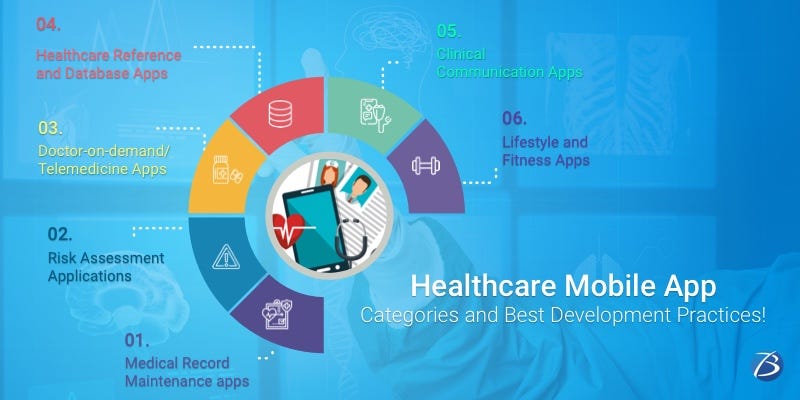
Telehealth apps offer convenient patient services like online appointment scheduling/rescheduling/cancellation, remote doctor consultations for common ailments, and e-prescription uploading. Advanced communication capabilities like preliminary diagnoses via video conferencing and instant interaction with doctors and other medical professionals using text messages, emails, voice calls, etc. simplifies things for the patient community.
Reminder apps and e-prescription apps facilitate chronic disease management. These apps help patients to stick to stringent medication regimes, set reminders for pill intake, and refill medicines before it runs out of stock. Pharmacy applications enable online medication ordering and door-step delivery.
Clinical Assistance
Clinical assistance apps offer supportive software for medical practitioners. Such apps come with medical calculators, clinical decision-making functionalities, and disease diagnosis assistance functions. Medical professionals can benefit from the various references and databases providing information about drugs, healthcare terminologies, medical conditions, symptoms of diseases, and guides on medication compatibility.
Healthcare Data Storage/Management

Healthcare facilities need to handle humongous data and hence data management becomes challenging with traditional solutions. However, healthcare apps integrated with EHR (Electronic Health Records) simplify the processes of organizing and managing data effectively. These apps automatically gather and record patient data like personal information, demographics, previous treatment history, allergies, chronic conditions, immunizations, radiology reports, billing info, etc. from different sources. EHR systems enable providers to store medical data in a way that promotes clarity, transparency, and accuracy.
EMR (Electronic Medical Records) stores information about patients’ clinical data, ongoing treatment particulars, etc. Such records help clinicians monitor patients in a better way, assess how patients are responding to a specific course of treatment, and find out the patients who are due for follow-up visits or preventive screenings.
Medical database software converts patient data like healthcare/treatment history, medications, imaging/lab results, procedures, etc. into electronic data. This data is categorized by employing various filters and is stored for internal usage within the facility.
Wellness Tracking: Wearables & Fitness Apps
Fitness applications track the health vitals of users including steps walked, calories burnt, heart rate, water consumption, body weight, etc. using wearable devices. This provides users with quantifiable data on their health parameters and level of fitness. These apps also set fitness goals for users and offer dietary suggestions, encouraging them to practice a healthy lifestyle and adhere to wellness regimes. Users get reminders for activities like drinking water, exercising, and so on. Some fitness apps even make use of intelligent strategies like offering positive feedback and even gamification for motivating users toward a healthy lifestyle. Such apps monitor users’ health vitals and provide a report of their progress periodically. The users can share their fitness-related success stories on social media amongst like-minded people and also opt for joint wellness experiences on social media.
Today, fitness apps are leveraging Artificial Intelligence to obtain the best user outcomes. Machine learning/deep learning algorithms autonomously analyze the healthcare care data collected by the app and the users’ behavioral patterns gathered. This information is then compared with generic human health data contained within a database and matched with the most befitting predefined use case. The algorithms then, draw conclusions and provide users with customized suggestions and corrective measures regarding exercise regimes and diet.
Valuable Informational Resources
Healthcare apps are often a valuable and easily accessible storehouse of informational resources for medical students. Students utilize this information for gaining insights on health conditions, treatment, & medication, preparing notes, and drawing inferences. Moreover, apps offer online study material, lectures, healthcare podcasts, drug references, medical guidelines, healthcare calculators, and even quizzes/tests on medical topics.
Practicing HCPs also benefit from the resources and information provided in healthcare applications. Important case studies can be referred to while treating complicated cases and conducting surgeries.
Healthcare App Downsides & their Ethical Implications
Despite the endless advantages of healthcare applications, this approach involves downsides that raise ethical questions as below:
- Is there any protocol to ensure whether clinical data is being entered for the right user at all times?
- Is patient data completely protected from security threats and hackers?
- Where does the healthcare data get stored and who can access this data?
- Can the PHI of patients be used by the app owners or sold to unreliable third parties?
- Can users completely trust the content published and the results generated by healthcare apps?
Let’s explore these aspects in detail!
Data Authentication Errors
Several apps fail to verify whether the clinical findings, e-prescriptions, and other medical diagnoses details are being entered into the profile of the right patients at all times. As a result, the chances of costly errors are quite likely. Such errors may lead to misdiagnosis, wrong treatment/medication, ending up causing harm to patients, and can even be fatal for patients. Furthermore, erratic data may adversely affect clinical research. If incorrect information is used for forming therapeutic deductions, the effectiveness of the research will be hampered and could put billions of investments at stake.
Security Threats
Cyber-security threats like ransomware, phishing attacks, data theft, and unauthorized access can cripple the effectiveness of the healthcare environment altogether. Moreover, data security breaches can lead to hefty fines and penalties for medical entities that have not followed standard security protocols.
Healthcare Data Ownership
Modern-day medical app technologies like AI, ML, etc. can predict user behavior to the minutest detail. And, for obtaining the desired outcome, the relevant contextual patient data including personally identifiable and biometric data has to be fed to the app or system software. Hence, users need to enter personally identifiable data in their profiles and other systems; for reaping the benefits of systems like electronic medical records, biometric scanners, health apps, activity trackers, video doctor consultations, and so on.
Moreover, healthcare data is a valuable source for research teams, analytics identification, and marketers who depend on personal patient data to send relevant promotional offers to their target audiences. As a result, app owners might be tempted to utilize patient data stored in the app as a profitable monetization strategy. Sometimes, data may be sold without the users’ consent in unethical ways to the marketers who offer lucrative deals to app owners.
Clinical Accuracy of Healthcare Apps & the Trustworthiness of App Content
The clinical accuracy and the reliability of quality and scientific correctness of the published content are below average in some healthcare apps and fitness trackers. The anomalies identified in healthcare applications include incomplete information, inaccurate content, variation in content information, improper responses to customer queries, delayed data processing, faulty alarm systems, security gaps in functionalities, and inability to promptly respond to emergency situations. Such inconsistencies may result in life-threatening situations.
Coming to fitness and activity trackers, parameters like step count, health vitals, etc. are not always 100% accurate. This may mislead users in the long run, thereby minimizing the app’s usability.
Corrective Measures for addressing Health App Pitfalls
Data Authentication Protocols
A healthcare app should correctly authenticate the users’ particulars to verify whether the right person is accessing or entering data into a specific user profile. The commonest authentication measures include SSO, two-factor authentication, and implementing technologies like facial recognition, fingerprint readers, etc. within medical apps.
Take a look at how biometric authentication works!
Biometric Authentication System:

Data Security Practices
Strong encryption methodologies, multifactor authentication, and restricting access to sensitive patient data are some of the data security measures that are adopted by app owners. Proper data usage controls should be followed in case of sensitive data. For example, while handling sensitive medical data, all actions like uploading data to the web or sharing data with external sources should be blocked. Managers are advised to log and monitor the usage and access of healthcare data and conduct vulnerability assessment checks periodically, to identify any weak points.
While exchanging data with connected devices powered by IoT, AI, etc., healthcare entities must adhere to these security practices. All the security patches must be installed and the connected devices must be updated regularly. During data exchange with connected devices, all the unnecessary features must be disabled so that only the required data is captured.
Coming to users’ mobile devices; data should be encrypted in transit as well as during storage, robust passwords must be used, and there should be a way to remotely lock stolen devices. Users should be encouraged to update their OS whenever required and install solutions for mobile security and device management.
Segregating the wireless network of your healthcare organization into sub-networks for different groups of users like staff, patients, visitors, third-party partners, etc. is an effective security practice. This allows you to protect your private network from external environments. It is also necessary to backup data regularly on cloud-based systems, for retrieving sensitive data if damaged or lost. The app owner must also check the security readiness of business associates like insurance agencies, pharmacies, etc. with whom the app exchanges medical data.
A Hack-Proof System & Continuous Monitoring
Healthcare providers must ensure that the patient data collected, stored, and used by them is protected from privacy issues, unauthorized access, and unscrupulous practices. So, developers of Healthcare app in USA must create hack-proof software to protect PHI (Protected Health Information).
Internal healthcare networks within an organization are easy to protect as these are mostly intranets that are isolated from other networks. The real challenge is protecting medical data collected by health apps that function across multiple open networks and are accessed from various locations. Also, the existence of several interconnected systems within a healthcare environment complicates developers’ tasks. And, even if the system is end-to-end encrypted, security threats cannot be ruled out. The physical device used to operate the software may lack privacy or safety measures that are usually adopted while developing the application. Also, security practices may become obsolete after a certain time owing to constant technology changes.
Therefore, building a hack-proof software system is not enough. You also need to continuously monitor the app for security loopholes post-deployment and upgrade the app’s infrastructure and security practices as per the changing market requirements. You must necessarily adhere to security compliances like HIPAA mandated by authorities.
Medical App Assessment Protocols
Certain mandated assessment protocols are being introduced to examine the quality and security of healthcare software. The rating scale evaluates healthcare apps based on parameters such as app aesthetics, user engagement, the app’s usability quotient, feature set, and the correctness of the information provided. For instance, MARS is a protocol for assessing mental health apps.
Closing Thoughts:
Healthcare mobile app development is a complex, time-consuming, and costly affair. It involves adherence to a host of regulations, specifications, third-party integrations, and compliances. Also, post-deployment maintenance and support is an essential prerequisite for the smooth functioning of the app, rolling out updates, resolving bugs, and eliminating security woes. Such requirements can be too much of a challenge for newbies and start-ups. Therefore, it’s advisable for healthcare providers to partner with an experienced healthcare application development company in USA that will provide end-to-end services including post-launch support.