Thursday, March 17, 2022

Prominent Local Databases used for developing Applications with React Native!

React Native has become the most talked-about technology in the last couple of years. Its popularity as a cross-platform framework due to cost efficiency has made React Native Development the most preferred development technology in the tech world. Due to the ever-growing demand, developers are expected to build highly performant apps. One of the challenging decisions while architecting React Native apps is to select the right database for the project. The good news is, that the React Native framework comes with some really good choices available for data storage. So, in this blog, we will shed light on top React Native databases for 2022. Let’s explore them in detail. But before that, let’s quickly run through the significant factors that should be considered while choosing the apt database for React Native projects.

Variables to be considered while choosing the Apt Database for Your Project

Data and App Complexity: complex data sets in the applications can cause severe app performance issues. So, databases that can store complex data should be chosen. Apps that have lower complexity can use simple databases so that such apps can be easily synced with the server. But complicated apps with multiple-user collaboration requirements require a complex database for ensuring seamless syncing.

Memory Handling: Inadequate database memory management can lead to the crashing of apps. Hence, it should be ensured that memory management is done efficiently through processes like compaction, garbage collection, etc.

Line of Codes: If a higher number of code lines are used in a project for CRUD-like operations, then an advanced database should not be the choice as the coding gets more cumbersome. This code complication deteriorates the performance of the app significantly.

Data Conflicts: the possibility of data conflicts increases when more collaboration-related features are added to the app and data is being used concurrently. So, it is always good to select a database that handles data conflicts and concurrency and shares the conflict handling policies on the website or at least on repository pages.

Top Databases for React Native in 2022!
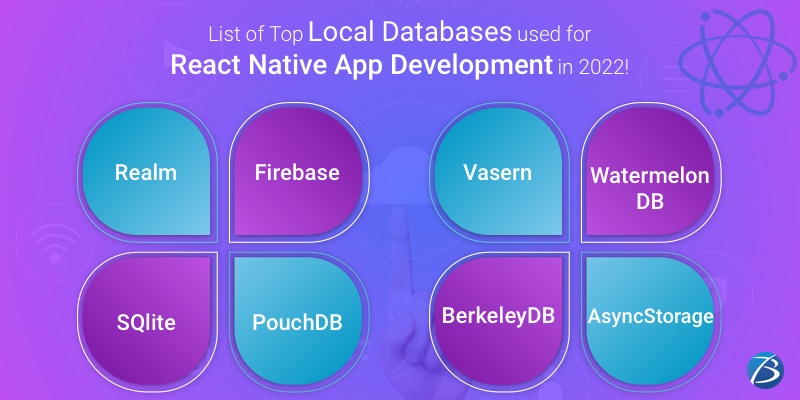
Realm

Realm is an object-oriented database that enables the creation of real-time and offline applications that run on both- wearable devices as well as smartphones. It is one of the top React Native databases amongst all the available ones. This database is highly preferred when the end goal of the project is building high-performance apps that can deal with a huge data flow. The database benefits both platforms- iOS and Android. It doesn’t depend on key-value stores as it has its own database engine. Realm allows the React Native app developers to frequently undergo tables, mapping classes, fields, foreign keys, etc.

Key Advantages of Realm:

  • Makes use of multiple encryption standards to ensure good security for diverse mobile platforms
  • Realm Synchronization service works locally in the background for recording user interactions and service requests and sends the data to the server after the device goes online.
  • Redux offline can be used to fulfill offline-first architecture requirements.

Firebase

For React Native development, Firebase supports real-time NoSQL DB. This database is known for its offline data modifications and data synchronization capabilities. Besides, it can handle M (model) and C (controller) of the MVC that is needed while building React Native applications.

Key Advantages of Firebase:

  • This database allows real-time data syncing for all the clients simultaneously.
  • Firebase offers a cross-platform API that can be easily set up with minimum effort.
  • Firebase database can be directly accessed with a mobile device and so, the application servers are not needed.
  • Firebase supports the creation of real-time apps with offline persistence capabilities.

SQlite

SQLite is a relational database management system developed for offering local storage to React Native applications. ‘Lite’ in SQLite depicts the lightweight nature of this database. Also, this database is very easy to set up. It can be directly integrated with mobile applications for accessing the database. For data encryption, SQLite can be used with an extension called SQLite Encryption Extension (SEE).

Key Advantages of SQLite:

  • This database can support offline persistence, simply by using a react-native-SQLite-storage plugin for data management within the mobile app.
  • SQLite is ACID-compliant and employs most of the SQL standards with just a few omissions. It comes with a file-based library architecture and some tools for easily and efficiently handling all data types.

PouchDB

This is a JavaScript database developed using a storage mechanism and CouchDB protocols. It stores the data in JSON format. This open-source database enables the React Native developers to read, create, delete, update, and query the objects using a singleJS API. Furthermore, PouchDB is compatible with MongoDB, CouchDB, PostgreSQL, and MySQL.

Key Advantages of PouchDB:

  • It allows data syncing using a supported server for running the apps online as well as offline.
  • Ensures speedier execution of queries.
  • Also, as PouchDB remains inside a browser, it is not necessary to run queries over the network resulting in faster execution of queries.

Vasern

This is an open-source, lightweight, and fast database used for React Native-based application development for both- Android and iOS. It is developed with a robust server-side language-Golang, created by Google. Vasern’s API can also be utilized for syncing across app clients, local storage, and for cloud storage.

Key Advantages of Vasern:

  • Vasern ensures good performance of apps and speedier operations
  • Provides end-to-end database syncing
  • Support basic data types like string, double, int, double, reference, DateTime, etc.
  • Provides support to languages that use UTF – 8 coding.

Watermelon DB

This database is built on top of SQLite. It can scale a myriad number of records without impacting the application speed. This database is perfectly optimized for complex apps built with React Native that ensures real-world performance.

Key Advantages of Watermelon DB:

  • It is a fast, multi-threaded, relational, and highly cached database.
  • It supports an offline first system for syncing with your own backend.
  • It allows static typing with flow

BerkeleyDB

This is a high-performing backend and allows the developers to handle data in several ways. It comes with an API that is compatible with numerous languages and several platforms like Android and iOS.

Key Advantages of BerkeleyDB:

  • Simple to use
  • Provides support for industrial-strength transactions
  • Ensures concurrent access for multiple users

AsyncStorage

This is a local storage database and comes in-built with React Native. It enables developers to persist data between reboots of the apps. It acts as an outstanding solution for saving the data that the app required, even when the app is being closed by the users.

Concluding Views:

Apart from the local databases mentioned here, there are several other databases available for the React Native app developers to utilize in their projects. But, the choice of a database ultimately depends on the project requirement, its scope, and end goals. For instance, Firebase suits perfectly when one has to develop real-time apps. Realm is great for almost every possible requirement, but comparatively, SQLite doesn’t provide the same level of performance, scalability, and security. Rather SQLite is good to go with when one needs to leverage the abilities of a relational database. So, the one that suits your requirements is the best choice for you.

Here we come to an end! We hope this write-up was insightful.

To know more about our other core technologies, refer to links below:


.Net App Development

Tuesday, March 15, 2022

What are APIs, how do they work, and why are they Beneficial to Developers and Businesses?


We’re living in an API-centric world. Many of our daily activities revolve around APIs, and most of us are not even aware of it!

Have you ever wondered how the following actions are executed?

You can instantly browse information on the current weather conditions as well as the weather forecast using platforms like Apple’s weather app, Google search, or smart home devices.
The travel booking websites aggregate numerous destinations and flights right away for displaying the cheapest option to you.
You can log in to certain websites and mobile apps using the profile login details of your Google/Facebook/Twitter account.
You can play Spotify while using the Uber app.
Well, the common component responsible for all these prompt and useful actions is an API! APIs connect two distanced entities and enable them to communicate with each other in a standardized format. APIs reduce a considerable amount of time and effort to securely exchange data. For instance, weather booking sites collect information from a third party via APIs, and the weather data is sent to them in a manner that can be easily reformatted. Travel booking sites use third-party APIs for gathering information on the availability of flights and hotels directly from the providers. A website can leverage the API of popular services like Google or Facebook to authenticate a user so that users do not have to bear the hassles of creating a new profile for every website service. Likewise, Uber uses an API to connect with Spotify.
So, what is an API, how does it work, and why is it important? This post answers them all! Read along to gain comprehensive insights on an API, its functioning, and its importance from the perspective of developers and businesses.

The Basic Principle of an API

An Application Programming Interface, commonly known as an API, is a software intermediary that enables computers/computer programs to communicate with one another. In other words, an API contains a set of functions using which apps can access data and can interact with various OSs, external software components, or microservices.
When one uses an app using a smartphone device, the app sends data to the server using the internet. The server retrieves this data, then interprets the data, carries on the required actions, and finally sends the data back to the user’s mobile device. Now, the app interprets this data and displays the information requested by the user in a readable format. All the aforementioned actions are made possible by an API.

How does an API function?

Technically, an API comprises a bunch of defined rules that instruct how software apps or computers will communicate amongst each other. An API works as the intermediary layer between an app and the web server; it processes the data transfer that takes place between the systems.
Steps on how an API works:
Step # 1
A request is placed by the user – the client app initiates an API call for retrieving information. Then the request gets processed from the app to the web server, through the URI (Uniform Resource Identifier) of the API.
Step # 2
Once a valid request is received, the API makes a call to the web server or the external program.
Step # 3
A response is then sent by the server/program to the API. This response contains the requested information.
Step # 4
Now, the API transfers this data to the app that had initiated the request for obtaining the information.
Here, the data transfer varies based on the web service used.

Example:
When you search flights online, you need to choose from different options available like departure/return dates, one-way/round trip, names of the departure & destination city, the type of seats, the number of passengers, and so on. Through these actions, you are actually interacting with the website of a particular airline and accessing their database to check the seat availability and flight fare on the desired dates.
Now, let’s discuss an instance when you are not using any specific airline’s site for directly obtaining the information; but using an online travel service to check out the deals offered by various airlines and choose the best available option. Travel services like Expedia, MakeMyTrip, Kayak, etc. aggregate information from the databases of several airlines by interacting with an airline’s API. The third-party provider will allow this interface to execute actions like acquiring information from airline databases, booking seats for passengers, etc. After receiving the request for such actions, the API will collect the airline’s response to this request and deliver the response back to the aggregator. And, thereafter the aggregator will display the updated and relevant information to the passenger.

Tips on API Development

A sound API comes with clear and concise commands that can be reused by programmers. While designing APIs, developers need to create endpoints within an API. An endpoint is an URL performing a specific kind of function. Endpoint provides a path for other fellow developers to follow and this way, the API development process is smoother, ruling out chances of confusion and guesswork.

The Modern API Development: Characteristic Traits

Today, APIs are considered more as products than codes and are created for specific sets of users like software developers. And, like any other software end-product, APIs come with their own SDLCs (software development lifecycles) – designing, development, testing, managing, and versioning. A modern API adheres to HTTPS and REST standards so that they are understood properly, can be easily accessed, and are developer-friendly and secured.
APIs ensures safe data transfer between different platforms. The endpoint of the API decouples the consuming app from the service provider’s infrastructure, API calls include authorization credentials for minimizing the threat of attacks on the server, and an API gateway is empowered to limit access for ruling out security risks. Besides, during the exchange of data, extra layers of security are employed in the form of cookies, HTTP headers, query string parameters, etc. Navigate this link to learn more about the best practices for ensuring API security.
A good API usually contains different formats as various apps communicate in different languages including CSV, XML, and JSON. Furthermore, comprehensive documentation stating an API’s usage is present to make it DevOps-friendly. Also, good APIs are supported and backed by dynamic developer communities for extending help to the ones who get stuck.

Types of APIs

Public API
Public APIs are meant to be shared with the outer world such that an external mobile app development company or developer can leverage the capabilities of these APIs for building apps. Certain firms provide semi-public access to their APIs – no public documentation is available; developers/development companies need to submit their apps for approval.
Private API
These APIs are internal ones created for specific user bases and audiences. Such APIs are used within an enterprise for enhancing collaboration and facilitating communication amongst employees. These APIs can be used by those employees who are granted access.

Why are APIs important for Developers?


No Need to Reinvent the Wheel
Ready-to-use APIs are available for all OSs including iOS, Android, and Windows to carry out most standard developmental tasks. As such, things become easier for developers; they do not have to reinvent the wheel and waste their time and efforts in API development.
For example, if developers are building an iOS application and need to embed a web browser for displaying pages on browser inside the app; they don’t have to program a web browser from scratch. All they need to do is utilize the WKWebView API for embedding a WebKit (Safari) browser object within the app. Similarly, instead of creating a camera interface separately for an app, the camera API is used for embedding the in-built iPhone camera into the application. If developers intend to provide the facility of fingerprint authentication support for an Android app, they need not test every fingerprint sensor of different Android manufacturers. They just need to use a ready-made API!
With such useful APIs, developers can acquire quite a lot of data, services, and resources while building apps. This reduces the time-to-market.
More Scope for Innovation
After integrating APIs into a system, you get an application layer for distributing pieces of information smoothly into other systems. This way, new services can be introduced to new audiences as per their ever-changing desires & needs – developers can utilize APIs for creating personalized services/features for them.
Increased Efficiency
API access enables businesses to publish the app content very quickly as the system automatically publishes content and makes it available for all channels. This way, the content reaches a wide range of audiences effortlessly and in much lesser time and cost as compared to traditional marketing practices.
Effortless Adaption
Software systems of a firm need to be updated within time and the presence of a custom API speeds up this process. Furthermore, data migration becomes easier and the information can be reviewed in a better way.

Why are APIs important for Businesses?

Workflow Automation
API integration has helped several enterprises to automate workflows and enhance workplace collaboration. The absence of APIs would have created connectivity woes and informational silos, adversely affecting performance and productivity.
Facilitates B2B Dataflows
APIs are essential for running data-driven businesses. API usage enables businesses to integrate data flows with their partner’s systems or customers. They also increase the flexibility of traditional data exchange methods like EDI and MFT.
Improved Success Rates
Several businesses maximized efficiency as well as revenue generation through joining forces with other businesses. For example, Uber didn’t waste time, money, and efforts in creating their own services like mapping, communication, or payment gateway. Instead, they utilized the best available services and integrated these services into their app via APIs. And, their success rate and profits are evident.

Bottomline:

APIs are omnipresent, empowering our daily activities from behind the scenes, without being noticed. And, most importantly, they are an integral part of today’s economy. APIs not only enable the sharing of crucial data, but also makes it possible to utilize practical business functionality between individuals, apps, and devices.
If you require professional help in API Development and successfully implementing the API’s, reach out to Biz4Solutions, a distinguished IT firm offering outsourcing software development services for the past 10+ years. We understand our client’s business objective and add value to their products/services.

To know more about our core technologies, refer to links below:

PHP App development

RoR App Development

Node.JS App Development


Monday, March 14, 2022

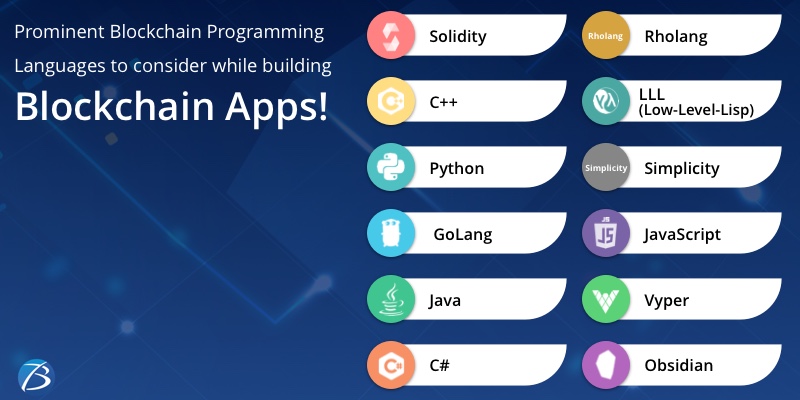
Prominent Blockchain Programming Languages to consider while building Blockchain Apps!

Blockchain has become a buzzword in today’s tech world. This technology has successfully resolved the traditional roadblocks existent in certain industrial domains by decentralizing data and opening up new avenues of security and transparency.

Blockchain records digital information in a manner that the information can be recorded and distributed, but not altered. Hence, Blockchain is used to form immutable ledgers and records or transactions that cannot be hacked, modified, or destroyed. Blockchain applications are employed for demanding tasks like the exchange of cryptocurrencies, the secure sharing of medical data, voting mechanism, NFT marketplaces, making/receiving cross-border payments, monitoring supply chain/logistics, and many more.

However, developing such solutions is not an easy task, and businesses planning to adopt Blockchain systems must be aware of the ins and outs of Blockchain development. One of the crucial considerations for creating Blockchain solutions is the programming language stack chosen for development. And, needless to say, the programming language should be chosen as per the project requirements. This post explores the offerings of the top Blockchain programming languages with examples of use cases. The write-up will provide a clear idea and help you to pick the most suitable language stack for your upcoming Blockchain project.

Blockchain Functioning: In a Nutshell

The Blockchain system comprises a digital ledger of transactions. Each block within the chain contains a certain number of transactions and whenever a new transaction takes place on the blockchain network, the transaction record is added to each participant’s ledger. This decentralized database is called DLT (Distributed Ledger Technology) and is managed by multiple participants.

Top Blockchain Programming Languages

Solidity

Solidity was created by the Ethereum team in 2014 for writing Ethereum-based smart contracts, to enhance the usability of Blockchain solutions. With Solidity, developers were able to write a high-level code that is smart-contract oriented and that could be translated into the usable lower-level languages prevalent at that time. The language resembles the ECMAScript syntax but contains features such as static typing, variadic return types, and so on. And hence, it is one of the most preferred programming languages used for Blockchain projects and recommended by most Blockchain app developers around the world.

This statically typed Blockchain language offers a stable and flexible coding pattern for smart contracts and provides an accurate as well as a safe medium where different sources can frame smart contracts between parties. Moreover, it is a flexible and user-friendly language that comes with ABI (Application Binary Interface) that provides several type-safe functions. Developers can effortlessly acquire the necessary skills needed to use Solidity, whether they are experienced ones or simply beginners.

Blockchain Project Use Cases: Ethereum, Chainlink, Sushiswap, and Compound Protocol.

C++

This object-oriented language is one of the key Blockchain programming languages. C++ was created to code the decentralized cryptocurrency system and developers employed it to code bitcoins. But today, it suits the purpose of other Blockchain-based projects and has been used for storing transaction information in cryptocurrencies like Ripple’s XRP Ledger, Ethereum’s smart contracts, etc.

C++ is easy to use and flexible; and comes with abilities like advanced multi-threading, primitive control over memory, and an efficient CPU management capability. It enables one to isolate the code for various data structures and allows you to move semantics so that data can be copied effectively. C++ users can control the code as desired – they can choose between providing full access to the code or allowing access to only certain aspects as per the need. With C++, one can easily manipulate blocks and chains, and so, is an ideal pick for scenarios where one needs to fully control their system resources.

Blockchain Project Use Cases: Monero, Ripple, Stellar, EOS, Litecoin.

Python

Python is one of the most popular programming languages used for architecting Blockchain applications, crypto exchange, and smart contracts. It is a robust, versatile, and object-oriented programming language that comes with open-source support and also, several frameworks and libraries such as Numba that accelerate the development without affecting the performance or security. Python dynamically supports OOP, and hence, facilitates crafting solutions in Blockchain as well as in Machine Learning and Artificial Intelligence. Using this language, one can easily detect errors and debug those errors.

Python is particularly helpful for newbie developers working on Blockchain projects as this language facilitates building prototypes quickly without having to write lengthy codes and the developers have the option of selecting from a wide range of plugins, libraries, and online resources.

Python, being an interpreted language creates roadblocks when complicated cryptographic operations are involved, but this problem can be resolved by the proficiency of experienced Blockchain app developers.

Blockchain Project Use Cases: Steemit, Ethereum, Hyperledger Fabric, NEO, etc

GoLang

GoLang, a statically typed, compiled and multi-threaded language created by Google, is one of the most popular Blockchain programming languages in the NFT marketplace. The language integrates the best of both worlds – the ease of developing the code and the effectiveness of compiled language. It combines the features of Java, Python, and C++ and is being used by the Hyperledger Fabric platform currently. It is user-friendly, fast, flexible, and scalable.

Using GoLang, one can run several processes simultaneously, and therefore, it is can effectively handle several parts of blockchain simultaneously. GoLang is not only speedy but also offers accessible maintenance features and so, it’s an ideal pick when a decentralized app is being distributed on Ethereum’s network. However, it comes with a difficult learning curve but will be simple for C++ developers.

Blockchain Project Use Cases: Ethereum, Loom Network, Hyperledger Fabric, GoChain, and Dero.

Java

Java is an object-oriented programming language that follows a “write once and follow everywhere” approach and so, enables one to write codes that are highly portable. With the Java Virtual Machine (JVM), developers can run their codes on any system or platform. And, as the universal JVM is used for execution, Java programs need not depend on a system-specific architecture. This portability of Java facilitates the creation of easy-going and immutable blockchains. Furthermore, Java comes with an abundant API (Application Programming Interface) that contains several Java classes, interfaces, packages, etc. This property helps in building apps without any need to know their internal implementations.

Java offers a simple and extensible plugin architecture that helps to create a flexible Blockchain solution. Java has a huge and dynamic community that provides prompt and effective solutions to developers whenever they encounter any issue.

Blockchain Project Use Cases: IOTA, NEO, NEM, Ethereum, Fabric, and Hyperledger.

C#

C# is an open-source programming language coined by Microsoft and enjoys humongous popularity worldwide. It employs easy Object-Oriented and Extensible Markup methods, without the developer’s help. Its rich library class simplifies the use of menu functions and implements them for coding. The assembly feature eases out handling the issue of version control. With C#, open-source developers can effortlessly write codes that are highly portable and run across several OS like Mac, Linux, Android, and Windows.

Blockchain Project Use Cases: IOTA, NEO, Blockchain as a Service, and Stratis.

Rholang

Rholang is employed for creating smart contracts and high-grade Blockchain projects. It follows a functional approach – at first, it examines the application through several functions and thereafter, solves them as per the sequence. It is secure, reliable, easy to use, and speedy.

LLL (Low-Level-Lisp-like language)

Low-Level-Lisp-like language, commonly known as LLL, is a low-level programming language. LLL happens to be quite easy-going and minimalistic, it’s just a small-sized wrapper directly placed over the EVM coding. This is one of the original Ethereum programming languages used for smart contracts. It offers a different programming discipline and point of view as compared to the universal Solidity language.

To make it compatible with EVM programming, the Lisp-like code contains a thin layer of parentheses. So, the LLL users enjoy high-end programming support while accessing various lower-level sources of power as well as memory locations. Moreover, this language enables programmers to develop effective contracts that are smaller in size as compared to the ones created using higher-level languages.

Simplicity

This high-level Blockchain programming language was designed for smart contracts and it caters to professional programmers as well as open-source developers. This language is relatively new and reduces the low-level understanding and complicated functionality of the Bitcoin Script.

Simplicity helps Blockchain app developers to enhance productivity and avoid distractions. It hides low-level components from engineers and developers, resulting in a rapid development speed.

JavaScript

This popular programming language works for Blockchain development as well because of Node.js, a runtime environment of JavaScript. The language helps developers to handle asynchronous code which is the fundamental prerequisite in the Blockchain environment. Moreover, it enables asynchronous parallel programming due to which the Blockchain program can complete more than one action simultaneously. 

Vyper

This Blockchain programming language is derived from Python3, although it doesn’t contain all the Python features in it. It was designed as an alternative for the language Solidity and is primarily employed in EVM (Ethereum Virtual Machine). However, Vyper’s control structures are different from the ones in Solidity and it handles security issues differently as well. Vyper’s control structure is distinct and contains features such as modifiers, recursive calling, infinite loops, etc.

Obsidian

Obsidian is one of the newer Blockchain programming languages. It presently functions on the Hyperledger Fabric platform and the Ethereum Blockchain platform.

Most blockchain programs are organized around a machine having a high-level state and Obsidian’s state-oriented programming helps one to explicitly declare and transition amongst states. Obsidian builds a flowchart-like sequence that helps one to view contracts through different stages. The states and transitions within the states have to be mentioned while coding.

Obsidian offers a linear type system that simplifies the process of implementing a belt to suspenders. The compiler can make full use of the types for avoiding bug issues or typo-based errors.

End Note

I hope the aforesaid information was beneficial and will help you in selecting the best-suited programming language for building Blockchain solutions. Coming to Blockchain development, it’s a challenging task and has to be executed properly for obtaining the best results. Moreover, creating a Blockchain network is not enough, the system needs to be managed and maintained properly. So, in most cases, entrepreneurs seek professional help.

For professional assistance in developing and maintaining Blockchain solutions, the transformative Blockchain app development services offered by Biz4Solutions, is worth a try! We have the experience and expertise to cater to the Blockchain development needs of global clients with diverse requirements.

Thursday, March 10, 2022

FLUTTER VS. REACT NATIVE VS. KOTLIN: WHICH ONE FOR APP DEVELOPMENT IN 2022-23?

  React Native development services

Technology has turned around the software development sector. It is becoming exciting and interesting every day. The millennial generation is driven towards digital space and keeps looking for better and faster solutions. New tech stacks are getting introduced by the software development giants in the market, enabling competition in every sphere.

Mobile application is a competitive and complex aspect. With remote devices and their technologies introducing new innovations every now and then, the application developers have to step up their speed and developments strategy. There are many aspects that the developers need to think about before finalizing a mobile application development technology like High responsiveness is the pre-requisite for any application that intends to make its way into the public domain, Application development technology should be capable to develop cross-platform and hybrid applications to be functional across every platform and Moderate or low development cost is important while targeting multiple platforms.

The three mobile application development frameworks - Flutter, React Native and Kotlin have started a new thread of judgments and competition. A thorough analysis is required to understand the common factors and differentiators amongst them.

 Flutter

 Google has nailed it once again with Flutter, the mobile application development platform. The company has made sure to provide every necessary aspect for cross-platform development. The open-source framework is capable of developing applications for different platforms using a single code base. It has been used by many companies including eBay, GROUPON, and Toyota.

 React Native

 React Native uses JavaScript library to develop applications for Android and iOS platforms. React native is helping developers to deliver a highly rich user interface that is winning customer confidence. It is another technology that is winning the race in cross-platform development. It has been used in the development of thousands of applications including Flipkart, Pinterest, and Facebook.

 Kotlin

Kotlin is a modern programming language to develop multiplatform mobile applications. As one of the most concise Java language, Kotlin is known for its simple and precise commands that make development easier. It has been used to develop applications and scripts for Coursera, Gradle, and many other leading applications.

All the three application development platforms can be differentiated and compared on different development aspects.

Comparison of Languages on different development aspects:

Language

 Flutter uses Dart which is a client-optimized language that aims for faster application development. Development in React Native involves React JS, JavaScript, C, C++, and Python. The integration of multiple programming and development languages increases its likelihood of selection as an application development platform. Kotlin is compatible with Java Framework. It is called a better version of Java as it offers excellent features over Java.

Ease of Use

Flutter uses Dart which is easy to learn and use. Any developer with prior experience in React Native and Java can develop a complete application in less time with Flutter. The installation is easy and the application is open-source, both of which contribute to ease of use

React native app developers prefer the language for its code reuse feature. It uses React JS, JavaScript, and C-related language which are popular amongst most software developers. Anything involving them mostly will not require time investment in learning the language.

Kotlin can be easily used by Android developers. It is gaining popularity over Java with Java-compatible tools and frameworks. The number of lines in coding can be significantly lesser than in Java.

Features

Every language comes with its own set of features. Flutter comes with automated developer and testing tools that can make the development very fast. This ensures real-time error checks and fast deployment.

React Native helps the react native developers to build Native-like applications. A single codebase can be used to develop platform-specific versions of components. The fast refresh feature immediately reflects the changes made in the code. The developments and improvements can be really fast.

Kotlin allows the application logic to be reused between the web, desktop, and mobile platforms saving a lot of time. It is popularly known as multiplatform programming language. The syntax used in the coding is very compact and clear which again saves time and fastens the development process.

 Advantages

The basics of all three languages are different. The ultimate differentiation comes with the overall impact created with the performance and development.

Flutter

Dart being easy to learn and use can be used by any developer to develop the application at a fast pace. Quick and simple installation is also very motivating for the new users. The user-friendly free documentation makes the development journey easier. The large community of developers keeps making improvements in the code to ensure a bug-free flutter app.

Real-time code changes and corrections is a real advantage. A significant time is saved in activities such as development and compilation.

It facilitates communication with the native modules which makes features such as scrolling very seamless on every platform. Flutter is gaining popularity day by day.

React Native

React Native app development allows the developer's changes to immediately reflect on the application, allowing the developer to make faster changes.

Higher flexibility in using the third-party plug-ins is also making it developer's favorite.

Reusing the code reduces the go-to-market time, making it a great development language for today

Kotlin

The code is clear and concise. It is gaining popularity over Java, and Java developers would prefer it anytime for application development. The lines of codes are less which implies lesser development time.

Shorter codebase leads to a shorter debugging time. With many of the Java language issues fixed in Kotlin, it is considered to be highly safe for application development.

Which One is Making the Way Towards 2022

React Native is expected to be accepted by the majority for its multi-language support. Its fast refresh feature and seamless integration with the third-party plug-in is something that every developer is looking for. It is definitely futuristic with faster development cycles and deliveries. Flutter and Kotlin, both are going to get their fair market share. The Java developers may opt for Kotlin and Google will definitely append its offering with Flutter to capture the maximum market.

Conclusion:

React Native is certainly something a developer can look forward to while others do not stand a less chance. If you need assistance with the development, we are here for you. We are the leading mobile app development company offering React Native development services. Our experts will help you develop the best React Native application as per your requirements. Contact us today to get the best React Native development services at affordable rates.

To know more about our core technologies, refer to links below

 Ionic App Development

Angular App Development 

Swift Web App Development

Monday, March 7, 2022

Tips on Software Development Outsourcing from Industry Veterans!

The practice of outsourcing software product development projects to IT firms has proved to be a super-effective success formula, applied by several business brands big and small; ever since the inception of this approach. Outsourcing product development to global locations offering low-cost labor and highly skilled professionals, has proved to be immensely profitable for entrepreneurs.

Take a look at how these biggies benefitted from outsourcing:

WhatsApp, today’s most popular messaging brand, happened to be a small firm back in 2012, functioning with only thirty in-house employees and a few part-time professionals. They intended to grow while keeping the costs low and hence chose to outsource their development process to a Russian-based technology partner. Offshoring helped them to cut costs and focus on core business objectives during their initial years, helping them to grow exponentially.

Basecamp’s tool helped other enterprises in managing projects, but they were finding it difficult to handle the internal workflow and manage client support systems. So, they outsourced a portion of their essential functions, so that their in-house team is able to concentrate on their product and improve it for achieving the best outcomes.

Outsourcing proves to be an excellent strategic tool for businesses to maximize profits and minimize bottlenecks; only if executed properly. This post pens down some handy software development outsourcing tips coming from industry veterans and will guide you through the proper methodology to follow when hiring/managing outsourced help.

What is Outsourcing and why do businesses choose to outsource?

Outsourcing refers to the practice of hiring third-party services for delegating functions like software development, coding, testing, product support, etc. to a team of programmers or software outsourcing companies instead of engaging one’s in-house team for this purpose. The outsourced vendor provides the much-needed proficiency, innovative strategies, expertise, and experience for custom software application development. Moreover, the client enterprise can choose from a wide range of skillsets available around the globe and can even collaborate with different software service providers skilled in various technologies for developing a robust software product.

As per Igor Tkach, the CTO at Daxx, distributed teams have the potential to drive digital transformation. Organizations that opt for outsourced help experience a speedier transformation and therefore, stay a few steps ahead of their competitors. This approach is an efficient way of maintaining a uniform balance between budgetary constraints and digital transformation requirements.

Software Development Outsourcing Tips from Industry Experts

Sergii Zhuravel, Software Engineer

Software development outsourcing tips from Sergii suggests the factors that should be considered by product companies for cracking the best-suited outsourcing deal. The outsourcing partner must follow agile product development methodology; adhere to a properly-defined security policy, and have a functional knowledge transfer plan. The vendor should also possess robust project management skills, advanced tools for effective communication, transparency, and enthusiasm.

According to him, while selecting the region for offshoring services, watch out for the following factors – resource availability, technical education opportunities, English-speaking skills, tech competency, proficiency, diversity, global ratings of the company, etc.

Warith Niallah: Executive Head, “FTC Publications Inc.”  

Warith’s outsourcing tips for software development is that he is against choosing a large-scale enterprise-level outsourcing vendor as they might prove to be far too expensive. Instead, one should examine the service offerings by all available service providers, irrespective of the magnitude of the outsourcing company, to validate whose services best suit your project needs as well as business objectives. The clients’ final decision should be based on the project requirement rather than the brand reputation of the vendor.

Martin Broadhurst, a UK-based Digital Strategist

It’s important for the client company to thoroughly understand the scope of the proposed project while outsourcing product development to offshore software developers. The project scope must be clearly defined at the very beginning and here, one needs to be really specific, so that there aren’t any arguments concerning deadlines and cost during the later phases of the project.

Eliza Nimmich: Co-Founder/COO, “Tutor the People”

Software development outsourcing tips from Eliza states that in order to ensure a productive partnership between the client company and its outsourcing partner, sound communication is essential. Here the level of sound communication depends on how effectively the vendor communicates their thought processing and how much they acknowledge the client’s perspective concerning the project workflow. If the outsourcing vendor displays sluggish behavior or a lack of good interaction, it is an indication of challenges going forward.

Steve Mezak: Founder/CEO “Accelerance Inc.”

Steve says that it isn’t a good idea to decide the outsourcing partner based on the project cost alone as quality may be compromised. Low-cost vendors are likely to deliver below-average software products with bugs, delay timelines, etc. resulting in costly rework. So, as per Steve, one should opt for the provider offering the right amount of skillsets and expertise.

Jan Kaminski, Co-Founder & Head of Sales at “Applover”

Jan says that the client company must thoroughly verify the service quality, expertise, and years of experience of the outsourcing services provider. For this, Jan recommends visiting the company’s website and checking their profile, credibility, skillsets, work culture, case studies of products delivered, and reviews by past clients. He also suggest checking for recognitions on online portals like GoodFirms, Clutch, etc. These checks will indicate whether the company is trustworthy and worth your investment.

Eric Carrell: The Chief Marketing Manager for SurfShark

Eric opines that micromanaging the developers is an unprofessional practice that should be avoided. According to Eric’s software development outsourcing tips, micromanagement subdues innovation and creativity, hindering development teams from producing the best possible results. Instead, if experienced professionals are allowed the freedom to experiment and apply their judgement, amazing outcomes can be achieved. And, to optimize developers’ output, business heads must focus on defining the final objective expected from the end-product rather than specifying developmental methods.

The process owners, a part of the outsourced team, should provide required resources, follow the best practices, and create a conducive development environment. They should also be well versed with the development methods so that they are able to pick the one that best suits the project needs as well as the company’s constraints. 

He further suggests that the software product owners must peruse the product’s approach and progress from the perspective of an end-user – user tasks, user stories, etc. Moreover, while validating the software product they must involve a practical methodology – a functional prototype using a real device or even a simple wireframe.

Shawna Koch, Head of Healthcare and Biomedical, “SenecaGlobal”

As per Shawna’s outsourcing tips on software development, if one hires a single outsourcing vendor, it’s likely to give rise to a leadership silo and create an echo chamber, particularly if the firm is a huge one. And, this may reduce the velocity of the desired outputs and turn off room for innovation. So, hiring more than one vendor for specific developmental requirements is a good idea.

Brian Dean, Founder, “Exploding Topics”

Brian says that the client firm should have a sound strategy to overcome all hurdles. Some of the roadblocks likely in outsourcing are poor project management by the vendor firm, below-average product quality, etc. So, the product owner needs to establish an in-house leader (a CTO, CIO, or technical co-founder) often named as the ‘Product Owner’ who will serve as the bridge between the business and the professionals involved in product development. This ‘Product Owner’ will be responsible for the product development process executed by outsourced developers.

Sreenivasan Iyer: Product-oriented C-suite Executive, “Shasta Ventures”, San Fransisco.

Sreenivasan’s tips for software outsourcing points out a challenge involved in software development – the difference in time-zones might create unwanted roadblocks and adversely affect productivity. According to him, this challenge can be successfully addressed by dividing work amongst distributed teams to minimize the need for continuous communication. This is indeed an effective way of avoiding late-night and early-morning meetings for offshore teams.

Veronica Miller, Cyber security Expert, “VPNoverview”

Veronica stresses maintaining consistent communication practices between both parties to convey well-defined methodologies during different phases of the project. This will help in ensuring that the daily development efforts are in accordance with product objectives. Veronica suggests some best practices for effective communication.

Here are her tips for software outsourcing! Daily stand-up meetings help in keeping everyone on the same page. Frequent check-ins by product owners can avoid unwanted surprises & save time. Retrospective sessions after the completion of each sprint help in identifying issues, discussing product improvement schemes, and deciding on the modifications that can enhance the development process during the next sprint.

Closing Thoughts

Outsourcing is a strategic move for delegating the responsibility of building customized application software or complex software product development projects to proficient Offshore teams who can handle it efficiently. And, offshoring projects help you to obtain the best of global talents at affordable rates. If executed correctly, the outsourcing approach will facilitate continuous innovation, speedy releases, and humongous profits.

In this regard, Biz4Solutions, a distinguished software development company in India, the most popular outsourcing destination, would be a great choice. We have partnered with myriad business brands for the last 10+ years and helped them to create success stories. 

To know more about our core technologies, refer to links below


Thursday, March 3, 2022

Swift Or Dart: Which One is the Most Viable Choice for iOS App Development!

Planning to develop an iOS app and pondering which programming language to pick – Swift or Dart? Well, both Swift and Dart are exceptional languages and therefore, it’s not an easy task to pick the right option that best suits your iOS app development requirements.

So, I have penned down a comparative analysis between Swift and Dart - the two most noteworthy programming languages that are used for architecting iOS apps. A quick read will help you to understand which programming language is a perfect fit for your upcoming iOS mobile app development project.

Swift: An Overview

Swift is an open-source programming language and is entirely dedicated to native iOS app development. It was developed by Apple and came into being in 2014. Swift had gained a lot of traction in the developer community and is preferred over Objective-C for building iOS apps.

It is an interactive, secure, and speedy programming language that integrates the best of both worlds – the wisdom of Apple’s engineering culture and the thought processing of new-age programming languages. Its compiler is optimized for performance and at the same time, the language itself is optimized for development.

Swift is an intuitive and powerful language that comes with some disruptive offerings including speedy coding, imaginative methodology, and intensive documentation. Moreover, it is conducive for mobile app development, ensures security, and creates software that runs very fast. Furthermore, the design patterns of Swift can be utilized for work area, web, and worker apps.

Coding with Swift is not only interactive and enjoyable for iOS developers but is also concise and yet, expressive. Most of the iOS devices including Apple watches, iPads, Apple TV, etc. are programmed using Swift.

Dart: An Overview

Dart is a Google-developed open-source programming language that was launched in 2011. Dart is used for building iOS as well as Android apps having a solitary codebase.

Dart is a client-optimized programming language for crafting fast apps. It provides a native-like look and feel, to both iOS as well as Android applications, thereby saving the time, cost, and efforts of developing apps for these two platforms separately.

This mobile software development kit (SDK) forms the foundation of the Flutter framework. It powers Flutter apps by offering the language and runtimes. It also supports several core tasks of developers including formatting, analyzing as well as testing the code.

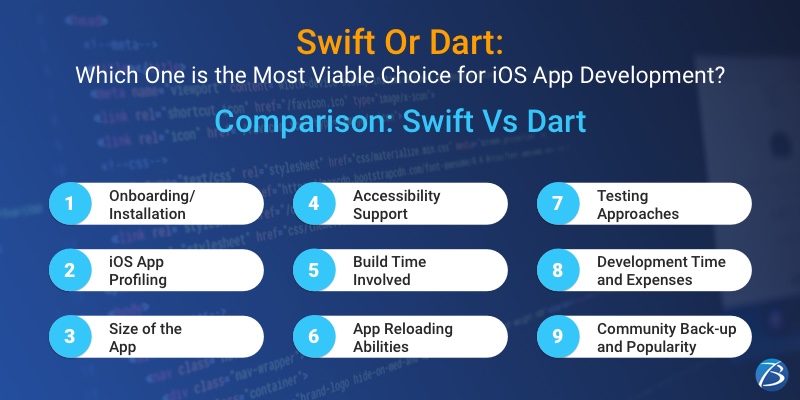
Comparing Swift & Dart in terms of iOS App Development Requirements

Take a look at the differences between Swift and Dart in terms of iOS app development requirements based on the following parameters.

Onboarding/Installation

The first step in iOS app development is onboarding – the process of downloading and installing the Integrated Development Environment commonly called the IDE. Once this IDE is set up, it provides a Software Development Kit (SDK) that is used to begin coding.

The only tool required for iOS mobile app development with Swift is XCode which has to be installed on the Mac OS device. Dart, on the other hand, needs a larger toolkit as compared to Swift to create binaries for coding. Dart developers use XCode, a Mac device, and an IDE such as Android Studio or IntelliJ IDEA for this purpose.

Inference: Swift needs lesser onboarding tools than Dart, though both of these involve an easy configuration process!

iOS App Profiling

Profiling refers to the process that estimates how an iOS app will be presented. This process revolves around the CPU, memories, and assets.

Swift uses XCode which provides a comprehensive framework that enables one to monitor an iOS app. Here, there are certain layouts that can be used for different profiling tests including the Time Profiler. The Time Profile allows one to evaluate the CPU strings in multiple occasions. This way, you can assess an iOS app’s performance, focussing on the resources, memory, and the CPU.

Dart comes with exceptional documentation concerning app profiling. Here you can use either an IDE or an order line to indicate the time required for Dart app profiling.

Inference: Win-win situation between Swift and Dart!

Size of the App

Dart applications turn out to be bulky in terms of size as its engine doesn’t permit the app size to be smaller than a specific value. Contrarily, the apps created with Swift are smaller in size.

Inference: Swift is the winner!

Accessibility Support

Accessibility support refers to an app’s capacity to cater to the needs of individuals with disabilities. Accessibility was considered as an optional feature earlier but now has become an essential function to include while developing apps, particularly in iOS app development. Today’s applications must be accessible to everyone, including the ones with physical disabilities.

Swift comes with an iOS native-owned in-built feature, a UIKit that offers accessibility support features, and so, you need not import any other framework for this purpose. The only aspect that needs to be taken care of is providing the correct accessibility to each UI element duing the process of swift app development. However, Dart lacks this feature, and to include this function, Dart developers need to employ the Accessibility Inspector of X-code; as suggested in Dart’s documentation.

Inference: Swift outshines Dart!

Build Time Involved

The build time refers to the time taken for creating a clean build (A build that is not incremental or a build that doesn’t contain any derived data). And, the build time happens to be a crucial aspect for a developer because the more the build time the higher is the cost of development. Moreover, quicker build time enables the addition of new features effectively as well as speedily.

Swift fares better than Dart in regards to native iOS app development and hence, is preferred for building iOS-only applications.

Inference: Swift outshines Dart when it comes to build time!

App Reloading Abilities

When there is a need to append new features to an iOS application, developers have to reload and then conduct testing on a device or a simulator. During this phase of iOS app development, the developer assesses the code and evaluates how the app is affected by the modifications introduced.

Dart uses the hot reloading approach and so the modifications made to the app are instantly displayed and can be viewed pretty fast, in just two or three seconds. However, with Swift as the programming language, the reloading process takes longer. Here, when the changes made are reflected in the app while the app is running on a test framework, simulator, or device, Swift developers need to alter a feature. Like the renaming of button and then the native code is upgraded for testing. And, this process approximately takes 12 seconds. Nevertheless, these days, the Swift UI enables hot reloads and one can also use non-native solutions like InjectionIII to append novel features speedily.

Inference: Dart is speedier than Swift in presenting changes made in the code!

Testing Approaches

Despite following different testing approaches, both Dart and Swift offer robust and effective testing modules. The testing environment offered by Dart allows developers to execute various kinds of tests including UI tests and functional-level tests. Developers can create tests that are to be executed by the Dart driver.

Swift eases out conducting tests during iOS app development owing to the availability of its testing platform XCTest. Using the Swift testing environment, one can test myriad components and aspects including UI modules, execution, incorporation, performance, integration, and navigation.

Inference: Swift outshines Dart!

Development Time and Expenses

The time taken for architecting apps are of great significance to the development team as well as the clients. A lengthy iOS app development process means more expenses and efforts. While Dart and Swift employ XCode for determining the development process, Swift apps overshadow Dart apps in this area.

Coming to the development cost, both Swift and Dart being open-source programming languages, do not incur additional expenses.

Inference: If you intend to create an iOS app only, Swift is preferable whereas Dart is recommended if you develop an app for Android as well as iOS.

Community Back-up and Popularity

The central Swift community, Swift.org boasts of 902 contributors on GitHub, enjoys 57.5k GitHub stars and 9.2k forks, and has 303463+ questions concerning Swift on the popular online portal Stack Overflow.

Dart has only 36 GitHub contributors, 1.5k stars and 117 forks, and 58480+ questions on the Stack Overflow platform.

Inference: Swift is more popular than Dart!

Conclusion:

Both Swift and Dart are incredible programming languages and cater to specific iOS development needs. Swift is recommended for native iOS mobile app development projects, while Dart is more suitable for projects that include developing apps for Android as well as iOS platforms.

If you need assistance with iOS app development, contact Biz4Solutions, a Swift app development company that has helped numerous clients around the globe to craft unparalleled apps.

To know more about our other core technologies, refer to links below:

Ionic App Development

.Net App Development

React Native App Development

Tuesday, March 1, 2022

What, Why And How Of Blockchain Applications You Should Know

Technology has been rapidly progressing in recent years, with new revolutions coming to the fore. One such technology is blockchain technology. Blockchain is a term you might have likely seen thrown around in recent years. This has been chiefly due to the popularity of cryptocurrency and, now very recently, NFTs. Supporters of these applications have been very vocal about the benefits of blockchain technology. Some of the benefits you have likely heard are the presence of a decentralized structure, improved security and reduced costs.

Many people are well aware of all this and still cannot understand what blockchain exactly is. Don’t worry; you are certainly not alone when trying to understand this new technology. Therefore, we will be discussing blockchain applications besides the more common ones you already know about, like crypto. The purpose of this is so you can get a better idea of how this technology works. We will discuss everything there is to know about each of the applications that you should know about. Without further delay, let’s get into it.

International Money Transfer

Money transfer on an international level is standard and is typically done through banks. Banks usually take a certain fee, with government interference, when it comes to money transfer which means increased costs for all the parties involved. With blockchain technology, the middle man is removed with increasingly secure transfer activity. This can allow companies and banks to save significant amounts of money due to cheaper processes that they can automate.

Traditional money transfers required many transactions to be settled manually, making the process less efficient. An example of how this benefits businesses is a manufacturing company sending money to a branch in the UK. They may not have to incur as many fees during frequent transactions that will likely occur between them. This can go a long way in saving costs in the long term while their transactions are protected.

Voting

Blockchain technology has a lot of potentials when it comes to voting. It can make the process more accessible to people while improving security. Typically, hackers cannot break blockchain technology since each block of the ‘chain’ is across multiple nodes. Even if they somehow manage to access the terminal, they still cannot affect these other nodes. The system can assign each vote to one ID, allowing government officials to tally the ballots a lot faster and efficiently. It would also eliminate the chances of there being tampering, which many presidential candidates tend to claim at times.

Non-Profit Organizations (NGOs)

Many people have a common issue when donating to charities and NGOs because they don’t know if their money is being used properly. After all, there are various incidents of charities cheating out donors and using the money for selfish purposes. Blockchain technology can help solve this problem. It allows greater transparency by showing donors that their money is being used the right way. As discussed before, blockchains typically have a decentralized structure meaning that the information is available to everyone. In this way, donors will be more likely to trust NGOs and charities, and those parties will also benefit from the increased donations sent their way.

Supply Chain Management

Blockchain proves a new and innovative way for companies to organize supply chain data, manage it, and put it to use accordingly. This is due to the feature of blockchain technology which involves a ledger that no one can change. This ledger is suitable for real-time tracking of goods that will likely be moved around a lot when transported. This gives companies several ways of transporting their goods. The system can use entries to present all events in the supply chain, like when a parcel goes from point A to B.

In conclusion

Blockchain technology is a new technology that has come to light in recent years due to the popularity of cryptocurrency and NFTs. However, these are not the only applications you should know about when it comes to blockchain technology. We have discussed various practical applications that you should know about that can change many real-life industries. We hope this article has been insightful and has given you a better understanding of blockchain technology.

Would you also like to create your own Blockchain apps to gain a competitive edge? Contact Biz4Solutions, a prominent software firm offering Blockchain app development services. Our experienced and technically sound professionals would help you to design and maintain your Blockchain environment.

To know more about our core technologies, refer to links below:

Flutter App development

Node.js App Development

.Net App Development