Friday, August 6, 2021

How does HIPAA Compliance protect data privacy and security in Healthcare Apps?

The modern era of digitalization has brought about transformative changes in the healthcare sector. Global spending on healthcare services is on the rise, a bright future awaits this industry for sure! Healthcare service providers are hiring Healthcare App Development Companies and leveraging advanced technologies to deliver premium-quality services to their patients. Advanced healthcare mobility solutions are helping the users to actively track their basic health statistics like tracking their heart rate, checking their blood glucose/ BMI level, avail online doctor consultation services via the app, appointment booking, etc. Moreover, both patients and practitioners can access electronic Health Records whenever required.

But, despite the convenience quotient of using digital healthcare services via an app, data security happens to be one of the greatest concerns of the healthcare industry. These medical apps are susceptible to data breaches, hacking, cyber-attacks, etc. which can pose a risk to the sensitive medical data of patients, causing massive losses to medical facilities. Therefore, healthcare organizations should be more vigilant of their software and cyber-security practices. For avoiding theft, misuse, and fraud of the patients’ data, all healthcare applications in the US have to be HIPAA compliant and strictly adhere to the HIPAA rules and regulations.

What is HIPAA?

HIPAA refers to the Health Insurance Portability and Accountability Act and is issued by federal regulators. This Act mandates a set of safety and privacy standards to protect the confidentiality and availability of medical records and sensitive patient information. Initially, the purpose of introducing this act was to improve the efficiency and effectiveness of the medical organizations in the U.S. With time, several rules were added to the Act to protect the individually identifiable health information commonly known as Protected Health Information (PHI). These rules influence the functioning and security protocol of healthcare mobile applications.

The entities covered under the HIPAA Act are health plans, healthcare clearinghouses, and healthcare providers that use electronic media for transmitting data such as health claims, coordination of benefits, referral authorizations, etc. These entities may comprise small/large organizations, institutions, research centers, individual practitioners, and even government agencies.

How HIPAA Compliance plays a major role in protecting data privacy in Healthcare Apps?

Adhering to HIPAA for data privacy is federally mandated for healthcare facilities and other healthcare IT service providers such as healthcare mobile app development services and mHealth development services. So, let’s understand why HIPAA compliance plays a major role in protecting data privacy in Healthcare Applications.
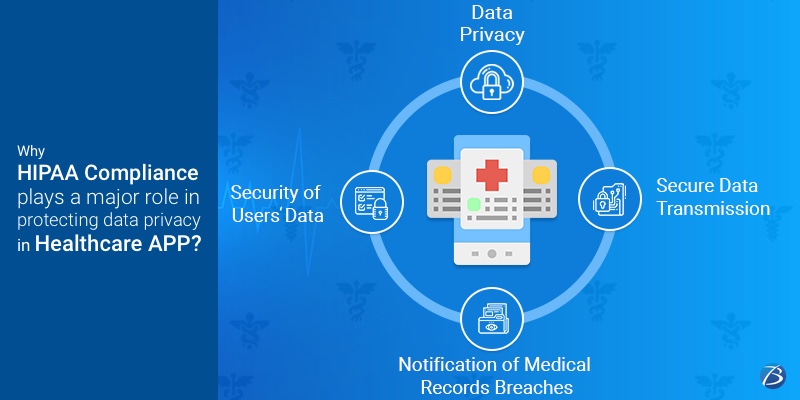
Data Privacy

The importance of capturing data has risen over the years to improve the overall healthcare operations, using advanced technologies like the Internet of Things (IoT), Robotic Process Automation (RPA), etc. The personal information of patients, their contact details, and medical reports are recorded and saved digitally by several hospital bodies. As such, maintaining data privacy is important to ensure that only the relevant information is shared with the right set of people and at the proper time. This strategy helps providers to build trust amongst the patients.

HIPAA compliant apps abide by strict rules to ensure data security and privacy. These apps are hosted on HIPAA-compliant servers to ensure that all the HIPAA standards are fulfilled correctly. They have to display a link in the privacy policy of the mobile app, while the users download the app. The apps take consent from the patients/users before storing their information. Furthermore, the users are informed about how their data will be used.

Security of the healthcare data

Data breaches can lead to disastrous consequences for patients, hospitals as well as healthcare facilities. Fraudulent insurance claims, extortion, or identity thefts are likely, and once this data is hacked/lost, it can be devastating for both patients and medical providers. So, it is essential to secure the data of patients, the hospital workforce, or other back-office data.

A HIPAA compliant mobile app solution ensures the safety and privacy of healthcare data. The medical app users can access the data only through a secure login procedure. Additionally, two-factor authentications are applied for more security and all data presented in the app can be only accessed using a secure PHI key. Besides, in case the mobile device is lost or stolen, personal user information cannot be accessed easily owing to the advanced security standards and encryption. Data stored on database servers are also encrypted to prevent easy access to healthcare data.

Secure transmission of data

In many large Healthcare Organizations with multiple branches, the medical data needs to be shared with several doctors or concerned authorities. If such hospitals use a mobile app for data transmission, it must be as per HIPAA rules and regulations. Moreover, hospital bodies should audit data from time to time for ensuring that the user data in the app isn’t accessed inappropriately or modified abruptly. Furthermore, in the case of remote monitoring of patients using wearable technology, like IoT or AI; only the required data will be transferred to ensure the security of data. For this reason, the communication networks of the apps possess integrity control mechanisms.

A HIPAA compliant app ensures that the amount of sensitive data stored in them has access limitations when the device is carried outside the hospital premises. Additionally, when users delete these apps, any related health data is deleted completely from their device. Remember that HIPAA laws apply only to the apps using PHI i.e. protected health information. Therefore, the data transferred from an app that does not deal with personally identifiable information need not be protected under HIPAA guidelines.

Notification of healthcare records breaches

Today, there is a high possibility of sensitive Healthcare data getting fraudulently accessed by hackers. However, if the Healthcare app is HIPAA compliant, it needs to notify affected individuals about the breach of data without unreasonable delay and this notification should not be sent later than 60 days. This policy is mandatory for all apps that are adhering to HIPAA to abide by data breach notification laws. As per these laws, eligible data breaches are obliged to alert the users or relevant parties.

Some of the data breaches may not cause serious repercussions to medical facilities. In case any disclosure of information, unauthorized access to it, or loss of personal information is bound to cause serious damage, then such breaches are known as eligible data breaches. They can cause financial losses or even damage the reputation of the medical organization. So, the mobile app they employ should be HIPAA compliant and should send prompt notifications to users.

Key Takeaways:

Today, data is the biggest asset for any industry vertical, and healthcare bodies are no exception to it. Today, most hospitals implement diverse innovative digital technologies to deliver improved services to their patients. However, the medical data handled by apps are vulnerable to security and privacy threats. In order to protect this data, these digital healthcare apps must follow the HIPAA guidelines. As per HIPAA compliance, the covered entities need to administer physical, technical as well as administrative safeguards for PHI in place for ensuring privacy, integrity, confidentiality, and security of healthcare data.

To know more about our core technologies, refer to links below:

Swift App Development

Java App Development

Node.js App Development

Tuesday, August 3, 2021

Estimating Prices of Offshore Software Services: A Guide for US Companies!

US entrepreneurs and companies have emerged as global leaders in technology over the past two decades. But surprisingly, most of US-based firms face a severe challenge due to the shortage of local software developers. At times, they cannot match with the package expectations of the local developers and this costs the companies a big-time, leading to business losses.

This is where the concept of hiring an offshore software development workforce comes into the picture. Over a few years, outsourcing has successfully resolved the critical issue of shortage of developers for US firms to a great extent. Today, these firms are availing top-notch software services from any corner of the world.

But another challenge that these companies face is that the costs of offshore software developers and the services aren’t uniform globally. Every country has different rules, practices, and cost considerations. So this blog is meant to help US businesses in this scenario. Here we have jotted down in detail the components that affect offshore development costs, region-wise hourly rates, various outsourcing models, etc. for estimating costs of offshore development services. So, let’s get started.


Fundamental Components Affecting Offshore Software Development Costs

Size of the Software Project

Project size directly affects the development costs. The higher the number of screens, features, and other factors, the higher will be the team required and so is the cost. For instance, a small software app will have between 10-25 screens and a larger app will have 40+ screens. So, the efforts and overall costs will hike accordingly.


Technical Considerations of the Project

Technical aspects like software architecture, UI/UX designs, tools and methodology selected, third-party integrations, etc. influence the cost of the project. Ultimately, it depends on the quality of the software product you are looking for.


Time to Market

Whether you want to bring your product early to the market or want to give it more time, both will affect the development costs. Also, deadlines affect the software project in myriad ways. For example, if you have an excellent idea but the timeframe to complete the project is shorter, chances are, it will affect the R&D, planning, and overall development. In such a case, you will have to hire an extended team of experienced developers to get things done efficiently and quickly, incurring higher costs.


Skills and Expertise of the Offshore Team

The knowledge, experience, and skills of your offshore development team are directly proportional to the project costs. If your project is simple, you can hire developers with comparatively less experience and skills. But if your project is complex, you need a qualified team of senior developers and this adds to the project costs.


Additional Costs

The offshore companies may charge extra for maintenance and support, some licenses like HIPAA in healthcare apps, infrastructural costs, etc. They may even charge in case the clients want some modifications. So, such factors should be clarified beforehand to avoid any ambiguity.


Region-wise Hourly Rates of Offshore Software Development Services Worldwide

North American Regions and Western European Countries: These countries charge the highest rates as compared to most of the other regions worldwide. Have a look.

  • New York: $58.44
  • California: $58.96
  • Washington: $55.01
  • Texas: $46.11
  • UK: $71
  • France: $82
  • Netherlands: $60
  • Germany: $56
  • Sweden: $67


Eastern European Countries: The average hourly rates in these countries range from $20 - $50. These countries include:

  • Belarus
  • Poland
  • Slovakia
  • Ukraine
  • Bulgaria
  • Romania
  • Estonia
  • Czech Republic
  • Hungary


African Countries: The average hourly rates of countries in Africa range from $20 - $40; which include:

  • Tunisia
  • South Africa
  • Belarus
  • Kenya
  • Nigeria
  • Polan Egypt
  • Morocco


Countries in Latin America: The average hourly rates in Latin American countries range from $30 - $50. They include the following:

  • Brazil
  • Argentina
  • Chile
  • Costa Rica
  • Columbia
  • Panama
  • Mexico
  • Peru


Asian Countries: Asian countries have average hourly rates that range from $18 - $40. India ranks in 1st position as an offshore destination in the Asia region. The countries that provide outsourcing services include the following:

  • India
  • Indonesia
  • Malaysia
  • Vietnam
  • Thailand
  • Pakistan
  • Nepal
  • China
  • Bangladesh
  • Philippines


A Glimpse at Diverse Outsourcing Pricing Models

  1. Manager Team Model or Dedicated Development Team Model

In this model, the offshore software development services provide an entire team of expert software development professionals and this team operates independently. It is managed by a Lead or Project Manager from the offshore company and is responsible for reporting to the client firm. This type of model ensures effective communication between both parties, assures high-quality results, saves time for the internal team, and eliminates the risks to a great extent. This model is the best choice when you want a highly experienced team with good technical expertise and want to lead the software development process and decision-making of the project. 


  1. Extended Development Team Model or Staff Augmentation Model

This business model includes the addition of offshore software developers to the existing in-house team of the clients as and when required for the project. This boosts the overall efficiency of the in-house team while being in total control of the project. This type of model helps in improving development capacity and project output. It is a scalable and flexible model and leads to a substantial reduction in costs of development, operations, and HR as well. This model is beneficial when the internal team lacks some kind of skills or expertise or when there is an urgent requirement for additional technical staff.


  1. Outsourced Product Development Model or Project-Based Model

This is a traditional model which frees the client company from the entire burden of the software project. Here, the offshore team takes complete control of the project and builds the software products as per the predetermined expectations of the clients. In this model, the client company has limited control over the project. They need to provide the initial details and specifications. The benefits of this model include- (1) lower time commitment from clients’ end, and (2) exact estimations of the project timelines and final outcomes. This model is the best option when the project scope is quite static and clients do not want to handle the burden of the project management. Besides, this model is good to go with when the project you are developing isn’t your core project.


Why India Has Emerged as a Global Favourite for Offshore Development Services?

For 15 years consecutively, India has remained the top-favorite destination of the US companies and other European countries too, for outsourcing software projects. Almost 50% of fortune 500 companies prefer India alone for their IT development services. Besides the software sector, India is a popular outsourcing destination for other services like BPO, LPO, KPO, engineering, R&D, etc. So, why India? Here are the potential reasons:

  • India is one of the largest English-speaking countries in the world, as per a BBC report, and hence, there is no or very little language barrier during project development. This improves communication, collaboration, and coordination of clients and offshore teams.
  • Budget-friendliness is another major reason behind the preference of India by the US and other western countries. As compared to the local developers, the average rates of developers in India are 30-35% lower.
  • Offshore software developers in India are known for delivering excellent quality products and services that meet the required global standards. India is home to the largest number of ISO 9000 certified IT firms and 75% of the world’s CMM Level 5 certified firms.
  • The availability of a massive talent pool is another driving force that attracts US companies to India. With a population of 1.3 billion, India boasts of highly educated, experienced, and certified software professionals.
  • To meet the business requirements of the clients, most of the Indian IT companies ensure flexibility in time zones, cultural differences, etc. making the offshoring process seamless.
  • Lastly, the favorable policies of the Indian Government are like a cherry on the cake. Their policies are designed for promoting ease of business in India. Also, there is a huge infrastructural support and numerous IT parks are often being developed across the country.


Final Thoughts

Partnering with offshore software development services cuts down several costs. It also helps protect your business from any probable issues that may occur during remote collaboration with the offshore partner. But before partnering with offshore software developers in India or any other country for that matter, it is always a good idea to calculate the approximate costs of project development beforehand. So, this blog is meant to make this calculation easier. Hope this helps.

That’s it for now!

Share your thoughts in the comments section and for any assistance on offshore development, reach out to us.

To know more about our core technologies, refer to links below:

Node.js App Development Company

PHP App Development Company

Flutter App Development Company

Redefining the Event Industry: Top Event App Trends to Watch Out for in 2021!

The event industry has witnessed immense advancement in the last few years. Besides, since the year 2020, since the outbreak of the Covid-19 Pandemic, all types of events, big or small, are being carried out virtually. New-age techniques are being utilized to host the events successfully. Owing to this, several innovative event app trends have emerged and are making the events more interactive, engaging, and dynamic.

So, what are these trends? How are these trends impacting the event industry? Why should the event app owners or the event development services keep pace with these trends? In this blog, we are going to look at these trends and related aspects. So, without much ado, let’s begin.

Top Event App Trends for 2021 that Event App Developers and Owners Should Consider!

Enhancing User Experience

Optimizing the user experience is a MUST. This can be done by ensuring that the app content is highly relevant and engaging. For this, the app should possess content like the schedule of the events, contact information, directions of the events, speaker details/biographies, etc. Also, the user experience can be elevated by ensuring consistent styling throughout the app, using graphics or HD images in the app, etc.

Branding of the Event App

Your event app is the representation of your event business and hence, it should be branded accordingly. Pick the logo, fonts, styles, etc. wisely. Using color palettes that will be visually impactful is also quite essential for the app. Furthermore, all the app elements should be consistent with each other. Lastly, certain guidelines must be followed by every event application development company during its development to meet the standards of the app.

Virtual Technology

Virtual event applications are trending nowadays but, this feature is not yet much compatible with current platforms when it comes to matching with live engagement. There are a few other challenges too, like the untested solutions, no support, no integration, cost concerns, etc. But, these virtual apps are quite beneficial. They can help in expanding the customers, increasing the revenue, tracking vital data, promotional purposes, etc.

Facial Recognition

This is a new and innovative trend that comes with huge potential. It helps a big time in improving registration processes and app security. It streamlines the participation in events and reduces wait timings to some extent. Besides, for physical events, facial recognition in the event applications acts as a check-in tool. It’s a contactless and secure way for event attendees to check in the events.

Inclusion of Polls, Surveys, Reviews, etc.

These features are meant to improve user engagement. These can also be used for fun purposes during the events. It will engage the users and make them feel they are important and their views matter. You can gather real-time insights using the poll answers and live surveys and this data can be used for the enhancement of the app.

The Projection Mapping

Projection mapping technique is becoming quite popular amongst event planners nowadays. Projection mapping or Hologram is used for an in-depth understanding of content and then for higher user engagement. This trend enhances extra dimensions, optical illusions, and 3D movement, etc. Besides this, another technique called table projection mapping can be utilized in events for personalization, branding, story-telling, etc. Also, this technique helps to show pre-recorded presentations to the participants. Speakers from any corner of the world can deliver their presentations while not being physically present at the venue.

Augmented and Virtual Reality

Augmented Reality (AR) and Virtual Reality (VR) experiences have been impacting the event industry quite a lot in recent years. AR is used for grabbing the attention of attendees and motivating them to interact within the event. This technology has the ability to enhance the user experience, and result in increased media attention, more engagement, social media shares, etc. VR helps to create a computer-generated 3D world for the app users that makes the app much appealing.

Machine Learning and AI Chatbots.

These advanced technologies have influenced almost every existing industrial sector and the event industry is no exception. AI-powered programs collect the live event data and these programs are based on preferences, activity, behavioral data of the attendees, etc. This is real-time data and can be quickly altered or modified depending on the interest of attendees. AI chatbots can be used for interacting with attendees and answer their queries. Also, both these technologies can help the app owners to conduct multiple sessions, and deliver a powerful experience to the remote attendees.

Live Streaming

The live streaming feature is already being used on a large scale in countless apps. The live streaming events attract a huge number of people in real-time. These are more lively, authentic, and connecting and so, they get a much better response from the users. Using this feature, Q&A sessions can be extended during the live events, there can be group chats, the users can raise a hand, provide feedback, and similar engaging activities can be carried out.

Proximity Marketing with Beacons

While hosting an event, beacons can be placed around the event location for the creation of an interactive network for the online attendees using the event app. These beacons help in several important tasks like attendee tracking, online check-ins, proximity marketing, etc. This technology can also be useful in monitoring the floor plan flow in the events.

A Few More Trends for Optimizing the Adoption of Event Applications

  • Inform the attendees about the event app much earlier for ensuring widespread adoption of the event. This can be done using emails, social media, etc.
  • Use the app for registrations for early promotion of the app.
  • Let the promotion of the app be done by event speakers and other attendees as well. Encourage them to share the app with their contacts.
  • On the event day, introduce the app in various ways and ensure that the attendees use the app for some or the other reason like reviews, polls, or any games, etc.

Final Thoughts

Event professionals and also the event mobile app development companies all across the globe will remember the year 2021 as a transforming year for this industry. Several effective event app trends have emerged during this period benefitting the app owners and the related community. We have enlisted most of these trends in this blog. We hope they will be helpful to you.

Do comment below or drop us a mail and let us know your views about these trends. Also, share with us any other trends in this industry.

Friday, July 30, 2021

The Contribution of the healthcare mobile apps crafted by Biz4Solutions in the fight against COVID-19!

“The pandemic hit the world like a bolt from the blue!”

Ever since the COVID-19 pandemic rocked the world last year, everything underwent a drastic transformation. Millions of people lost their lives, businesses across several sectors came to a standstill and economies disrupted like never before! During such moments of crises, individuals, as well as organizations, have devised ways for contributing their bit against the pandemic. Myriad technological innovations were being carried out to prevent the spread of coronavirus.

Biz4Solutions, a prominent software firm that excels in Healthcare mobile app development, has crafted several new-age mobile apps for supporting healthcare facilities in their response to the COVID-19 pandemic. Our team of skilled professionals is engaged in developing medical apps catering to social awareness, providing information, counseling, etc. We are constantly striving to find new ways for dealing with this crisis using futuristic technology.

How do our Healthcare Mobility Solutions prove beneficial during the COVID-19 crises?

Counselling Apps

Many countries are still following the lockdown guidelines and are encouraging social distancing. Such a situation is likely to cause anxiety and take a toll on an individual’s mental health. Hence, the importance of counseling can’t be underestimated for managing stress. Counseling apps have already helped many people around the globe.

On-Demand Caretaker Apps

Biz4Solutions has built an On-Demand healthcare app that allows one to book appointments or online sessions with healthcare providers. For example, the Phlex65 app built by us is a practical solution for elderly people for hiring licensed care providers from nearby areas. These care providers assist old people in daily activities like consuming medicines, healthy cooking, bathing, etc. This app empowers care providers as well. We can develop a similar counseling app for clients.

Social Awareness Apps

The pandemic scenario has pushed people into spending most of their time on smartphones and it has been observed that a considerable amount of this time is devoted to gathering information using social media. Social media awareness apps can keep individuals informed about the latest news concerning the current situation. Moreover, if someone needs stuff like groceries, masks, or generic medicines, social awareness apps can be used for obtaining the contact details of nearby stores.

Biz4Solutions has crafted many social apps, one of them being Link. It’s a social networking and awareness app. This app enables individuals with similar health interests to connect online, chat with each other as well as create groups. They can share information such as the best doctors nearby, the cheapest medications, health management tips, etc. on this social platform. They can also share images, audio/videos. This app uses the features of geo-location tracking and ‘push notifications’ for providing a rich UX.

Patient-Doctor Communication Apps

A patient-doctor communication app is a blessing for most patients. Such apps allow people with less mobility needing any guidance or medical advice, to instantly contact a doctor via online communication channels without having to pay a visit to the medical facility. Furthermore, patients with COVID-like symptoms requiring online help from doctors can get real-time access to practitioners through these apps. We have created such apps wherein the patient can book the appointment via video conferencing with the healthcare providers, make payments digitally, and then go ahead with the video-calling session. During video conferencing sessions, patients can speak directly to the practitioner and explain the symptoms. Thereafter, the doctor diagnoses the condition and prescribes medication.

Informative Apps

Fake information regarding healthcare being circulated on social media and other communication platforms has become commonplace. Hence the need for genuine apps that provide authentic information from trusted/authorized sources such as the Centers for Disease Control and Prevention (CDC), the World Health Organization (WHO),  etc. to resolve the confusion amongst people.

The proficient healthcare app developers at Biz4Solutions have crafted highly secure HIPAA compliant apps for leading hospitals facilities and other medical organizations around the globe. We make sure that all healthcare data is safe and its privacy protocol is maintained. We acquire information from trusted and authentic sources only.

Medical Emergency Response Apps

Biz4Solutions has architected an incredible app that instantly connects patients to their doctors or medical professionals in case of an emergency. During life-threatening conditions, the patients can use this app to get much-needed assistance immediately to save their lives. Such apps provide handy information and reliable emergency alerts to people trapped in critical situations.

Total Management Apps for Practitioners

Several medium and large-sized hospital facilities are witnessing a tough time now. Patients are visiting hospitals in huge numbers and as such, the hospitals are struggling to manage this situation. However, applications like Total Management App and the Practice Management System (PMS) offered at Biz4Solutions, have eased out things!

These apps and systems help medical organizations in many ways. They not only integrate the medical data of the patients but also store it in centralized systems. This data is saved in digital format and can be accessed by the doctors immediately for providing better treatment to patients. The doctors working in different branches of a chain of hospitals can access it as well. This data assists in improved-decision making.

Additionally, it is used for self-automating the appointment-scheduling process. The patients can book appointment slots as per their availability of doctors. A PMS is a comprehensive solution that simplifies many complex hospital functions.

Final Words

Technology has been the greatest weapon in this war against COVID-19. Healthcare software solutions are working wonders to combat this pandemic. As a leading healthcare app development company based in Texas, Biz4Solutions is also trying its best to tackle the new, daunting challenges of modern times with technological innovations.

We leverage the power of technologies like RPA (Robotic Process Automation), IoT, Cloud Solutions, for our healthcare projects. We have extensive experience in providing novel app solutions for the healthcare sector.

If you have an idea for a healthcare app, partner with Biz4solutions, a reliable technology partner!

Tuesday, July 27, 2021

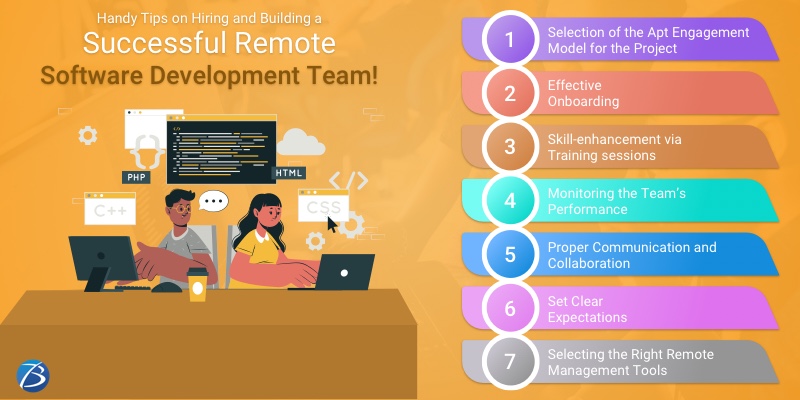
Handy Tips on Hiring and Building a Successful Remote Software Development Team!

The trend of hiring remote software development teams for executing IT projects has fuelled up in recent years. Take a look at the interesting data on remote software development as of 2021, gathered by the online portal Review42!

  • 55% of the businesses around the world prefer hiring remote employees up to a certain capacity.
  • 18% of the working professionals are engaged in telecommuting on a full-time basis and 77% of these telecommuters have reported being more productive.
  • Firms can save as much as $ 11,000 per year, for each remote employee working on a part-time basis.

Remote work undoubtedly ushers in myriad benefits for employers and employees unanimously. The key gain is of course enhanced productivity for employees and cost-reduction for employers.

However, managing a remote dedicated software development team, particularly in offshore locations, is quite challenging and requires a different management approach altogether. Therefore, I have penned down crucial strategies that will help you to lessen the gap between your in-house and remote teams, and also ensure that your remote workforce stays efficient, productive, satisfied, and accountable for their deliveries.

Check out some important insights on remote hiring and the effective management of remote software development teams!

Remote Teams: An Overview

The term remote teams generally refer to a group of professionals with diverse competencies, belonging to various time zones; working in unison towards a specified objective. Nevertheless, many software development teams/agencies have their employees working remotely from a single country or even city. These employees usually work from their respective dens and are categorized as remote teams as well.

The Key Components of a Remote Software Development team

  • A Business Analyst for accumulating the requirements of the project, comprehending the project’s scope, and understanding the needs of clients as well as their pain areas.
  • Software engineers, front-end and back-end developers, or a full stack developer depending on your project needs
  • A team lead, who understands the technical requirements well, is a part of the development team and looks after the technical delivery of the project.
  • UI/UX designer for ensuring that your product possesses a rich interface and delivers a sound user experience
  • A QA engineer for analyzing test results and identifying errors during the initial developmental stages
  • A project manager for handling documentation and budgeting, leading teams and making them accountable for what they deliver, anticipating as well as managing risks, ensuring timely project delivery, signing SOWs, and communicating with clients.
  • A scrum master who will implement agile principles and make sure they are adhered to by the team members as well as by the client-side in order to avoid sprint interruptions by introducing unexpected add-ons.

Tips on Hiring Remote Programmers

Hiring the right set of software programmers/agency is no cakewalk and involves a series of validations and checklists. Check them out!

For validating the proficiency and engineering skills of software development firms/dedicated teams; you can go through their company profiles published on B2B research platforms such as Clutch, GoodFirms, Wadline, Upwork, Freelancer, VenturePact, Toptal, RemoteOK, etc. These platforms analyze and enlist leading software firms, mentioning their level of excellence; and as such, ease out the process of hiring an IT agency.

Check out the following aspects while hiring developers or an app development company from a remote location.

  • Industry-specific content published by the firms through reading their blogs, research papers, surveys, podcasts, etc.
  • Core competencies and technology stacks
  • The firm’s achievement – Projects delivered successfully and other accolades
  • The various work models offered
  • Events and recognitions like hackathons

Factors to Consider while picking your Remote Software Development Team

Skillset and Expertise

Ensure that the software developers you hire possess the following virtues.

  • Talented engineers who not only write good quality codes but also are capable of communicating effectively.
  • They should handle the team by sharing their controversial opinions, are capable of accomplishing goals along with a team, and acknowledge individual inputs by peers at the same time.

Pro-activeness

Software professionals should be keen to work on interesting and challenging projects. They should be proactive enough to ask questions, provide suggestions concerning tasks like organizing sprints, and imbibe thought processing within the members of other teams as well.

Ability to acquire new Skills

The members of your remote team should be able to walk that extra mile and be eager to expand their skillset. Professionals who are naturally self-learners and are willing to push limits for acquiring new skills without even being asked to do so; are preferable.

Sense of Responsibility

A sense of responsibility is an important trait to look for in the software workforce you hire. Employers may ask questions regarding their way of preparing reports, planning their day, prioritizing tasks, dealing with unplanned fixes, and executing alignment meetings and rollbacks; to figure out this trait.

Key Steps to Building a Productive Software Development Team

Selection of the Apt Engagement Model for the Project

Selecting the right set of remote programmers or a development team is crucial. Coming to the first step of hiring a workforce for your project, consider the below-mentioned questions.

  • Does their technical skillset befit your project requirements?
  • Is the developers’ location suitable for you?
  • Are the developer charges within your budget?

Once, you are satisfied that the aforesaid criteria suit your needs, check on the following aspects.

  • The past projects they had worked on, the skills they had obtained, and the quality of work accomplished by them.
  • Check for references like clients’ testimonials, reviews, etc.

Effective Onboarding

Once, you have finalized your dedicated developers’ team, it’s time for onboarding. The steps given below will ensure a smooth onboarding process.

  • Introducing the team to your project management toolkit through training sessions and providing the required login credentials.
  • Providing clear instructions about your data security protocols and the communication strategy you’ve selected.
  • Discussing the preferred payment model for the team
  • Setting the priorities and tasks for individual programmers
  • Ensuring that all team members are on the same page regarding the fulfilling of project objectives.

Skill-enhancement via Training sessions

Improving the skill set of your remote team via training sessions enables you to create a trustworthy team that will stay with your enterprise for a longer period. Moreover, this strategy helps you to deliver successful projects, grow exponentially, and hence, elevates the productivity of your business to the next level.

Monitoring the Team’s Performance

Since your team is working remotely, you need to effectively monitor their performances through continual tracking of the team’s performance and the project’s progress. This can be accomplished by keeping in touch, through conducting meetings, audio/video calls, etc.

Proper Communication and Collaboration

Proper communication and collaboration is the stepping stone towards success. For this reason, you need to establish a robust and open communication channel with the remote professionals, and more so, if they are working from various time zones. Consider them to be a part of your team and make them feel that they belong to your organization. This way of team building ensures more contribution from your remote programmers. Besides, your firm’s processes should allow them to focus on their core competencies and deliver top-quality product/software. Furthermore, following a bi-directional communication methodology is recommended, to promote knowledge sharing, so that you can benefit from their valuable inputs and suggestions.

Set Clear Expectations

Whether your remote team of software developers is working remotely or virtually, convey your expectations at the very beginning. Be transparent about the working hours, communication processes, required employee availability, responsiveness expected, scheduled meetings, and the need to adhere to strict timelines.

Selecting the Right Remote Management Tools

Invest in the correct Remote Project Management Software, for achieving success. Remote management tools and software come with the following advantages.

  • Tracking the project evolution and workforce productivity
  • Maintaining and managing timesheets/tasks
  • Holding team discussions and interacting effectively across various time zones

Some of the suggested remote management tools are ZOOM, TRELLO, ASANA, G-Suite, SLACK, and ZOHO.

Final Verdict:

Now, that you are well versed in all aspects of remote hiring and management, analyze your objectives and finalize the outsourcing location of your upcoming software development project. It has been observed that most business enterprises prefer a remote software development team in India for fulfilling their project needs.

To know more about our core technologies, refer to links below:

Node.js App Development Company

Swift App Development Company

.Net App Development Company

Monday, July 26, 2021

An Overview of On-demand Apps: Types, Features, Development Steps and Costing!

The first on-demand app model was designed for Uber- the world-famous taxi booking app. Who knew that this concept of delivering services on-demand to the customer would make the business world go crazy?

Many ask whether this is just a bubble. Whether is this just a short-term trend? Will this trend slow down soon?

But today, these fast, reliable, and user-friendly on-demand apps are present everywhere. The on-demand economy has disrupted almost every business sector whether grocery, healthcare, home renovation, and many more, and there is no sign of stopping.

So, if you want to gain detailed insights about it or want to know how to approach the creation of a futuristic on-demand app, this article is for you. Here, I have discussed the on-demand app types, working, features, pricing, the development process, and much more. Let’s dive deeper into the topic.

How does an On-demand Application Work?

  • Consumers place a request for the products/services they want
  • The app then connects the consumers with the concerned service provider
  • The service provider looks over the consumer request and accepts it
  • Consumer confirms the address, contact details, cost of the service, etc.
  • Payment is authorized.
  • The service provider delivers the product/service.
  • The consumer does the payment if the ‘Cash-on-delivery’ option was selected

Types of On-demand Apps in the Market with Examples

Taxi and Travel-related Apps: This domain has benefitted the most from the on-demand economy. Giant players like Uber, Lyft, Curb, Free Now, Airbnb, Booking.com, etc., are helping the users to avail the taxi services using their smartphones.

Food Delivery or Restaurant Apps: Using these apps, the users can order meals from their favorite eateries nearby. These apps help restaurants to expand their customer base online. UberEats, GrubHub, Doordash, Zomato, etc. the well-known examples of these apps.

Healthcare Services On-demand Apps: Healthcare apps like Doctor on-demand, IsDocin, Medicast, Phlex65, etc. are some of the on-demand healthcare apps that help patients to hire doctors, physicians, caregivers, or even order medicines online.

Home Services Apps: Applications like TaskRabbit, Thumbtack, UrbanClap i.e. Urban Company, Merry Maids, etc. are being widely used for hiring services or individuals for carrying out tasks like household chores, dog walking, repairs, plumbing services, etc.

Grocery Apps: Now people can easily purchase groceries using the apps like Instacart, Amazon Fresh, Walmart, Dumpling, Shipt, etc., and get them delivered to their homes. The usage of these apps has sky-rocketed, especially during the pandemic.

Other On-demand Apps: Other examples include Treatwell- for salon services nearby, SweatFlix- for exercising and fitness classes, BloomThat- flower delivery services, Starz- an app for downloading movies, shows, etc.

Key Features of an MVP Model for the On-demand Apps

Before hiring an on-demand app development partner, it is always better to decide the potential features to be included in the app. Here I have mentioned are the MVP features required for creating a basic but impactful version of the app. Since there are three versions for any on-demand app, viz. customer app, service provider app, and Admin app, I have accordingly jotted the features.

Customer Version

  • Simple Registration and Profile Creation
  • Push Notifications
  • GPS Tracking
  • Flexible Online Payments
  • Feedback and Rating System
  • Support and Customer Care Services

Service Provider’s Version

  • Simple Registration and Profile Management
  • Buttons for Accepting/Rejecting Orders
  • Push Notifications
  • Button for Online/Offline Status
  • Dedicated Page for Earnings

Admin’s App Version

  • Admin Dashboard
  • Accessibility to Customer’s and Service Provider’s Data
  • Authority to Change Rates and Fees
  • Analytics and Reports

Significant Steps for Architecting a Top-class On-demand Application

Do Your Research

Before getting into the development straight-a-way, it is of paramount importance to do your research well. Research helps you know your target audience better, their preferences, behavioral patterns, etc. Also, research about the ongoing trends, competitors, etc.

Pick the Desired Features and the Relevant Technology Stack

Decide the features you want in your app; you can refer to the above-mentioned list of features for this. But, it is essential to include at least the basic features like registration, GPS, payment, notifications, etc. in the app.

Also, pick the right technology stack for frontend development, backend development, database, web or native (iOS/Android platforms), or cross-platform development, etc. as per your budget.

Hire the Right Development Firm

Finally, it is time to either hire an in-house development team if you are looking for a long-term project or you may even look for an offshore app development company for the project.

Estimated On-demand App development Cost and Pricing

Predicting the exact price for an on-demand app is a tedious job because every project has different specifications and requirements. Besides, the price is affected by various factors like design complexity, features to be embedded, technology stack, platform/s selected, the development team working on the project, etc. So, here I have roughly bifurcated the cost of an on-demand application, take a look.

  • An on-demand app with the fundamental features can range from $20,000 to $40,000.
  • An app with a few moderate features can cost anywhere from $40,000 to $70,000.
  • A full-fledged on-demand app with several advanced and robust features could approximately cost from $70,000 to $150,000 or so.

Final Words:

Needless to say, on-demand delivery apps are the future. They have offered unimaginable flexibility to the consumers for availing a wide range of services, from the very comfort of their homes and this flexibility has made them addicted to these apps. Besides, this economy has empowered diverse businesses and helped them expand their horizon.

So, when are you leveraging the on-demand economy?

Do comment here and let me know your thoughts on this.

Also, share your experiences in case you have already developed on-demand app projects.

Thursday, July 22, 2021

Tips on Selecting the Right Software Offshore Company for Your Upcoming Project!

What would be a better choice when it comes to architecting a mobile app or a website for your business?

Hiring an in-house team? Or offshoring to a tech partner?

Well, this decision entirely depends on what your requirement is, what type of software product you want to build, whether you want just a single product or a number of products, your budget constraints, and similar other questions.

If you want to design world-class software products, hiring an offshore software development company would be the best choice. Besides, if you decide to hire offshore software development services in India, you will benefit all the more. You will get faster market releases, cost-efficiency, reduced team management efforts, better project visibility, high-quality products, a competitive advantage over others, and much more.

So in this blog, we have explained some practical tips and tricks for choosing the right software development firm. Please read ahead to know more.

Actionable Tips to Consider while Choosing the Right Offshore Software Development Company!

Enlisting Project Requirements

Before approaching a software outsourcing company, you need to list down your requirements according to your goals and objectives. This list of well-defined requirements will help you to narrow down your search. For making this list, you need to keep these fundamental questions in mind- Do I need a mobile application, or a website, or both? Do I need one or more software products? Do you want a complete product or want to redesign an older product of yours?

Verification and Background Check

You need to verify using several tactics whether the firm you are going to work with has the required experience, and expertise in the required services. Their core competency must be in delivering software services. This can be verified by connecting with their clients, checking their social media pages for reviews, checking their ratings on authorized sites, etc. Go for a background check by checking their credentials and certificates and see whether the company has been progressing in recent years or downsizing.

Agile Development Methodologies

Make sure that the offshore partner you select follows the agile development process. The Agile Software Development model is essential for proper management of the project, especially during the pandemic. It ensures benefits like

  • enhanced ability to implement changes on the fly,
  • accelerated delivery of projects,
  • better transparency,
  • improved quality,
  • time predictability,
  • lower costs

Scalability of the Product

You need to make sure that your software provider will develop a scalable product for you. The product needs to be future-ready so that additional features can be added to it and its capabilities can be molded as your business grows. So check if the software provider offers customized solutions. Also, enquire in advance whether there are any additional or hidden charges for this.

Intellectual Property and related Agreement

The tech partner must mention clearly in the agreement that the intellectual property of the project, i.e. all the project data will be given in your custody, once the project is over. This will ensure data security and assure you that your property will not be leaked in any condition.

Communication and Transparency

Make sure that the company to whom you outsource your software project has an advanced level of tools for transparent and continual communication. You need to ask them questions like- ‘How often will there be follow-up calls?’ and ‘Will the company set up extra calls if required?’ This will help you understand if the company can establish strong communication with you and avoid miscommunication.

Flexibility in Pricing Structure

Choose a partner who offers several pricing models for you to select one that perfectly suits your needs. There could be pricing models such as-

  • dedicated development team model for directly hiring the offshore software developers for the project
  • fixed-price contracts for smaller or medium-sized projects
  • T&M model for hiring an expert professional temporarily.

Key Selection Criteria for the Right Software Outsourcing Company

The offshore development firm should rank high on overall performance, teamwork, scalability, on-time delivery, security, etc. across various verticals of its clients. It must offer the following services for a software product so that you can focus on your core business.

Development of Software Product: The development firm should offer end-to-end software development services right from initial architectural design to its release. Their team should have knowledge of both partial and full product life cycle development depending on the specific requirements of the clients.

Product Modification: As and when required by the clients, the offshore vendor (usually ISV- independent software vendor) should provide product enhancements or add extra features.

Project Migration: The offshore company should be capable of migrating the projects involving a complete process of a developed client-server product to web-based technology and migration from older technology platforms to advanced ones.

Testing and Quality Assurance: It is a must that the offshore vendor should provide testing and quality assurance services for the software product from modular and unit testing to integrated functionality and performance testing.

Maintenance of Product: Once the development and testing of the product are complete, support and maintenance is required from time to time. So, make sure that the vendor provides product maintenance services as well.

Final Thoughts

Choosing an offshore technology partner is quite a tough job, especially in today’s competitive business world. There are countless top-notch software development outsourcing companies in India and all over the world. Yet, businesses ranging from a small company to a Fortune 500 company prefer offshoring their software projects mostly to India due to the 360-degree services that they can offer.

So, in this blog, we shared some vital tips to hire an offshore software company, along with some selection criteria. We hope that they will be helpful to you in finding the right offshore tech partner.

To know more about our core technologies, refer to links below:

 Node.js App Development Company

 PHP App Development Company

 Flutter App Development Company