
Thursday, January 13, 2022

Blockchain as a Service: All You Need to Know!

The application of Blockchain technology is no longer limited to cryptocurrency transactions. Blockchain technology has broadened its spectrum over time, and today it is a viable solution to secure various kinds of transactions across diverse industrial domains and offers certain strategic business benefits as well. Consequently, more and more businesses are incorporating Blockchain application development.

But several business enterprises, particularly small to mid-sized firms are finding it challenging to establish the necessary infrastructure required to architect, configure, and maintain Blockchain solutions owing to the following reasons:

  • Blockchain is technically complex and the creation and maintenance of Blockchain solutions are time-consuming involving high operational overhead costs. So, this approach doesn’t work for companies with limited software resources, inadequate skillsets, and budgetary constraints.
  • Developers without prior experience in crafting Blockchain solutions are likely to leave several security loopholes that may be detrimental for the company in the long run.

The one-stop solution to successfully address this roadblock is opting for a third-party Blockchain hosting service commonly called Blockchain as a Service (BaaS). A BaaS provider develops, manages, and maintains a cloud-based network/infrastructure for businesses that architect and operate Blockchain apps/solutions. The demand for BaaS providers is on the rise! As per a report published in November 2021 by the global market research and consulting company, “kvb research”, ‘The global BaaS market is expected to grow at the rate of 54.2% CAGR, and the market size is predicted to reach 17.9 billion dollars by the year 2027.’

Let’s explore the BaaS platform further and dig into the key aspects and facts that every entrepreneur planning to adopt this service needs to know!

Understanding the Term - Blockchain as a Service (BaaS)

Blockchain as a Service (BaaS) refers to a fully functional and managed Blockchain platform offering cloud-based solutions as per the needs of consumers. Such solutions are utilized by the consumer companies for creating, using, and hosting their Blockchain app solutions, functions as well as smart contracts. BaaS works like a web host that runs the back-end operations for Blockchain-powered apps/platforms. The BaaS vendors provide the necessary infrastructure as well as Blockchain development tools that enable consumers to build Blockchain apps/software services on a distributed network.

How is BaaS beneficial to Consumer Firms?

BaaS makes transactions highly transparent and traceable. Businesses using BaaS can effortlessly create their own Blockchain apps, host them, run the apps as well as associated functions smoothly, while service provider supports the infrastructure by keeping it operational as well as agile and manage the network. This approach enables enterprises to reap the benefits of Blockchain technology – data security, enhanced transparency and accountability, and trust minimization - without the need for creating or maintaining their own Blockchain environment.

This way, companies using Blockchain apps and smart contracts can save time, avoid investing heavily on in-house computing resources, and eliminate the hassles, issues, or probable glitches involved in the creation, deployment, and management of in-house Blockchain solutions. And most importantly, BaaS users will be able to devote more time and resources to manage their core business functions instead of having to worry about performance woes or network statistics.

How does the BaaS Business Model Function?

The functioning of Blockchain as a Service is quite similar to the functioning of the SaaS (Software as a Service) model. Under the BaaS business model, a third-party service provider installs, hosts, deploys and maintains a Blockchain network on behalf of their client companies. The BaaS providers set up their clients’ Blockchain infrastructure and deploy as well as maintain clients’ Blockchain nodes. The BaaS partner handles back-end services, particularly the complicated ones, take care of crucial Blockchain-related artifacts and keep them running as well. BaaS vendors are also responsible for executing support activities like resource allocation, hosting requirements, system health surveillance, security protocol monitoring like anti-hack layering for preventing cyber-attacks, and bandwidth management.

The business enterprises availing of BaaS need to pay service charges to their provider for the platform offered for Blockchain implementation. Blockchain networks are usually configured on platforms like Bitcoin, Ethereum, Hyperledger Fabric, BlockApps, Chain Core, R3 Corda, Quorum, etc. depending on customer needs.

To sum up, the BaaS partner manages the Blockchain infrastructure as well as its performance.

Renowned BaaS Providers

Major Cloud Service Providers offering BaaS

  • Microsoft
  • IBM
  • SalesForce
  • Amazon
  • Baidu
  • Alibaba
  • Oracle

Blockchain-only Service Providers

  • iCommunity Labs
  • Bloq
  • Dragonchain
  • Kaleido
  • Factom

Factors to Consider while Choosing your BaaS Partner
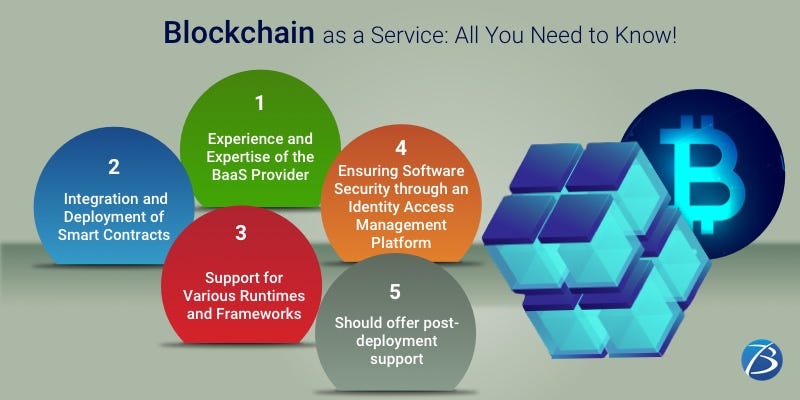
Experience and Expertise of the BaaS Provider

Your BaaS Provider must have ample domain experience as well as expertise in crafting and deploying Blockchain solutions on a similar eco-system and scale that you intend to adhere to. So, do not forget to check their credentials and ask for recommendations/reviews from previous clients they have worked with. You also need to check whether the provider has any prior experience in deploying cloud-based solutions to operate similar systems that are used by your company. Remember to ensure that the new Blockchain infrastructure deployed by the provider integrates seamlessly with your legacy systems.

Integration and Deployment of Smart Contracts

Smart Contract integration is necessary as it makes your Blockchain solution all the more transformative and distinct. Smart Contracts mechanism is required to integrate business logic into a Blockchain solution. It enforces the terms and conditions between the parties involved, and imposes penalties whenever any rule is violated. However, due to the immutable nature of BaaS platforms, Blockchain app developers find it complicated and challenging to test and deploy smart contracts. Hence, ensure that your service provider takes care of the integration as well as deployment of Smart Contracts.

Support for Various Runtimes and Frameworks

Some BaaS providers support only one type of enterprise Blockchain development. This model creates bottlenecks in case you wish to switch to another Blockchain platform during Blockchain application development using BaaS architecture. So pick a provider who supports a wide range of frameworks and runtimes. This approach will undoubtedly allow room for flexibility to your business needs.

Ensuring Software Security through an Identity Access Management Platform

The security of your Blockchain solution is of utmost importance. And, what can be a better way of ensuring the security of your Blockchain network than integrating an identity management platform. This way users will be permitted for accessing only a certain amount of information/layers. This concept works in a similar manner as the protocol for most firms - all employees are not given access to the internal sensitive information of an enterprise. For this reason, IAM or Identity Access Management platforms are deployed. An IAM platform empowers an enterprise to define access controls for digital identities. The process of identity management works in the following manner – either a single sign-in method or multiple authentication methodologies are employed for providing access to information. So, make sure that your BaaS provider offers the platform wherein an IAM framework can be integrated.

Other Crucial Considerations

  • The systems and processes of the proposed Blockchain should be easy to adopt and user-friendly.
  • A minor bug in distributed ledgers can result in dire consequences. So, you need to ensure that the proposed implementation plan doesn’t contain any potential gaps concerning security assurance.
  • You should carefully analyze the pricing model offered by your vendor and check for any hidden costs. Thereafter, select the option that proves most profitable for your business.
  • Make sure that your provider offers post-deployment support

Final Words:

The Blockchain as a Service approach had undoubtedly simplified Blockchain adoption for companies and organizations that intend to harness the potential of Blockchain solutions. However, entrepreneurs need to choose the right BaaS provider, proficient Blockchain developers, and the correct approach for integrating the Blockchain environment into their businesses.

Would like to build an impeccable and highly performant Blockchain solution? Contact Biz4Solutions, a proficient software development company offering high-end Blockchain technology services to clients across the globe.

To know more about our core technologies, refer to links below:

Swift App development

Java App Development

.Net App Development

Disrupting Mobile App Development Trends that are set to Dominate 2022!

The technology and methodology of mobile app development are constantly changing to meet the demands of a dynamic and competitive market. Every year, new and fresh app development trends are replacing the existing ones to maximize profitability as well as customer satisfaction.

So, what are the mobile app development trends that will dominate 2022? Well, this post explores the most recent and upcoming trends concerning mobile app creation. A quick read will provide mobile app creators with comprehensive insights on the best technology trends for mobile app development in 2022.

Key Mobile App Development Trends: 2022


Artificial Intelligence and Machine Learning

Employing Artificial Intelligence (AI) for the functioning of chatbots, and using a combination of AI and ML to form Siri are the latest trends in mobile app development. Other noteworthy AI/ML implementations include facial recognition features in smartphones, ensuring improved security in mobile phones, etc.

But, in the year 2022, the use cases of AI and ML will not just be limited to Chatbots and Siri. New innovative trends of implementing AI and ML are expected that will prove profitable to enterprises and reduce their operational costs.

Upcoming AI/ML trends

  • Automated ML
  • AI-empowered chips
  • Establishing interoperability amongst neural networks
  • AI-enabled automated DevOps via AIOps
  • Geo detection
  • Improved gaming experience
  • Image/speech/face recognition
  • Predictive maintenance
  • Authentication of apps to ensure cyber/IoT security
  • Classification of text and images
  • Recognition and classification of sediments

Augmented Reality (AR) and Virtual Reality (VR)

AR and VR have immensely impacted mobile app development trends and have elevated the gaming sector to the next level. Mobile apps powered by AR and VR are known for their distinct abilities such as people occlusion, light estimation, movement tracking, and environmental understanding. AR-enabled apps have proved beneficial to industrial domains like healthcare, retail, tourism, marketing, education, etc.

Examples of AR/VR Implementation

  • AR/VR software solutions enable doctors to conduct live surgeries from any location across the globe.
  • App users enjoy the option of interacting with VR in Facebook locations.
  • Instagram has employed several AR filters within its app.
  • Gadgets like HoloLens, Magic Leap, and Oculus, offer an immersive experience to users.
  • AR/VR solutions can virtually transfer individuals to unseen areas of the universe like other planets, deep oceans, etc. for rediscovering realities.

Upcoming AR/VR mobile app trends

A host of new use cases are predicted in the coming years. Apple and Google have launched their AR demos – ARKit and Google ARcore. Check out the future trends!

  • AR-powered navigators for reaching one’s destination
  • Providing simulations for conducting virtual training
  • Carrying out exploration activities using VR
  • AR-empowered virtual user manual
  • AR and VR powered visual learning process by employing images
  • VR-based solutions for live concerts, festivals, and music events

5G Telecommunication Network

The 5G telecommunication network is fast replacing the 4G technology and it turns out to be way better than its predecessor.

5G Technology: offerings and add-ons

  • It is almost 100 times speedier than 4G.
  • The super-fast streaming capacity can be utilized by the gaming sector by promoting mobile versions of the most sought-after games like Clash Royale and Fortnite.
  • It comes with low latency, better stability, and enhanced security.
  • It enables more number of connections per square kilometer.
  • 5G resolves the issue of buffering that existed in earlier networks.
  • Videos will get replaced by images which means better user engagement.
  • Higher resolution textures will enhance the visual clarity for users.
  • Its wider bandwidth will allow better handling of VR/AR 3D objects, resulting in the creation of more realistic and advanced AR/VR applications.
  • It will improve IoT services because of better connectivity.

5G Technology: Present/Future Implementations

  • Cloud computing
  • Driverless car mechanism
  • Wireless healthcare Services

Edge Computing: Advanced version of Cloud

Cloud has undergone an evolution giving rise to edge computing. Cloud computing has been a valuable asset of the software industry so far, but it comes with its own set of shortcomings. Owing to Cloud’s highly centralized nature, latency becomes a big deal for the technological advancements ushered in by 5G. However, edge computing resolves this challenge.

The role of Edge Computing is to move the Cloud nearer to the users. This is done by processing some computational requirements locally or on the nearest station which is the edge of the cloud. And, the cloud remains, but goes into the users’ device, such that the device becomes a part of the Cloud. This approach removes latency issues to a certain extent. Hence, the innovations brought about by 5G technology – wireless/autonomous cars, and the IoT eco-system will take cues from devices that are edge-powered. Besides, the increasing trend of B2B mobile apps will also promote edge computing in the years to come.

In the recent past, mobile edge computing has already been employed in location-based services to meet demanding requirements like improved data transmission and 5G implementation.

Mobile Wallet Integration

The practice of integrating mobile wallets into smartphones has gained momentum in recent years as they are effective tools for contactless payments and are also effortless and convenient to use. The users have to simply link their bank account details to a mobile wallet application for paying bills, transferring money to friends/family members, and purchasing items from eCommerce websites. Google Pay, PayPal, and Amazon Pay are some of the most popular mobile wallets used by global consumers.

The upcoming trends include adding future-friendly functionalities into mobile wallets – audio-based methodology, RFID payments, and NFC. As per veterans, mobile wallets are going to gradually replace traditional payment practices.

Beacon Technology

The Beacon technology has been successfully implemented in the retail sector so far. Beacons are used by retailers to comprehend customer behavior as they track down the real-time interaction of shoppers with mobile applications in stores, provide information about the number of store visits by a consumer, and so on. This way, retailers are able to identify the shopping patterns and preferences of a specific customer and thereafter, send them relevant ads based on this information. This strategy has turned out to be an effective tool in accelerating sales.  Moreover, Beacons also help individuals navigate through huge stores or busy shopping centers.

In 2022, Beacon technology is expected to integrate with more smartphone functionalities.

Future trends: Beacon Technology

  • AI-powered chips
  • Mobile payments via Beacons
  • Beacon-enabled gaming: treasure hunting, clue games, etc.
  • Automated ML

Blockchain

We have already experienced the disruptive capabilities of Blockchain by applying it in the form of cryptocurrencies and smart contracts. Blockchain has a lot to deliver in the coming years.

Data exchange, gadget transactions, and document sharing happening within the Blockchain environment cannot be traced. Therefore, it can work wonders in protecting sensitive information/data and is the one-stop solution for preventing cybercrimes. Moreover, Blockchain can be used to build decentralized apps in which mediators won’t be needed for managing the humongous information; as suppliers would be directly connected with the users, leaving no room for infiltration of data. Such decentralized apps will prove handy across industrial domains such as healthcare, finance, gaming, media, and trading.

Future trends: Blockchain

  • Maintaining security protocols in public elections
  • Ensuring cyber security and eliminating piracy
  • Robotics and transparent betting
  • BaaS: Blockchain as a Service
  • Bringing transparency in the fashion industry
  • Tokenization of assets
  • Gaming and crypto space
  • Trading on the exchange of crypto-currencies

Wearable Technology

Wearable devices like smartwatches, smart bands, etc. have created ripples in the industrial sector by their unique ability to track and analyze health parameters like heart rate, body temperature, sleep patterns, blood oxygen/glucose levels, etc. The best part is users can control and communicate with wearables via smartphones. Wearable technology is expected to smarten in 2022 and touch new horizons.

Future trends: Wearables

  • Smart jewelry and body sensors to track down bodily movement and wellness parameters
  • Smart contact lenses have an in-built visual display and are equipped with virtual assistants
  • Smart glasses empowered with mind-reading technology
  • Virtual keyboards via contact lenses or nail polish

Progressive Web Apps

Progressive Web Apps, commonly known as PWAs – a hybrid combination of web pages and applications – are set to dominate the app development market in 2022. This is because PWAs successfully address most of the downsides of native apps. Take a look at their unique advantages over other kinds of apps!

  • Takes lesser time to develop as they are websites having app features
  • Loads faster
  • Occupies lesser storage space
  • Have lesser dependency on internet connections
  • Can be saved on the home screen of users’ smartphones
  • Are highly accessible and adaptable
  • Can be automatically updated

Touch-free User Interface

Touch-free user interfaces in mobile apps are expected to replace the existing touch-based UI so that users have to put in minimal effort while operating mobile apps. Touchless interfaces include voice-based/gesture-based UI. Besides raising the convenience quotient of average smartphone users, such interfaces will be a huge sigh of relief to the elderly and differently-abled individuals.

Instant Apps

Instant apps are the next big thing in the coming years. The most distinctive trait of such apps is that the users can test these apps without the need for installing or downloading the app, at first. Hence, the users enjoy the flexibility to test a wide range of applications available in the Android/Apple app stores; before they select the one that suits their requirements. Some brands like New York Times have already started using instant apps and more brands are expected to follow this trend in 2022.

Final words:

I hope this post has given you a thorough understanding of the novel development trends that are set to dominate the mobile app market in 2022.

If you are looking for an experienced and proficient technology partner, contact Biz4Solutions, a leading mobile app development company in India and USA.  Our outsourcing services in India and USA are unparalleled and our prime focus is to fulfill the business goals of customers.

To know more about our core technologies, refer to links below:

RoR App Development

Flutter App Development

PHP App Development

Tuesday, January 11, 2022

React Native or Xamarin: Which framework should you Pick in 2022?

Modern-era applications are required to run seamlessly on Android and iOS – the two major operating systems.  Needless to say, most entrepreneurs prefer cross-platform app development to stay competitive; and at the same time aim at offering outstanding UX at reduced development costs. Two of the most popular frameworks leveraged for crafting cross-platform apps are React Native and Xamarin.  Now, the million-dollar question is; ‘Which framework outshines the other?’

Well, this post compares the offerings of both these frameworks and guides you through picking the right one that best suits your app development requirements. Let’s explore!

React Native and Xamarin: An Overview

The React Native framework was coined by Facebook and launched in March 2015. This open-source app development technology has been leveraged by biggies like Uber, Tesla, Facebook, Walmart, Skype, Bloomberg, and Vogue to create success stories.

Xamarin, the brainchild of Novell, came into being in 2011 and was taken over by Microsoft in 2016. This framework has been adopted by high-end firms and brands such as Cognizant, Honeywell, Cinemark, 3M, Alaska Airlines, Pinterest, YouTube etc.

React Native vs Xamarin: Analyzing the Differences and Distinct Offerings

Let’s dig into the major differences between React Native and Xamarin based on the following parameters and analyze what each of these outstanding cross-platform frameworks has to offer.

Development Environment (IDE)

The React Native development eco-system promises a substantial amount of flexibility and adaptability. This is because, developers need to install Node and choose any text editor or IDE they are comfortable working on, from a host of options available and accessible on the internet - Vim Editor, Visual Studio Code, Atom, Nuclide, Sublime Text, GNU Emacs Editor, TextMate Editor, Spacemace Editor, Deco IDE, etc. Besides, the hot reloading feature allows React Native developers to instantly reload the application without having to compile it and view the impact of the code changes live in real-time, thereby speeding up the app development process.

The Xamarin app development environment offers one single choice – developers are required to work in Visual Studio. Developers need to download and install Microsoft Visual Studio or the Visual Studio Community Edition; along with Mac. This developer environment comes with an IDE, a host of handy development tools, designs, and controls to ease out the app development process and make it faster. Additionally, utilizing Xamarin and NuGet plugins can further simplify development.

Inference: React Native development environment offers more flexibility than Xamarin.

Market Trends: Popularity

As per the stack overflow survey, React Native is placed in the 6th position in terms of popularity whereas Xamarin has bagged the 8th position. Besides, React Native enjoys 52013 stars and 12207 forks on GitHub, while Xamarin doesn’t appear in GitHub altogether. React Native has elaborate tooling, large community support and a large talent pool. Also since React Native is open-source, it is more popular than Xamarin.

Inference: React Native is more popular and widely adopted globally as compared to Xamarin.

App Development Cost

Most open-source frameworks including React Native are free, but this is not the case for Xamarin. Xamarin has a free version, but with limited features and so, it usually suits the need of individuals or small-sized businesses. In most cases, the paid version is needed and the cost of obtaining a Visual Studio Annual Edition is approximately $3000. Contrarily, React Native is not only free but also allows developers to pick the IDE as per their choice. Thus, React Native is immensely cost-efficient.

Inference: React Native app development projects involve more flexibility to developers and reduced developmental expenses as compared to Xamarin projects.

Testing Abilities

Both React Native and Xamarin offer adequate testing tools. However, the React Native framework offers easily configurable tools such as Jest, PropTypes, etc., the opportunity of creating Snapshot testing, and a rich API behavior. For this reason, the testing process becomes easier with React native and the chances of regressions in the code are ruled out completely.

Inference: React Native outperforms Xamarin.

Architecture and Working Principles

Xamarin uses the MVVM (Model View-View Model) architecture clubbed with a two-way data binding approach that allows collaboration between divisions. It is highly recommended for an app development project wherein it is not known whether the developmental cycle follows a performance-suited approach or not. The reason is this architecture offers flexibility and enables developers to obtain the desired outcome within a short time.

React Native, too, possess a modular architecture that allows developers to separate the code into independent functional blocks. The data binding, in this case, is uni-directional that enables working on the app’s generic performance. React Native also supports manual data binding and this trait helps in minimizing complex errors.

Inference: It’s a win- win situation for both the frameworks!

Documentation

React Native provides comprehensive documentation that is accurate and well-organized too; such that developers can effortlessly find the required elements and use them productively.

Xamarin offers comprehensive documentation too. But, this documentation is less useful because accessing it becomes hassle-prone as well as time-consuming due to the segregation of components into two forms - the NuGet and the components store.

Inference: React Native outshines Xamarin in regards to community support.

Community Back-up

React native boasts of a humongous global community comprising more than 3000 developers, who are constantly working for the betterment of the framework. This vibrant and dynamic developers’ community answers questions on React Native development and are ready to extend help to developers via forums and websites.

Xamarin, being a paid platform, has the smallest community support as compared to the top-tier mobile app development platforms including React native. So, the professionals working with Xamarin lack instant access to community help.

Inference: React Native outshines Xamarin in regards to community support.

Programming Languages and Learning Curve

The key programming language used in React Native development is JavaScript, but certain modules are written in Swift, Java, Objective-C, and Kotlin as well. As such, it’s not enough for React Native app developers to master JavaScript alone - they must possess thorough knowledge of all the aforesaid programming languages for being able to write better and effective codes. Besides, developers must know about different third-party libraries that are essential for React Native app development.

Fortunately, Xamarin developers need to be proficient in only two programming languages - .Net and C# - for executing all the developmental processes that Swift, Java, Objective-C, or Kotlin are capable of accomplishing. Moreover, Xamarin enables reusing several open-source as well as in-house source code projects.

Inference: React Native developers need to discover and master new libraries besides being well versed in the required programming languages; while the knowledge of C# and .Net is sufficient for Xamarin developers. Hence, Xamarin fares better than React Native concerning the developer learning curve.

App Performance

React Native mobile apps deliver native-like performance. However, React Native apps encounter certain performance woes. Firstly, this framework doesn’t support the 64-bit mode on Android applications. Moreover, whenever the fastest codes are executed on the iOS platform, pathetic outcomes follow.

Xamarin, on the contrary, is known for running the fastest codes across Android as well as iOS platforms. It supports the apps that require the 64-bit mode and also offers extended support of UI tools to deliver an incredible performance. Furthermore, it employs platform-centric hardware to ensure top-quality service.

Inference: Xamarin apps outshine React Native applications in terms of performance.

Components

The React Native framework offers pre-built components such as buttons and text inputs that are partially adaptive. Therefore, for creating an advanced application, developers need to recompose the existing built-in components.

Xamarin.Forms provide a complete cross-platform UI toolkit containing native UI components that function on Android as well as iOS. Furthermore, Xamarin.Android and Xamarin.iOS enables the development of customized app user interfaces that deliver a rich performance.

Inference: Xamarin overshadows React Native regarding the availability of components.

Compilation

The compiler offered by Xamarin is well suited to Android as well as iOS. Contrarily, React Native employs the JIT (Just In Time) compilation approach, which works for Android only, and may adversely affect the performance if used for developing iOS apps.

Inference: Xamarin emerges as the winner in this category!

User Experience

React Native comes with ready-to-use UI kits including Shoutem and Virgin for building native UI components. Xamarin, on the other hand, is capable of customizing the components and elements of the app across Android and iOS platforms. Moreover, it employs native APIs and SDKs for improving the user experience.

Inference: Xamarin fares better than React Native concerning the UX.

Which Framework is best-suited for your Project: React Native or Xamarin?

React Native is ideal for developing eCommerce apps, social media apps, and applications intending to utilize Facebook ads.

Xamarin suits projects that require a speedier development cycle, apps with MVC and MVVM architectural patterns, applications that don’t need complex graphics, and situations where the app creators intend to conduct app testing within the development eco-system.

Final Words:

Both the frameworks React Native and Xamarin, come with distinct offerings and are suitable for specific app development needs. The choice of framework depends on factors like project requirement, business needs, resource availability, app development budget, etc.

For any assistance regarding app creation using either React Native or Xamarin; contact Biz4Solutions. We are a highly experienced mobile/web app development firm that excels in providing React Native app development services to clients around the globe.

To know more about our other core technologies, refer to links below:


Sunday, January 9, 2022

The Significant Role of Machine Learning Solutions in Reshaping the Fintech Sector!

The Fintech sector has progressed beyond imagination. Just a few years ago, it took several weeks to get loans approved, but today, everything is processed online and it takes barely a day. Likewise, financial frauds used to occur very often and the financial safety of the user was a big concern worldwide. However in recent times, such fraudulent transactions have reduced considerably, though, online transactions have increased immensely.

How did this happen? What changed?

The mobile revolution and the emergence of trending technologies like machine learning and artificial intelligence have brought a paradigm shift in the fintech industry. Machine learning technology has undoubtedly transformed financial services in a big way.

The algorithm used by Machine Learning solutions is used to identify correlations and work patterns within the large amount of data used in sequences, operations, and events. Hence it is used successfully in process automation, customer support optimization, financial monitoring, portfolio management, algorithmic trading, etc., and much more!

So, in this blog, we will outline how machine learning services has impacted the fintech sector! Rather, we will have a glimpse at the machine learning applications in this sector. Let’s commence.

Significant Role of Machine Learning Solutions in the Fintech Sector!

Risk Management

In the Fintech industry, risk management refers to the process of identifying, analyzing, and migrating or accepting uncertainties i.e. potential risks while making any investment. It also includes taking precautionary steps to reduce such financial risk. Machine learning solutions along with AI and deep learning can help in making informed decisions about financial reports or loan applications. The predictive analysis used in Machine learning can predict potential risks from this unstructured data, and curb financial fraud to some extent.

Detecting and Preventing Banking Frauds

Today, banks and other financial organizations are paying heavily to prevent fraudulent practices. A plethora of large financial institutes are still using outdated security measures and have no systems to deal with new kinds of threats. However, machine learning algorithms are proving beneficial in this scenario. These can be used to find patterns involved in thefts and identify the hack-prone areas or loopholes in the banking systems. Besides, machine learning models are used in image processing, data mining, language processing, etc. Machine learning provides a predictive model depending on historical data for making vital business decisions using result-oriented predictions.

Complying with Ever-changing Rules and Regulations

Adherence to regulatory compliance like HIPAA is vital for financial firms and they spend billions to comply with them. Yet, new rules keep popping up, and following all these rules every time becomes almost impossible, despite spending a lot of time, money, and effort. But, AI and ML platforms can help automate this process as they can read through the pile of regulatory documents and guidelines. They can track and monitor any regulatory updates faster while minimizing risks related to non-compliance.

Robo-Advisors

Robo-advisors are digital advisors or platforms that provide algorithm-driven, automated financial planning services with very little or no human intervention. The Robo-advisor collects data like age, financial status, current income, future goals, etc. from clients and uses this data to provide vital advice to them about the kind of investment they need to do based on their future goals. These Robo-advisors do a predictive analysis based on current market trends and the clients’ goals and find the best-suited investment plan for them. Likewise, they offer easy account setup, account services, robust goal planning, portfolio management, comprehensive education, attentive customer service, and security features, etc. Some experts also predict that these digital advisors could completely wipe out the human advisors in near future and save huge costs for Fintech app development services.

Chat-bots

Chatbots are being used by several financial institutes and they work as full-scale robotic assistants. These chatbots respond immediately to the customers, hence the customers feel satisfied. Most of the time, the customers are not even aware whether they are interacting with a non-human assistant.

Sentiment Analysis

Sentiment analysis is yet another application of machine learning in financial services; also called news analysis. Machine learning applications are majorly dependent on data. But these applications cannot depend just on the data from stock and trade prices. So in recent times, these are evolving to gather additional data from social media trends, news trends, etc. to do sentiment analysis. The algorithms can do predictive analysis using the available data, also taking into consideration the thoughts and opinions of the users, etc.

Safety and Security of User Data

Needless to say, users’ data is the biggest concern for every financial firm. If this sensitive data leaks or gets hacked by any chance, it can not only lead to financial losses but also result in defamation in the market.

Traditionally, the users are being provided with a username and password for secure access. In case of account recovery or lost password, mobile number validation is required or some security questions are asked. But in the future, with the use of machine learning and artificial intelligence, anomaly detection apps can be developed that make use of biometric data like voice recognition, facial recognition, or retina scan. Several machine learning development companies are shifting their focus towards this area. Such measures will surely improve the data security of the users to a much better level.

Influencing Stock Markets

Stock markets are impacting the Fintech sector too. Every day, huge trading operations are being carried out and they gather tons of historical data. Machine learning algorithms take advantage of this data and identify patterns of stock market dynamics to make predictions. The traders make use of such vital data and accordingly decide the strategies. Based on these patterns, they can make trading forecasts and get benefitted in the stock market world.

Final Words:

Machine learning development services have influenced the world of financial services in myriad ways. It is playing a significant role in improving several processes like loan approval, risk management, portfolio management, financial analysis, etc. It prevents fraudulent practices and helps in stock forecasts too. Besides these benefits, machine learning developers and experts all over the world are experimenting to invent several other applications that can empower the fintech industry to serve their customers better, outsmart the competition, enhance productivity, and save costs effectively.

So this read ends here! I hope it was insightful.

Have you leveraged Machine learning services in your business endeavours? We would like to hear about your experiences.

In case of any technical assistance concerning the development of machine learning solutions reach out to Biz4Solutions, a highly experienced outsourcing software company in India. We are a leading Machine learning Company in India and USA and excel in delivering high-end services to the global clientele.

To know more about our core technologies, refer to links below:

Swift App Development

Java App Development

Blockchain App Development

Wednesday, January 5, 2022

Guidance on how to develop a Progressive Web App using React Native!


A Progressive Web Application (PWA) is a disruptive innovation that integrates the functionality of a native mobile app and the usability of a responsive website. Several business brands have harnessed the goodies of progressive web apps to reach unprecedented heights of success.

Take a look at the success stories of the following brands on account of PWA adoption, as published by the online research portal “Cloud Four”.

  • ‘Flipkart’ experienced a 40% increase in the re-engagement rate.
  • ‘5miles’ was able to reduce the bounce rate by 50% and boost the conversion rate by 30%.
  • With their new PWA, ‘Tinder’s’ load times decreased from 11.91 sec to 4.69 sec and also, the engagement rate shot up. Besides, the PWA is 90% smaller as compared to their native Android app.
  • Twitter’ witnessed a 65% spike in the pages per session, a 75% increase in Tweets, and a 20% decrease in the bounce rate.
  • ‘Forbes’ experienced a 43% increase in the sessions per user, a 20% boost in the ad viewability, and a 100% spike in the engagement rate.

Thus, it is evident that progressive web app development is successfully fulfilling the demanding user expectations and challenging business requirements of modern times.

So, if you too are one of those planning to build a PWA, the obvious question that will crop up in your mind is, “Which framework is best suited for PWA development?” Many, businesses and corporates prefer React Native for end-to-end PWA development and hire efficient React Native developers for the same.

This blog guides you through crafting a PWA using the React Native Framework. But before we commence, let me enlighten you on some crucial facts about PWAs and the reasons to choose React Native Development.

Progressive Web App (PWA): Unique Strengths

The usual websites can be conveniently accessed from any device or browser, but they fail to leverage the platform-specific hardware that ensures high performance. Native apps, on the other hand, can completely utilize the platform-specific hardware and software capacities to optimize performance but are available only for the particular platform for which they are designed. But, progressive web applications combine the best of both worlds and are known for delivering a native app-like experience in the browser. The distinct capabilities of this futuristic software solution are as follows.

  • Delivers a native-like experience.
  • Loads instantly and promptly respond to user inputs.
  • Integrates push notifications for maximizing user engagement.
  • Offers a highly responsive UI and consistent UX across mobile phones, tablets, and PCs.
  • Integrates with users’ devices and utilizes the device capabilities to the fullest for delivering improved performance.
  • Employs cached data from earlier interactions to provide offline access to content and certain features.
  • Are easily discoverable and can be installed by simply clicking a pop-up without having to visit the app store.
  • Possesses cross-platform compatibility and involves a cost-efficient developmental cycle.
  • Is reliable and secure.
  • Takes up less storage memory.

Why choose React Native Development for PWA Creation?

React Native is considered to be an apt progressive web app development framework as it proves immensely advantageous for developers. Let’s peek into the reasons:

  • It is a JavaScript library containing multiple in-built packages and ready-to-use plugins.
  • The ‘create-react-app’package helps in configuring the app with ready-to-use features. This speeds up development and makes it possible to create a PWA in real-time.
  • The SW-Precache-Webpack-plugin enables the creation of highly functional PWAs decked up with rich features. Besides, the fact that this plugin is integrated with create-react-app, eases out things further.

Thus, if a PWA is built using React Native, the end-product becomes more progressive with lesser efforts.

Key Steps on Creating a PWA with React Native

Check out the key requirements for PWA creation.

Adoption of a Secure Network Connection

Adopting a secure network connection for PWA creation ensures security and helps you to gain users’ trust. Sometime back, the Google team had declared HTTP web pages as not safe and secure and had advised going for an HTTPS connections that is more secure. So, it is essential that mobile app companies opt for HTTPS connection while developing PWA. For using HTTPS, one can employ service workers, thus, activating home screen installations.

Implementing the “Add to Home Screen” Option

After you serve the web on HTTPS, do not forget to implement the “Add to Home Screen” option for your users. This move is sure to improve the user experience and as such, expedite the conversion rate for your brand. To execute this task you need to add a Web App Manifest or manifest.json file to the PWA.

Employing Web App Manifest

Adding the manifest.json file to the app’s root directory allows the users to install the app on their smartphones effortlessly. It should contain details such as name, icons, description as well as a splash screen for the application. The manifest.json file can either be written by your React Native Developers or created employing a tool. This file consists of metadata in a public folder that controls the app’s visual appearance on the home screen of users.

So, given below are key terms used while coding manifest.json. (Let’s assume that your app’s name is Dizon)

  • Short_name: The name of the app (Dizon) is displayed when you add it to the users’ home screen.
  • Name: Browser uses this name when users add the application to their home screen. It is displayed as “Add Dizon to Home Screen.”
  • Icons: The icon of your app is visible on the users’ home screens.
  • Start_url: It is the URL that specifies the starting point of the PWA.
  • Theme_color: It regulates the toolbar color of the users’ browsers.
  • Background color: When the app is launched, the background color of the splash screen can be changed.
  • Display: This feature enables one to tweak the browser view and you may run the app on a separate window or a full screen.

Implementing Custom Splash Screen

Whenever users launch a PWA on their Android devices, a white screen is displayed till the app is ready for use. This white blank screen is visible for a longer time, hence implementing a custom splash screen is important to get a better user experience. A Custom splash screen enables you to employ an icon displaying your brand and a custom background for the PWA, imparting a native-like look and feel.

Usage of Pusher to add Real-time Functionalities

A React Native App Development Company should employ Pusher to add Real-time functionalities in their PWA. This is so because Pusher simplifies the task of binding the UI interactions to the events which are triggered by the server or the client. The setup process involves:

  • Logging in to the dashboard and building a new app
  • Copying the app_id, secret, key, cluster and then store these for future usage.
  • Setting up a server in node.js which will assist in triggering events using Pusher.
  • Creating a file called ‘server.js’ in the project’s root directory with the required content. Further details can be viewed in this linked content by Pusher

Integrating a Service Worker

A PWA development company needs to integrate a service worker — a script running in the background that does not interact with the actual app. Its function is to regulate installations, push notifications, caching, etc. Service Workers play a vital role by intercepting the network requests in the background and caching information to facilitate offline usage.

Auditing the Code with Lighthouse

Auditing the code with Google’s automated open-source tool called Lighthouse will help in monitoring the performance of a web application. This tool runs multiple tests for examining the performance, accessibility, etc. of a web app and generates a report for the same. These reports prove useful in fixing the weak aspects of the PWA like performance, best practices, accessibility, etc. Additionally, the Lighthouse plugin guides on resolving the issues and thus, improving performance.

Final Verdict:

React Progressive Web Apps help businesses across diverse domains establish their digital footprints successfully. In today’s smartphone-dominated world, PWAs have become an absolute necessity for businesses to gain loyal and happy customers. Therefore, if you are planning to develop a web app or a website, it is advisable to deploy the same as a PWA as it adds convenience to the users and hence improves the user engagement and experience. For any technical assistance on PWA development reach out to Biz4Solutions, a distinguished React Native app development company offering incredible web/mobile app development services for clients across the globe.

I hope this blog was beneficial.

Do share your opinions and experiences on PWAs in the comments section.

To know more about our other core technologies, refer to links below:

Ionic App Development

.Net App Development

Angular App Development

Monday, January 3, 2022

Key Strategies to Improve your Angular Codebase Instantly!

Utilizing the Angular framework for building an app is immensely beneficial. Nevertheless, coding in Angular can turn tricky at times, thereby adversely affecting the code quality. Thankfully, there are certain tried and tested strategies that will instantly improve the quality of your Angular codebase. This post provides Angular Development Company with detailed insights into these ingenious strategies. Take a look!

Key Strategies that Improve your Angular Codebase

Strategy 1: Adhering to the Standard Practices established by the Angular Team

The Angular framework clearly defines a set of rules and practices that one should follow for creating a uniform codebase across the organization. Adhering to these Angular app design guidelines proves beneficial in the following ways:

  • Increases the uniformity of the code, thereby enhancing its quality
  • Makes the app easier to comprehend
  • Allows developers to speedily integrate into a new team owing to high familiarity with the code

Example: Take a look at this particular example of Angular design guideline

Naming Files:

Angular files should follow the naming conventions recommended by Angular team like each file with an Angular structure such as a pipe, a module, or a component is named in the following manner:

[Name].[structure].[file-extension]

Hence, for creating a component that is to be displayed to the customers, name it as ‘customer’ – its structure will be a component and the file extension will be ‘css’, ‘.ts’, or ‘html’ – Custumer.component.ts

All the aforesaid functions are taken care of by the Angular-cli by employing a command – ng-generate – for creating the structure, and the file that is created as an outcome of this function follows the naming convention automatically.

Strategy 2: Bundling the code into Modules

One of the commonest mistakes developers commit is placing everything into the application module resulting in a complete mess. Therefore, it is advisable to employ modules and structure those modules as defined by the Angular team. The usage of modules ushers in the following benefits:

  • Enables you to organize the code into small bundles/ chunks
  • Enhances the code’s readability
  • Allows one to effortlessly find errors while troubleshooting
  • Enriches the UX by downloading only the parts that need to function

Key Modules in the Angular framework and their Functioning

Feature Modules:

Feature modules are created in a different folder named ‘feature’ and are meant to contain a particular feature. For instance, the feature-module for the attribute named ‘feature’ is placed within a directory called feature and the module file follows the naming convention – feature.module.ts.

The top advantages of using feature-modules are as follows:

  • Enable structuring the code in an easy way that can be clearly understood
  • Allow complete separation of various features to avoid any weird overlapping that may cause confusion and potential bugs
  • Enable the usage of lazy-loading – a technique that makes it possible to download only the required module to the client’s device instead of downloading all modules. For instance, there’s no need for serving the code of the administration section for a blog to every user who visits the site. Instead, the admin-section can be separated into a feature-module and load it through lazy loading. So, the users now have to download the code for the blog-section only; the extra JavaScript code has to be downloaded by those users who wish to navigate to the admin section.

Core/Shared Modules

Why is Core/Shared Modules required?

Feature modules encase every directive/component/pipe into a separate module and so it cannot be used in other parts of the app if it is not imported. While such a function is immensely useful in certain situations, it doesn’t work for other cases. For instance, when there is a need to import the admin-module of the blog section for using a plain utility-directive, employing a feature module will complicate things and also overshadow its advantages. In such a case there arises a need to employ modules like ‘Core’ and ‘Shared’ for addressing other requirements. Check them out!

Shared Modules

Shared modules need to be used when pieces of your app are required to be used across multiple features/areas of the app. Therefore, components that are reused in multiple features are called shared modules like services and pipes. With shared modules, you can share common pieces for filling out feature module ‘sections’. All feature modules use shared modules without having to break the encasing of other modules. Example - A text-formatting module containing a set of pipes for formatting text in a particular way.

Core Modules

Core modules  are encased within the CoreModule inside a directory named ‘core’ and are used for placing app-wide services that have been used only once.

This module provides all application-wide singleton services that may be required. It is imported into the application module and keeps the app module nice and tidy. Nevertheless, the core module is not limited to services only. Everything that is used app-wide, but isn’t suitable for a shared module can be executed using the core module. Example: Loading-spinners at the beginning of the app are not used elsewhere in the app and so building an additional shared module for this purpose would be an over kill.

Private Services within Components

Most Angular services are meant for functioning globally and are thereafter provided at an app-level called the App Module. But this strategy is useful only if you need the global-singleton pattern wherein a single global instance is needed if your service requires to cache things. In other instances, each component comes with a separate cache on account of Angular’s scoped dependency injection.

But, there are several services that do not require to be provided globally, particularly if used by a single component. Here, you need to provide the service within the component – a service that is directly attached to the component. You can also provide the services in a module that is accessible from anywhere it is required. For this reason, the services are related to features/feature-modules and hence they become easier to locate as well as understand in the correct context. Moreover, these are contained by a feature module that enables lazy-loading abilities. Furthermore, it reduces the risk of a dead code when the only module using that service is deleted.

Strategy 3: Keeping Logic outside your Components as a Separate Service

Keeping logic outside your components is a good strategy for improving the code quality. But why should the business logic exist as a separate service? The reasons are manifold.

Firstly, conducting testing for components and UI is quite challenging as compared to conducting pure logic testing and secondly, this strategy enables you to create more efficient tests at a fast pace. If available as a separate service, your logic can also be used by other components. This way, more amount of code can be reused minimizing the need for writing codes altogether. Furthermore, the code can be read effortlessly, if the logic exists in a separate file.

Strategy 4: Ensuring the Accuracy of your Asynchronous code

Angular’s environment involves stringent rules for achieving code consistency and this is applicable for the asynchronous code as well. The rxjs library is employed for every asynchronous function and this library utilizes the observer pattern. The following piece of advice will help you in ensuring the accuracy of the asynchronous code.

  • Developers are often confused on which promises to use – The promise that enables using the TypeScript await operator or the powerful rxjs-observables? Remember that it is advisable to use the one suggested by the Angular team - rxjs-observables.
  • Using rxjs-observables is complicated and if used improperly serious bugs may appear. The commonest error is not unsubscribing from the observable leading to memory leaks, unwanted calculations, and alterations in your app. In order to avoid this mistake, it is advised to use the async pipe as this pipe automatically unsubscribes from the observable after the component is deleted.

Strategy 5: Centralized State Management

The larger the application, the lower is the code quality. This is because since every component has its own state, the presence of hundreds of components becomes confusing and makes debugging all the more challenging. This problem can be resolved by practicing centralized state management.

What is centralized state management?

Centralized state management is the practice of storing the entire app’s state in one single location rather than being scattered all over the application. Here, a single instance controls the overall state and executes changes to the state.

Benefits of centralized state management

  • It’s easy to find the state as it is present at one place and one need not have to search across the component tree
  • It is a single object that need not be acquired from multiple places and so simplifies transfer between apps
  • Problems arising during communication between components are solved as they react to state changes only.

Should you employ Redux/ngrx?

Using Redux is recommended while generating large apps containing multiple components. However Redux doesn’t work well in the case of small and mid-sized apps because it involves a host of boilerplate code that can over-complicate the code of the Angular application.

Final Words:

All Angular app developers must necessarily follow these groundbreaking strategies to develop an impeccable Angular app. Need technical assistance with Angular app development? Contact Biz4Solutions, a highly experienced outsourcing software development company in India and U.S.A. Our high-end AngularJS development services are worth a try!

To know more about our other core technologies, refer to links below:

Ionic App Development
.Net App Development
React Native App Development